
For the past 50 years, Americans have been told that natural gas was the clean fossil fuel, a climate-friendly choice for heating homes and cooking meals. But according to a new investigation, major oil and gas companies promoted that message while knowing all along that gas was a major source of air pollution and a contributor to climate change.
A report released today by the Center for Climate Integrity shines a light on a decades-long public relations campaign by oil and gas companies to re-brand natural gas as “clean energy,” despite internal knowledge dating back to the 1960s that methane emissions from natural gas posed climate risks.
Drawing on newly discovered industry documents, the report shows that gas companies deceived Americans by borrowing tactics from the tobacco industry to shape public opinion. It then funded favorable research, warded off regulation, and supported the expansion of gas use in American homes — a campaign whose effects persist today.
Around 1970, oil and gas companies faced a growing problem. Internal polling showed Americans viewed natural gas as a polluting fuel, just as environmentalism was gaining political traction and scientific evidence about gas emissions was mounting.
Rather than retreat, the industry launched an extensive effort to change the public’s perception of gas.
But when did the industry know that natural gas was a problem for climate change? Report co-author Rebecca Leber said in her previous reporting on natural gas campaigns, that question kept coming up.
“This investigation pushes back the timeline of what the industry knew by decades,” Leber said, by filling in gaps about how the industry “misrepresented the risks and impacts of methane coming from its operations for years.”
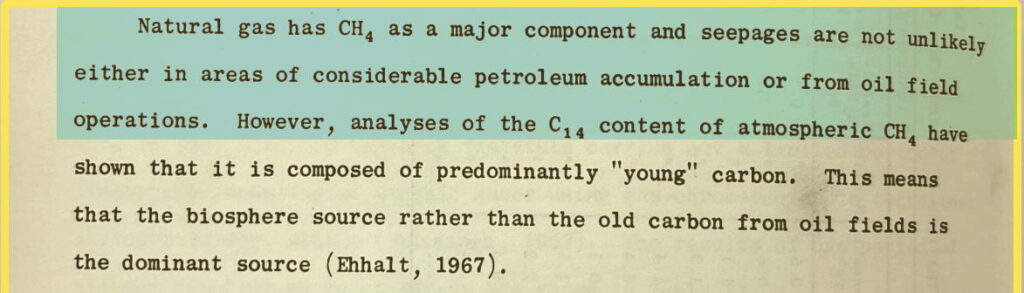
Among the early evidence of that knowledge is a 1968 report commissioned by the American Petroleum Institute (API), an oil industry trade group, which found that emissions from natural gas contributed to methane in the atmosphere. The report cited “oil field operations” as a factor, along with natural sources, which the authors said was the bigger contributor; they also referenced an earlier study that found elevated methane values in urban areas were caused in part by “distribution system leakage.”
Crisis Communications
In the 1950s, the tobacco industry had faced a similar crisis as the oil and gas companies when emerging science started to show the health risks of smoking. The tobacco industry’s solution was to bring in major advertising and public relations firms, including ad giant Hill & Knowlton, which helped to engineer scientific controversy and use advertising to manipulate public opinion.
The oil and gas industry decided to hire the same firms, who would adapt the tobacco playbook to promote natural gas, the new report, “The Fraud of ‘Clean’ Natural Gas: How Big Oil and Gas Created the Myth That Natural Gas Is a Climate Solution,” says.
But the advertisers encountered an issue: a lack of evidence to back up their “clean” gas claims. In an internal review in 1972, J. Walter Thompson, one of the most influential U.S. advertising companies at the time, admitted that its attempt to promote the environmental qualities of gas had been “mitigated to an extent” by “the lack of clear, simple substantiating facts on the pollution aspects of natural gas,” according to the new report.
“That’s an enormous revelation — that the PR guys asked for substantiation, and they couldn’t give it to them,” Robert Brulle, professor of environmental sociology at Drexel University, told Desmog.
But the experts had a plan. In 1972, during a talk on “How to Communicate in A Crisis,” Hill & Knowlton CEO Richard W. Darrow said that natural gas critics would keep coming back with “new facts or alleged facts, with new allies and with new proposals for regulation and restrictions,” according to a written copy of the speech the report authors shared with DeSmog.
But industry had an opportunity to become involved and “hopefully to play a significant role in shaping the decisions that will affect the future course of the nation — and, not so incidentally, the ability of businesses to keep on making fair profits,” Darrow said.
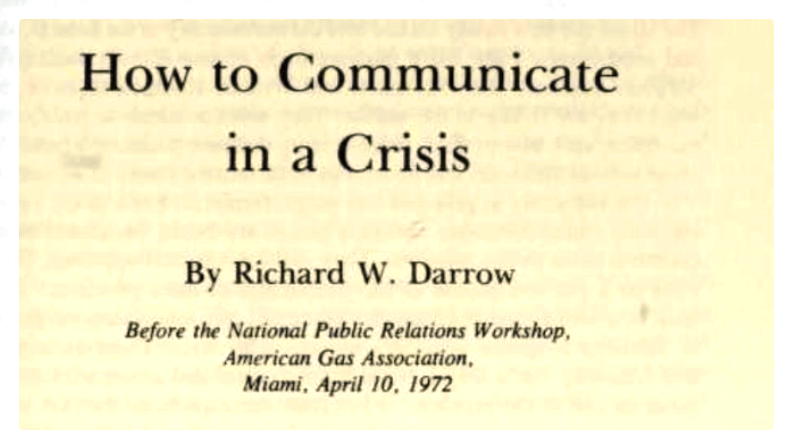
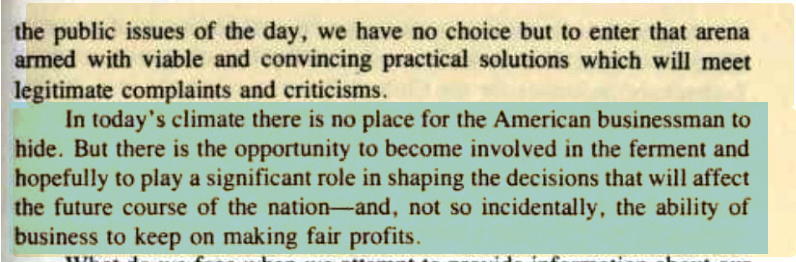
“There are, of course, some environmental problems related to the production, distribution, and use of natural gas,” he said. “These, too, should be recognized and the story of what the industry is doing to solve these problems should be told in detail.”
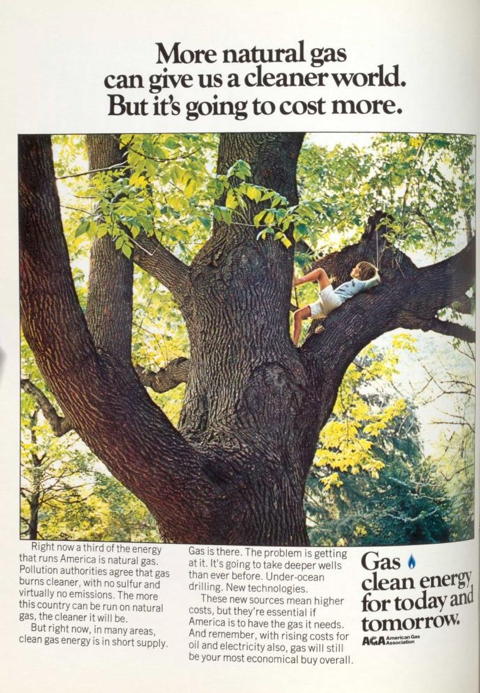
The “clean” natural gas myth was born that year, according to the report, and was formalized by J. Walter Thompson’s advertising plan for the American Gas Association (AGA) trade group, which contained the industry’s communications theme: “GAS, CLEAN ENERGY FOR TODAY AND TOMORROW.”
“It will take time and continuity to create awareness or to achieve a change in attitudes toward the gas industry on these subjects,” the AGA plan advised. “Such advertisements must sell intangibles or ideas which can be more difficult even than creating product preference.”
Hill & Knowlton, now part of Burson and VML, which includes J. Walter Thompson, did not respond to requests for comment, nor did the AGA.
In 1976, gas companies created the Gas Research Institute (GRI) — now the Gas Technology Institute — to carry out gas industry research and, according to a GRI publication, “function as an active part of the marketing arm of the gas industry.” It mirrored Hill & Knowlton’s idea to create the Tobacco Industry Research Committee two decades earlier, which marked “one of the most intensive efforts by an industry to derail independent science in modern history,” according to a 2012 American Journal of Public Health study.
Around the same time, a team at NASA published a pivotal paper suggesting that methane from fossil fuel use was contributing to the greenhouse effect, and stated that the increases the researchers predicted “would have substantial climatic significance.”
Meanwhile a GRI-funded study found that a “significant quantity” of gas was being flared or vented — and that “off-the-record,” “unverifiable” estimates suggested that unreported amounts may be much higher.
Undermining Scientific Consensus
During the 1980s, the industry funded its own research to disrupt growing scientific consensus that methane from natural gas posed a serious climate risk, with GRI working to promote natural gas as an environmentally friendly alternative to coal.
Faced with global warming concerns, “the gas industry would leverage its ‘clean’ image, based on gas’ relative advantages over coal and nuclear energy, to create the impression that gas had virtually no environmental and climate consequences at all,” the report’s authors write.
“As the risks of climate change gained national attention, the growing consensus that methane was a potent greenhouse gas threatened to become a serious obstacle to the industry’s ambitions of market expansion,” the new report states.
Then, a landmark 1985 study in the Journal of Geophysical Research further established the connection between natural gas use, methane leaks, and global warming. That study influenced the GRI and the gas industry to turn research attention away from studying methane and toward a context where gas could come out looking better than coal and oil.
Timeline of Events – (Click arrows to browse)
Gas Industry and EPA Partner on Research
Various wins solidified the gas industry’s future in energy dominance — including the repeal of the Fuel Use Act in 1987, allowing natural gas to be used for newly built power plants, growing relationships with environmental groups, and the selling of gas as a solution to acid rain. Still, growing evidence of methane’s risks meant the industry needed to address the topic to continue selling gas as a climate solution.
In a 1990 report to Congress, the Environmental Protection Agency (EPA) said that “very little emissions data have been developed for most of the emissions sources in the natural gas system.” It also noted that previous, independent estimates of methane emissions had ranged from 2-4 percent, and up to 6 percent in the U.S. and 10 percent in the UK — which would make gas no better than coal and oil.
“The leak rate becomes this big critical issue,” Brulle said. If the methane leak rate for gas was greater than 3 percent, “then you don’t have any advantage for climate change to switch from coal to natural gas.”
The industry tried pointing to previous data showing lower methane emissions rates; but eventually, it filled the void by launching new research, partnering with the EPA to help improve its credibility.
After years of heavy industry involvement, the GRI and EPA published a landmark report in 1996 using new methods to measure and calculate different methane emissions factors, which established 1.4 percent as the methane emissions rate, a number that would be used as a benchmark for decades to come.
But not only is that number not true, “it’s just set by industry without any independent review,” Brulle notes.
GTI Energy (formerly GRI), did not immediately respond to a request for comment
A Severe Underestimate
Conflicting emissions estimates and other criticisms of the GRI/EPA report emerged in the years that followed, but not before the fracking boom of the 2000s began.
By 2010 and again in 2014, the EPA admitted to issues and inaccuracies in the 1996 report. Various academic research — beginning with a 2011 study by Robert Howarth and other Cornell University scientists that found natural gas emissions, particularly from shale gas, did exceed those of coal — built a case that the 1.4 percent methane emissions rate finding was a severe underestimate.
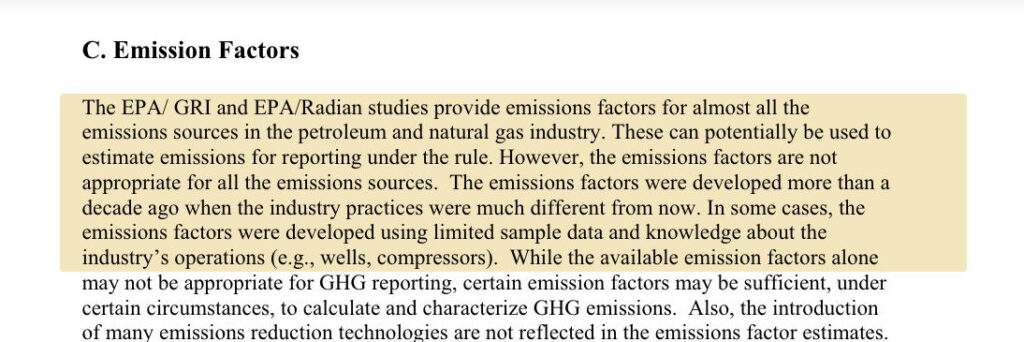
Excerpt from the EPA’s 2010 report, “Greenhouse Gas Emissions Reporting from the Petroleum and Natural Gas Industry,” admitting inaccuracies in its 1996 methane report. Read the full document on DocumentCloud
Still, the GRI-EPA study remains a cornerstone for methane emissions data today.
For a time it was plausible to argue about the 1996 study’s accuracy, “but there’s been study after study after study after study, since about 2015, that confirms Howarth. So by 2018 to 2019, it’s kind of implausible to argue that the leak rate isn’t what it is,” Brulle said.
Brulle thinks that the underestimated methane emissions rate has persisted “because there are a lot of people with vested interests that want it to be true.” He referenced the Obama administration’s support for natural gas, and the fracking boom as examples.
“It would cost too much for it to not be true,” he added.
Despite the EPA’s acknowledgment of the 1996 study’s shortcomings, the agency has continued to rely on it now, including in the 2024 Inventory of U.S. Greenhouse Gas Emissions and Sinks.
“There are a number of factors that could contribute to a discrepancy between peer-reviewed studies and previous versions of the U.S. Greenhouse Gas Inventory,” the EPA told DeSmog in a written statement, adding that the inventory was subject to “continuous improvement.”
In response to a question about the impacts of the oil and gas industry’s deceptive advertising, the EPA stated that “the real deception DeSmog should be writing about is the Green New Scam that raised the cost of living for Americans and threw hard-earned tax dollars after unreliable power generation.”
“The Trump EPA is working to Unleash American Energy Dominance” because economic growth and environmental protection is “not a binary choice,” the agency added.
“Officials who continue to justify expanding natural gas reliance by still claiming it’s clean or safe for the climate are using the same script and manipulated science that gas executives and their PR teams concocted decades ago,” Center for Climate Integrity President Richard Wiles said in a statement. “It’s time that these profoundly dangerous lies are finally put to rest.”