Amadou Diague sits in a plastic chair, looking out over the Atlantic Ocean. In the distance a traditional wooden pirogue cuts through the waves to deliver freshly caught fish to the city of Saint Louis in northern Senegal.
Further out at sea a bright flame lights up the evening sky. Production at the Grand Tortue Ahmeyim (GTA) gas field started on the last day of 2024 and in April 2025 GTA’s operating company BP loaded its first cargo of liquefied natural gas (LNG) into a British carrier.
The government in Senegal’s capital Dakar sees the sale of gas to Europe as a bridge to development. It hopes the fossil fuel will generate revenue, transform the country into a middle-income nation, and improve the standard of living for its population.
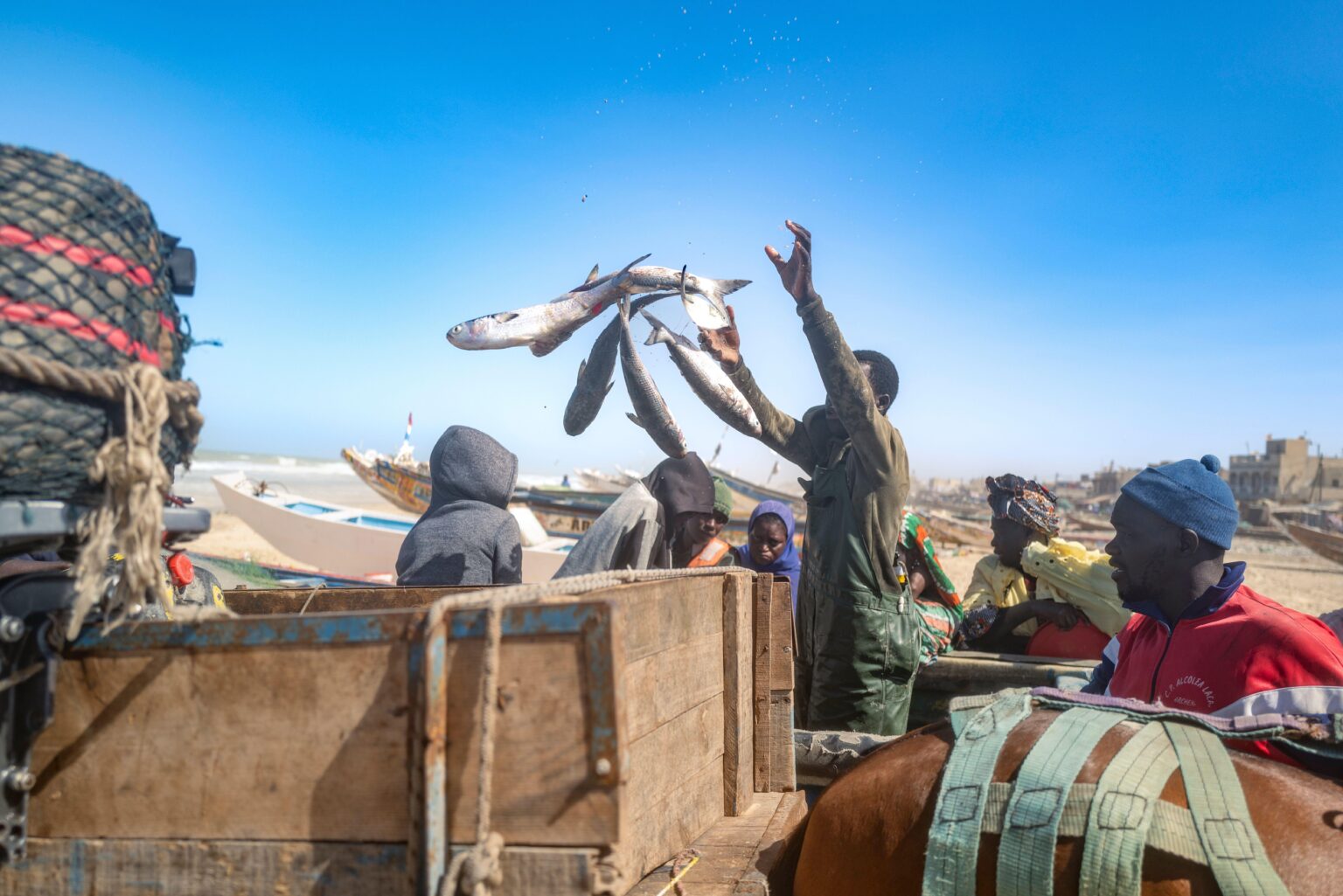
But as demand for gas continues to decline in the EU over the long term it may be the people of Senegal who pay the price for a risky investment. Local fishermen, whose livelihoods are threatened by the gas platform from Saint Louis, are the first in line — the gas field sits in the middle of their traditional fishing grounds.
“We are told to leave the coast because of climate change and sea level rise,” says Diague. “But at the same time a gas platform is being constructed meant to export LNG. I think these companies want us gone so they can have the whole sea for themselves.”
Livelihoods Interrupted
Saint Louis sits at the mouth of the Senegal River. A commercial centre for centuries, it emerged as a major hub in the devastating transatlantic slave trade, going on to become the capital of the French empire in West Africa.
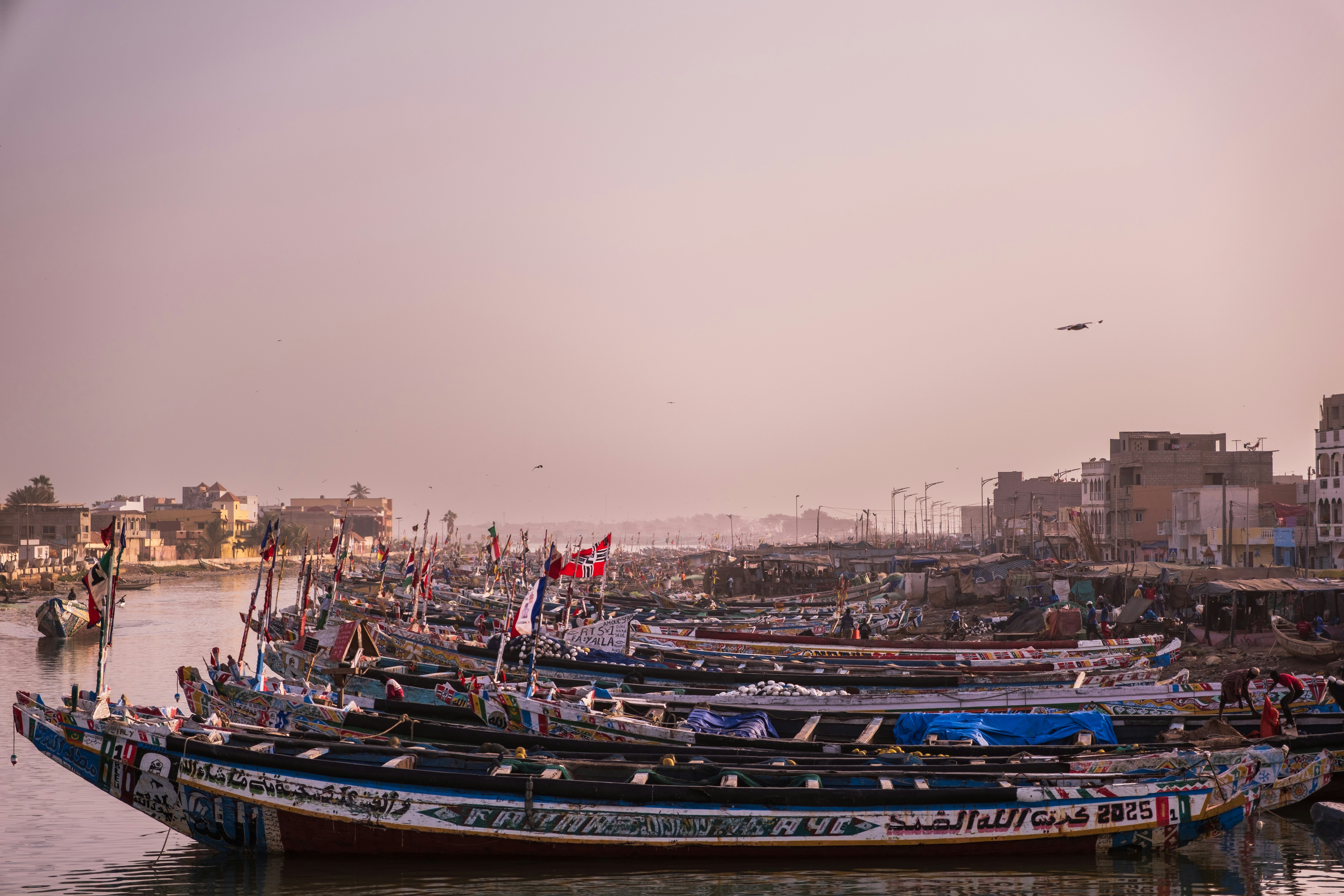
The town centre is picturesque, with crumbling colonial-style architecture painted in warm Mediterranean colours. Around the fishing quarters at the beach front, hundreds of wooden canoes are parked on the sand; goats and children fill the sandy streets.
But since the US company Kosmos Energy discovered gas deposits 10 kilometres off the Saint Louis shore in 2015, life in the fishing quarter has changed.
“This discovery of gas is the biggest problem we face right now,” says Diague, who sits with a group of elderly fishermen that have gathered in a small tent fashioned from wood and nets.
Out to sea, sits an LNG-terminal where carrier vessels can dock. Further out, a Floating Production, Storage and Offloading vessel connects to the deep water wells, 2,850 metres down, on the maritime border between Senegal and Mauritania.
“The terminal is in the area where we used to fish,” explains Diague. “Nowadays we’re not allowed to go there. And they use lights at night that attract all the fish [into off-limit zones]. They are taking away the livelihoods of local fisherfolk.”

Outsider Project
Senegal is a country of fishers. About 30 percent of all animal protein consumed in the country comes from the sea. Neighbouring countries like Mali or Burkina Faso are also dependent on fish from Senegal for their food security. Catching, smoking, drying and selling of sardinella or other small pelagic fish that used to be plentiful here, provides both food and income to local populations.
“This gas project was initiated by outsiders, as locals we are not involved,” says Boun Daouda Soumaré, director general at the municipal development agency of Saint Louis. Born and raised in the city, he works from a cool office in the heart of the colonial centre. “BP and [US oil firm] Kosmos Energy signed a contract with the state to extract the gas and sell it to foreign countries.”
Soumaré fears local townspeople will not see any benefits from gas. Senegal includes natural gas in its plan to boost domestic electricity, which is currently accessed by 75 percent of the population.
But the country is heavily indebted. And domestic gas supply will require major investments in both pipelines and power plant conversions, which poses “financial viability challenges”, the sustainable development think tank IISD has warned.
In a press release on its website, BP states it is the operator of GTA gas field, with a 56 percent stake in the project, alongside Dallas-based Kosmos Energy (27 percent), while the state-owned Société des Pétroles du Sénégal (Petrosen) owns a relatively small 10 percent of the shares.
The terms of BP’s gas deal has raised disputes over economic sovereignty in the Senegalese government, with prominent politician Ousmane Sonko alleging that the arrangement with BP is “unfair”. But threats to nationalize the GTA project have yet to materialise.
“What benefits the gas exploration will bring to Saint Louis is still to be seen. We don’t even know how many jobs will be created for the local population,” Soumaré says.
BP declined to comment. On its website, BP states some gas will be “allocated to help meet growing energy demand” in Senegal, and that it is supporting local economic development by investing in “fishing, women cooperatives, health, micro-finance, and business skills training”. BP also states it is training 47 apprentice technicians “to be among the next generation of offshore operators”.
The Senegalese government did not respond to multiple requests for comment.

Access Denied
Saint Louis fishers have sought redress for their plight. The artisanal fishing group Gaalou Guett, with the NGO Lumiere Synergie pour le Développement, has made an official complaint alleging that BP and Kosmos Energy are in breach of the OECD responsible business guidelines for multinationals. In February 2026, the UK body charged with upholding these rules reached a preliminary decision that the complaint warranted “further examination”. The case is ongoing.
“Stakeholders in this area feel threatened by the operations being conducted by BP and Kosmos, who have set up their platform in one of the areas with the highest fish stocks,” the complaint reads. “As a result, BP and Kosmos are denying access to this area to local artisanal fishermen, whose living conditions have been undermined since the development of GTA.”
Both associations say that areas around the platforms are now off-limits. They cite an agreement that keeps local fishermen at a distance of 500 metres from the LNG-production facilities – but say that in practice navy patrols have kept them at a distance of more than six kilometres. There also have been reports of local fishermen being threatened and one collision between a navy vessel and a pirogue.
Kosmos confirmed that the offshore facilities are surrounded by a “safety exclusion zone” which is “in place to protect fishermen, other mariners, project workers, and offshore equipment”, and that similar zones exist around offshore infrastructure throughout the world. “The GTA partnership does not prohibit fishing outside the exclusion zone,” they added.
A spokesperson said: “We understand that access to the sea is an important issue for Saint Louis fishermen and the wider community. That’s why the GTA has been engaging with fishing representatives, local authorities, and community members since the early stages of the project to listen to concerns, and support safe coexistence between fishing activity and offshore operations. That engagement is continuing, including efforts to clarify the boundaries of the safety zone.”
“When they talk about safety, we should be asking: safety for whom?” says Greenpeace Oceans campaigner Aliou Ba. For three weeks in 2025, he recalls, the GTA field was leaking methane, which can be toxic to fish in high concentrations. (BP described the leak at the time as “low-flow and negligible”).
“This field sits on top of one of the only deep-water coral reefs of its kind in the world,” he points out. “Any leak moves through the water column into the fish stocks these communities depend on.”
Ba says the lost fishing grounds are pushing Saint-Louis fishers out into Mauritanian waters in search of fish, leading to confontrations with authorities there. “The GTA exclusion zone isn’t just displacing fishermen locally,” he said. “It’s quietly pushing them into a more dangerous, contested part of the sea.”
In his office in downtown Saint Louis, Soumaré says he is aware of many incidents. In his view local fishermen are illegally denied access to crucial fishing grounds: “They build the platform exactly where the fish spawn. It’s a political choice to ignore the fishermen that have complained about this. Of course the government will earn more revenue from exporting gas than the fishery sector can ever provide. But the fishermen are the ones impacted.”
Elusive Long Term Contracts
Senegal’s positioning as an export hub for LNG is at the heart of the country’s economic development strategy. It had hoped for long-term supply contracts with EU countries, especially since Europe’s scramble to ween itself off Russian gas following President Putin’s full-scale invasion of Ukraine in 2022.
At first there were promising signs from Europe. Then-German chancellor Olaf Scholz announced plans for further gas cooperation with West-African countries during a visit to Dakar in May 2022, and Polish president Andrzej Duda visited Senegal in September 2024 to talk about a possible gas deal.
But to this day no European country has signed a long term gas supply agreement with Senegal, according to analyst Daouda Dienne of the Natural Resource Governance Institute (NRGI) in Dakar.
Instead operator BP is selling gas extracted from the Senegalese GTA field to a UK-based trading subsidiary, which might sell at short-term spot markets or sign long term agreements with customers.
Reliance on spot markets for LNG entails serious financial risks, Dienne warns. “The EU is moving toward renewables quickly,” he adds.
It’s not yet clear whether Senegal will benefit from the recent Middle East energy crisis, when Iran effectively shut the Strait of Hormuz. But a recent report notes that around 90 percent of LNG transiting the waterway was bound for Asia — not Europe.
Senegal’s LNG sector’s prospects depend more on the evolution of global gas demand, economic competitiveness and future investment decisions, NRGI stress.
To date, rather than any pivot towards West African gas, the EU says it will double down on a clean transition which would reduce exposure to future fossil fuel shocks.
Yet many new LNG projects across Africa may only become fully operational after 2030. As European demand was forecast to peak in 2024 and is set to decline long term, projects like the GTA-field are potentially unprofitable. “We suggest that Senegal is better off investing more money in renewables to avoid the risks associated with gas exports,” Dienne says.
Regional Energy Independence
Senegal relies on the regional powerhouse Nigeria for much of its oil. The government in Dakar hopes that its recent gas discoveries in the Atlantic Ocean would lead the country toward energy independence.
To this end, the minister of Energy, Petroleum and Mines has announced that Senegal plans to inaugurate a national gas pipeline by 2027 meant to transport natural gas from offshore fields to domestic consumers.
The pipeline is part of a broader project, valued at 650 billion CFA francs in total ($1.15 billion) to construct a national gas grid stretching over 400 kilometres and developed by the state-owned company Réseau Gazier du Senegal (RGS).
“This country hardly has any gas pipelines,” says Dienne. “According to our calculations it would cost more than $2 billion to get the gas from the ocean to end users. Investments of that magnitude are a huge risk for a country like Senegal.”
It may prove difficult for Senegal to raise the funds to build a fully fledged gas network. The country’s finances have been in crisis since the 2024 discovery of $13 billion in misreported, hidden debt attributed to the previous administration, and the economy is predicted to grow by 2.5 percent in 2026, a dramatic decline from earlier forecasts of 6.5 percent.
Alongside its gas development plans, Senegal also signed a Just Energy Transition Partnership (JETP) with France, Germany, the UK, Canada and the EU in 2023, which opened a credit line of $2.5 billion to building clean energy infrastructure, which aims for 40 percent of the the country’s energy mix to be renewable.
Financing new gas infrastructure is also getting harder. The International Energy Agency reports that investors are losing appetite for “regulated assets” like fossil fuel infrastructure. Last year, the UK government withdrew a $1.15 billion loan to French energy major TotalEnergies for a controversial LNG project in Mozambique, from which the Dutch government has also pulled out.
The IEA recommends the Senegalese government focus on developing the renewable energy sector for a “low-emission, affordable and reliable supply” of domestic power.
Environmental organizations like the New Climate Institute go even further and explicitly warn that the development of gas infrastructure could come at a high “social and environmental cost. This entails existential threats, particularly to Senegal’s fishing communities which represent a significant amount of economic activity and are important for Senegal’s food security”.
Singular Focus
The political landscape in Senegal shifted dramatically when Bassirou Diomaye Faye, the country’s youngest ever president, came to power in April 2024. The 46-year-old had campaigned on the promise to invest heavily in the fisheries sector, and to set up a commission to review the nation’s gas agreements.
But in May 2026, Faye sacked prime minister Ousmane Sonko, the most outspoken critic of Saint Louis’ gas project, over disagreements between the two men on how to handle Senegal’s spiralling debt crisis.
And in early 2025 Faye resumed discussions with Germany about LNG-supply agreements. NRGI’s Dienne notes that in contrast to the government’s fixation on gas, there still is no long-term plan to develop renewable energy across the country.
Meanwhile, gas exploration at sea risks destroying fisheries which traditionally have been the backbone of the Senegalese economy, employing around 15 percent of the population.
“The government should at least provide some sort of financial compensation, but I’m afraid that’s not realistic in this country,” reflects Dienne. “In the end, the short term interests of gas exploration will probably trump the needs of local fishing communities.”
This story was produced in partnership with the Pulitzer Center.