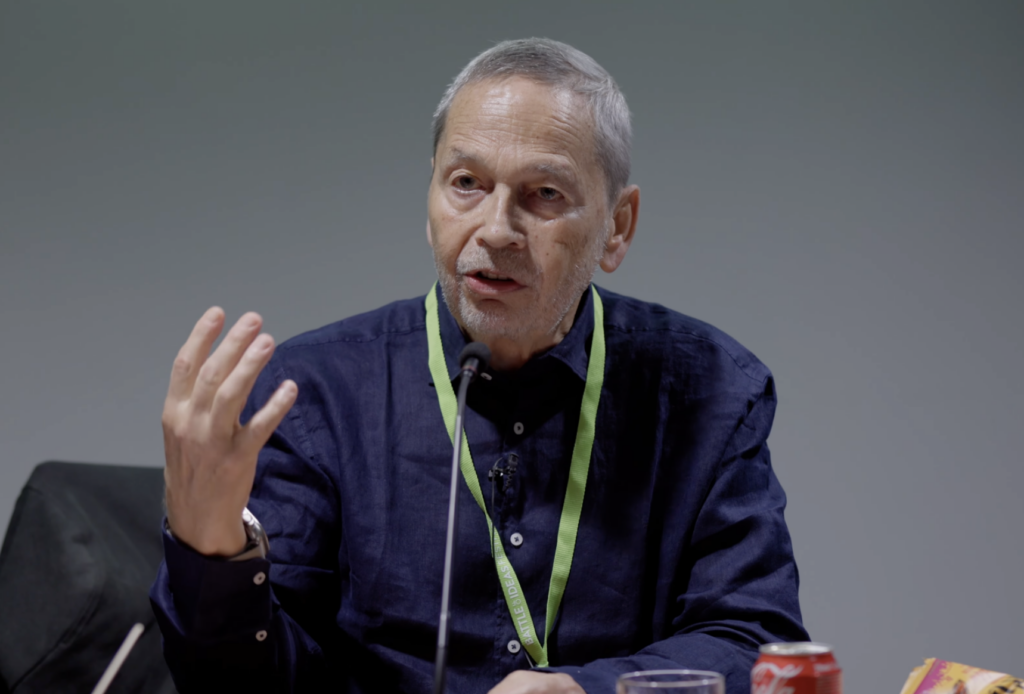

A Canadian opinion writer who’s argued in the Toronto Sun and other outlets that politicians should embrace data centres works for a U.S.-based anti-regulation organization with close ties to the AI industry.
Jay Goldberg—identified by the Toronto Sun as the “North American affairs manager at the Consumer Choice Center”—wrote a late June column arguing that Canadian municipalities shouldn’t stand in the way of AI data centre development.
“It would be a mistake for Hamilton, Toronto or any other municipality to put a moratorium on the construction of AI data centres,” Goldberg argued. “The concerns often cited about them are overblown, while their public benefit is almost always understated. Politicians would be wise to educate themselves about the positive benefits of the digital revolution before making decisions that hold back a city or, for that matter, a province.”
Around that time, Goldberg penned a press release entitled “Consumers call on Hamilton City Council to reverse course on proposed AI data centre moratorium” that was issued by the Consumer Choice Center (CCC). Goldberg wrote a July column in the Calgary Sun entitled “New data centre in Sturgeon County massive win for Alberta and all of Canada”. In it he claimed that “Meta’s data centre will use an efficient cooling system to reduce water use…it will use less water than a typical Alberta golf course.”
While Goldberg’s Toronto Sun bio page notes that he works for Consumer Choice Center, neither it nor the article mentions that CCC has previously received funding from NetChoice, which represents companies building AI data centres.
NetChoice is a registered U.S. lobby group whose association members include AirBnb, Amazon, Google, Meta, OpenAI, PayPal, and xAI, among many others. NetChoice advocates for “limited government”, saying the Internet has “thrived under light-touch regulation.” NetChoice has notably recently lobbied for tax incentives for the development of AI data centres in Wisconsin.
Tax records reviewed by DeSmog show that NetChoice provided CCC with $25,000 USD grants for “general support” in both 2023 and 2024. DeSmog reached out to Toronto Sun editor in chief Adrienne Batra with questions about Goldberg’s involvement with the CCC, but did not hear back.
Data Centres, Golf Courses, and Water Use
The connection between CCC and NetChoice isn’t limited to funding.
Consumer Choice Center and NetChoice frequently collaborate, are aligned on tech policy and have co-sponsored amicus briefs, including opposition to age-verification and parental-consent law on apps.
They are also enthusiastic supporters of the expansion of AI data centres. Both organizations are featured in a 2025 White House press release celebrating Trump’s AI strategy, with CCC calling it “a bold vision for the future of ensuring AI leadership by the Trump administration.”
Goldberg also appears to be using the same pro-AI data centre talking points as NetChoice president Steve DelBianco.
They both use the same argument to dismiss concerns around AI data centre water consumption— Goldberg in a Toronto Sun column and DelBianco in a recent interview with Bari Weiss’ The Free Press.
“The typical 18-hole golf course uses about 300,000 gallons of water per day during the summer months,” Goldberg wrote in the pages of the Toronto Sun, then argues that municipalities wouldn’t put a moratorium on golf courses.
In the Free Press, DelBianco is quoted as saying data centres use “about as much water annually as a municipal golf course.”
Goldberg repeated the golf course analogy in another column published in the Calgary Sun.
The same argument in favour of AI data centres was recently made by CCC policy analyst David Clement during an appearance on News Forum, a right-wing Canadian broadcaster that also has ties to the Atlas Network.
The golf course analogy appears to be highly inaccurate. According to the Environmental and Energy Study Institute, a large AI data centre actually consumes about 5 million gallons per day, which is roughly equivalent to the water use of a town of between 10,000 and 50,000 people.
Susan Torres, North American communications manager with the Institute for Energy Economics and Financial Analysis (IEEFA), told DeSmog in a statement “companies operating data centers have been downplaying and underreporting total water usage at their facilities”.
“Much of this stems from the fact that the industry is so new, companies are finding ways to take advantage of the lack of regulation and reporting requirements for water use,” said Torres. “According to congress, there are currently no legally binding energy standards that apply explicitly to operation of data centers in the private sector.”
Consumer Choice Center’s Ties to Atlas
According to U.S. tax filings, the Consumer Choice Center is based in Alexandria, Virginia, a suburb of Washington D.C. It is a registered lobbyist in the U.S. The organization claims to advocate for consumer freedom, innovation, privacy, science, and choice in digital, mobility, and health matters. The CCC is itself a creation of Students For Liberty, which has received funding from charitable foundations of oil and gas billionaire Charles Koch, and is a partner of the Atlas Network.
The Atlas Network is a Washington, D.C.-based non-profit organization that describes itself as a growing network of more than 500 “free market” organizations in nearly 100 countries. Many Atlas think tanks in Canada —which include the Fraser Institute, the Macdonald-Laurier Institute, and the Canadian Taxpayers Federation—have promoted climate science denial and have campaigned against legislation to limit greenhouse gas emissions.
In a petition letter to the government of the United Kingdom describing its funding sources, the CCC states “In the past and currently, we have received funding from multiple industries such as energy, fast moving consumer goods, nicotine, alcohol, airlines, agriculture, manufacturing, digital, healthcare, chemicals, banking, cryptocurrencies, and fin-tech.”
CCC is currently working to stop climate lawsuits against oil companies, notably in Democratic Party strongholds like New York and California. CCC has also endorsed the “Stop Climate Shakedowns Act of 2026”, which would shield the fossil fuel sector from lawsuits and other liabilities. In addition to receiving money from AI lobbyists and the Koch network, CCC has also received funding from the tobacco industry and has lobbied against the regulation of tobacco products in the European Union and elsewhere. DeSmog previously reported that the CCC was involved in secretive lobbying in the European Union, despite not being a registered EU lobbyist.
Jay Goldberg is connected to several other Atlas Network organizations in Canada. He was previously the Ontario Director of the Canadian Taxpayers Federation (CTF). The CTF has received funding from the fossil fuel sector, and has a long history of denying climate change and supporting anti-regulation efforts in support the fossil fuel sector.
Goldberg is listed as an associate researcher with the Montreal Economic Institute (MEI), and a fellow with the Frontier Centre for Public Policy
Both the Frontier Centre and MEI are also Atlas Network affiliates with long histories promoting anti-regulation economic policies, the expansion of the fossil fuel sector, and climate crisis denial.
Jay Goldberg’s advocacy for data centres on behalf of the American tech sector comes as Canadians are expressing growing concerns about AI expansion. A recent Nanos Research survey indicates that 64 percent of Canadians oppose government support for the development of AI data centres.
DeSmog reached out to Goldberg with questions about his lobbying work, but did not hear back from him.