

As this long and extremely hot summer of climate change-driven unnatural disasters gives way to an unpredictable autumn, a new comedy series is taking aim at one of the fossil fuel industry’s biggest enablers: the advertising and public relations industry.
Over five brief web episodes, SLICK follows employees at a fictional creative agency as they look to cash in on briefs from the Big Oil companies seeking to distance themselves from responsibility for heating the planet, and downplay their role in hooking the global economy on fossil fuels.
In one episode, a lifestyle vlogger powers through skin rashes and dizzy spells to espouse the many benefits of crude oil’s use in in skincare and other products. In another, agency staffers are tasked with creating a presentation about carbon capture and storage (CCS) for their latest Big Oil client, only to find that none of them actually understand how the elusive technology works.

By taking aim at the advertising and PR agencies that work with the world’s biggest polluters, co-creators Jessie Bluedorn and Kylie Hollway hope to expose how fossil fuel companies use advertising, influencers, and pop culture to maintain both public acceptance and record profits, despite the skyrocketing tolls of the climate crisis on lives, livelihoods, and the environment.
The series draws on Bluedorn’s own experience as a former digital media strategist at the Publicis Groupe-owned agency Digitas, as well as examples of real oil and gas campaigns — such as Shell’s “Fortnite” promotion, which engaged gamers by giving them the chance to fill up their virtual vehicles at Shell petrol stations, and Equinor’s “EnergyTown”, a free video game aimed at children that promotes the use of oil and gas.
The duo have already made great strides toward their goals. SLICK is a Digital Series finalist at the 2026 Jackson Wild-Hollywood Climate Summit awards, and was awarded Best Web Series at the New York Shorts International Film Festival.
Bluedorn is the founder of Carmack Productions, which produced the series, and The Carmack Collective, a philanthropic fund that uses popular culture to build support and momentum for dismantling the fossil fuel industry. Holloway is a writer and performer whose work has appeared in McSweeney’s, The Cut, and Vox Media’s Polygon. The climate campaign groups Clean Creatives and Creatives for Climate are both official series partners.
This interview with co-creator Jessie Bluedorn was conducted via email, and has been edited for length and clarity.
DeSmog: I thought it was interesting that you called the ad and PR industry “under-represented villains” in the climate story. Why do you think they have avoided scrutiny for so long?
Jessie Bludorn: I think there are a few reasons. The biggest one is that they operate behind the scenes. We rarely think about the cultural and narrative infrastructure that shape societal messaging, but it’s there in the background.
You’ve taken inspiration from some real campaigns, like Shell’s Fortnite activation and Equinor’s EnergyTown. Why did these stand out to you the most while doing your research?
It’s just so hard to believe that we’re in the 2020s and Big Oil is allowed to message to children via video games. I had to check a couple of times to make sure I wasn’t falling for fake news, and I think that’s exactly what makes these examples so powerful in the show. Viewers assume we must have completely dreamed up this unhinged premise, but then to reveal it’s a satirical heightening of an all- too- real example really packs a punch. We hope it illustrates just how bad the problem is and spurs action.
In the series, the characters aren’t straightforwardly villainous. Why did you choose to write them in this more relatable way?
It’s true to life. I think very few people working behind the scenes to spin for Big Oil are ideologues. Most people are just trying to get through the workday and get paid, but that doesn’t make the work they’re doing any less harmful to people and planet. A big contributor to the climate crisis writ large, and the greenwashing of ad and PR agencies specifically, is people’s willingness to keep their heads down and proceed with business as usual. It’s Hannah Arendt’s concept of the banality of evil.
Who are you most hopeful that the series will reach?
I’m most hopeful that SLICK will reach an online audience of Gen Z and Millennial creatives, who may very well be working at some of the agencies servicing Big Oil. This is an audience who data shows are worried about the climate crisis, but we’re also in a cost of living crisis. People are burned out, trying to afford housing, trying to keep their healthcare coverage – they might not want to go home and read the news or figure out how to be activists at work.
That’s where the comedy comes in! We designed SLICK to be an entertainment-first, socially native series that people will enjoy watching online. In watching and (hopefully) loving the show, they’ll leave better informed and with a clearer path to action.
I’m also hopeful that SLICK will at the very least make viewers start to question the accepted narratives around the fossil fuel industry. Is clean coal really clean just because I saw an ad for it? Is Big Oil really the future of green energy because they said so on TV? Or perhaps is there a very slick spin going on behind the scenes?

You partnered with both Clean Creatives and Creatives for Climate to work on this. How did they get involved and how did they help to shape the series?
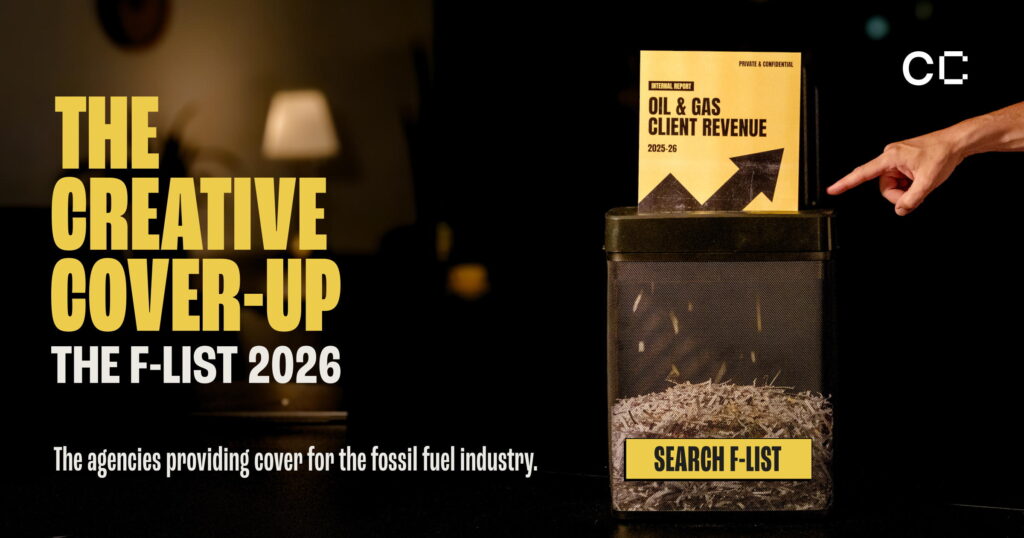
Our impact partners came aboard SLICK after the show was complete, but having worked with them both in the climate movement for a number of years, I was certainly very inspired by their work as we developed and wrote SLICK. Clean Creatives annual F-List report in particular is such an incredible source of data on the complicity of the ad and PR industry. In shouting out inspirations for the show, I would be remiss if I didn’t also thank Amy Westervelt. Her reporting on “the mad men of big oil” was foundational to my understanding of this issue.
Have you shown the series to anyone else working in ad and PR? What were their reactions?
A few! One of the (understandable) obstacles a lot of people express is they don’t know what they as one person can possibly do. That’s why it was so important to us to partner with Clean Creatives and Creatives for Climate. SLICK entertains while highlighting the problem, and our impact campaign funnels viewers into real tools and solutions that they can take part in.
What are you hoping their reactions will be?
We need to start organising within our agency, stat!