

Climate science is filled with “conflicting facts and opinions” and experts are “divided” on whether humans should be blamed for a warmer atmosphere.
Those were some of the “quick facts” and “speaking notes” disseminated by the Petroleum Communication Foundation (PCF) on December 15, 1997, just days after nations negotiated the world’s first binding treaty to reduce greenhouse gas emissions in Kyoto, Japan.
The Canadian foundation’s board at the time included representatives from the country’s top oil and gas producers, including Suncor, an oil sands giant whose U.S. subsidiary is, nearly three decades later, at the center of a landmark U.S. Supreme Court case.
On October 5, the Supreme Court will hear oral arguments for and against allowing a lawsuit scrutinizing Suncor’s alleged historic participation in climate denial and obstruction campaigns, along with the oil company Exxon, to proceed in Colorado.
If the court’s conservative majority issues a broad ruling in favor of Suncor, it could undercut or even halt dozens of similar lawsuits across the country that are attempting to hold the oil and gas industry financially liable for misleading the public on climate change.
Suncor has vociferously denied any effort to spread doubt about the urgency or causes of global warming. “None of this is true,” it argued in a 2020 court filing. “In fact, Suncor Canada has never denied climate change, and never funded any research in that regard.”
However, internal documents newly obtained by DeSmog reveal that the company, while it may not have denied climate change directly, was represented in the leadership of fossil fuel industry groups such as the PCF that explicitly elevated “uncertainties” about mainstream climate science.
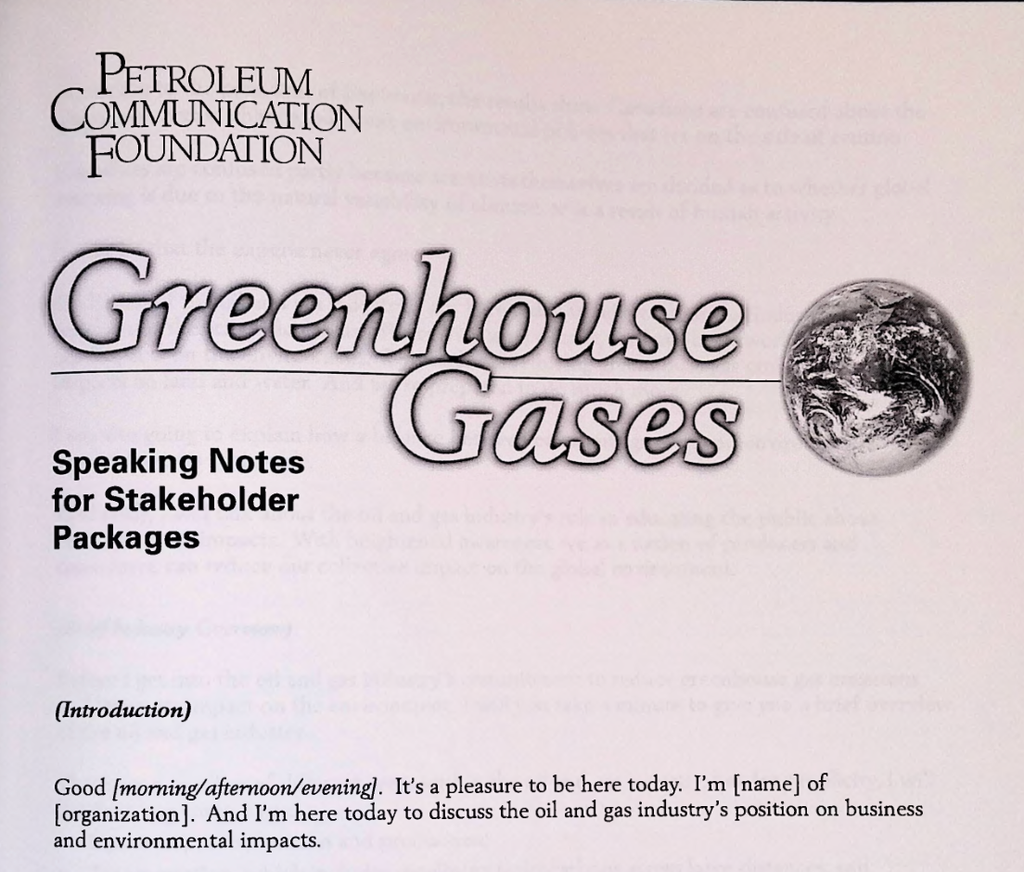
Suncor’s Patricia O’Reilly served as a governor on the foundation’s board when it released a 1997 fact sheet claiming that a landmark 1995 report from the Intergovernmental Panel on Climate Change “serves as a warning, but says very little about the timing or magnitude of climate change, if any. Uncertainties remain.”
Though there is a long and documented history of Exxon and its Canadian subsidiary Imperial Oil spreading doubt about the causes of global warming, there is far less publicly available evidence that Suncor engaged in similar campaigns.
But the internal documents suggest that the PCF, with Suncor represented on its board, widely distributed materials raising doubts and questions about whether global temperature rise was real and urgent.
This strategy of fostering doubt was also a key ingredient in the playbook of the American Petroleum Institute (API) and the Global Climate Coalition, which operated around the same time period and worked to confuse the public about the emerging scientific consensus to delay action and stifle momentum around the Kyoto Protocol. As DeSmog and others have reported extensively, Exxon and other industry insiders possessed advanced understanding of climate impacts decades prior, explaining in internal documents from the 1970s that “there is no doubt” that burning fossil fuels was causing the greenhouse effect.
Suncor didn’t respond to detailed questions from DeSmog.
Supreme Court Showdown
The future of climate litigation in the U.S. could hinge on what the Supreme Court decides after it hears oral arguments in the case Suncor Energy v. County Commissioners of Boulder County in early October.
It’s the latest development in a legal saga that began in 2018, when the city and county of Boulder, Colorado, filed a lawsuit against Suncor and Exxon alleging the companies led decades-long campaigns casting doubt about the role of fossil fuels in causing global warming. The lawsuit alleges that Suncor and Exxon benefited materially from those deception efforts, and it now demands the companies pay financial damages for the wildfires, droughts and other expensive climate impacts in Colorado linked to the burning of their products.
Though Suncor is Canadian-owned and headquartered, it has operations throughout Colorado, including the state’s only oil refinery. It’s the company’s American subsidiary, Suncor Energy (U.S.A.), that is currently facing legal action. The Canada-based parent company will not be held liable if the subsidiary is unable to pay.
Suncor and Exxon have argued in response to the Boulder lawsuit that Colorado courts lack jurisdiction to hear and potentially rule on the case, because whether multinational oil companies can be held liable for climate damages related to their out-of-state emissions is a question that only federal law, and not state law, can decide.
After the Colorado Supreme Court rejected that argument in May 2025, Suncor and Exxon asked the U.S. Supreme Court to weigh in.
In March 2026, the Supreme Court agreed to hear the oil company challenge. “This gives the Supreme Court justices an opportunity to short-circuit the case should it choose to do so, essentially depriving Boulder of the opportunity to have its day in state court,” UCLA law professor Cara Horowitz has argued on LegalPlanet.
“Moreover, the justices could issue a decision that simultaneously undercuts many or all of the other, similar cases unfolding in state courts around the country,” she added.
Though the forthcoming legal showdown revolves around questions of federal and state jurisdiction, and not whether the oil companies actually lied to the public, Suncor has still sought to set the record straight about its climate pollution record in Supreme Court filings.
The company has a “key role to play in helping Canada reduce its greenhouse gas emissions and meet its climate ambitions, while also supporting a vibrant economy, improving environmental performance and providing Canadians with secure access to affordable energy,” reads a merits brief Suncor’s legal team submitted last year.
‘Gone on Record’
Years before the Boulder case was filed, Suncor adamantly rejected the claim that it had spread climate denial. “Our president and CEO has gone on record — in multiple public forums — to say that climate change, as caused by humans, is a concern of his and of Suncor’s,” a spokesperson told Global News in 2014 when asked if the company was involved in efforts to sow doubt about global temperature rise.
The company’s efforts to portray itself as a good-faith actor on the issue go back to at least 1997, when Suncor released a seven-point action plan on addressing its emissions, stating in its annual report that it was “taking a leadership position.” Its then-CEO Rick George explained to the Globe & Mail in 2000 that, unlike some of its industry peers, Suncor wasn’t interested in contesting the science of climate change.
Documents reviewed by DeSmog show that Suncor had a board seat on the PCF when in December 1997 it sent out a package of materials to “individuals and groups interested in Canada’s oil and gas Industry” that could be “suitable for use in reports, newsletters, speeches, and other communication activities.”

That package included a sample speech “that may be given to a general audience at community meetings or to employees.” The foundation added that “changes to the introduction and conclusion, or, other modifications can easily be made to tailor it to your company’s requirements.”
The speech noted that “scientists themselves are divided as to whether global warming is due to the natural variability of climate, or is a result of human activity,” adding that “it may be that the experts never agree.”
That was an inaccurate depiction of the scientific consensus. It was also belied by the industry’s internal climate science programs and clear acknowledgments by Imperial Oil of CO2 pollution causing climate change.
Just two months before the foundation disseminated its speech template, more than 1,500 scientists, including what was then the vast majority of living Nobel Prize sciences winners, released a statement saying “a broad consensus among the world’s climatologists is that there is now ‘a discernible human influence on global climate.’”
The PCF speech didn’t deny climate change was an issue worth addressing, however. It stated that “on behalf of the oil and gas industry, I am here today to tell you that our industry is not waiting out the scientific debate,” and claimed that companies had been working for over a decade on “reducing greenhouse gas emissions as well as impacts on land and water.”
‘Many Uncertainties’
This framing appeared often in materials created by the PCF. First, a publication would highlight so-called “uncertainties” in climate science. Then, it would acknowledge that climate is worth taking seriously.
Next, it would portray the oil and gas industry as a leader on the issue and highlight examples of voluntary action. And finally, it would urge Canadians to accept their own responsibility for climate change and take individual action on reducing their carbon footprint.
The PCF released a publication called Sustain in summer 1998 that stated, “There are many uncertainties about how [climate] change occurs,” adding that “some scientists claim there is no scientific basis for attributing climate change to human activities.” Later, it noted that despite this debate, “the petroleum industry is taking action.”
It ended with a call for regular Canadians to “help reduce emissions of greenhouse gases by using energy more efficiently and wisely.”
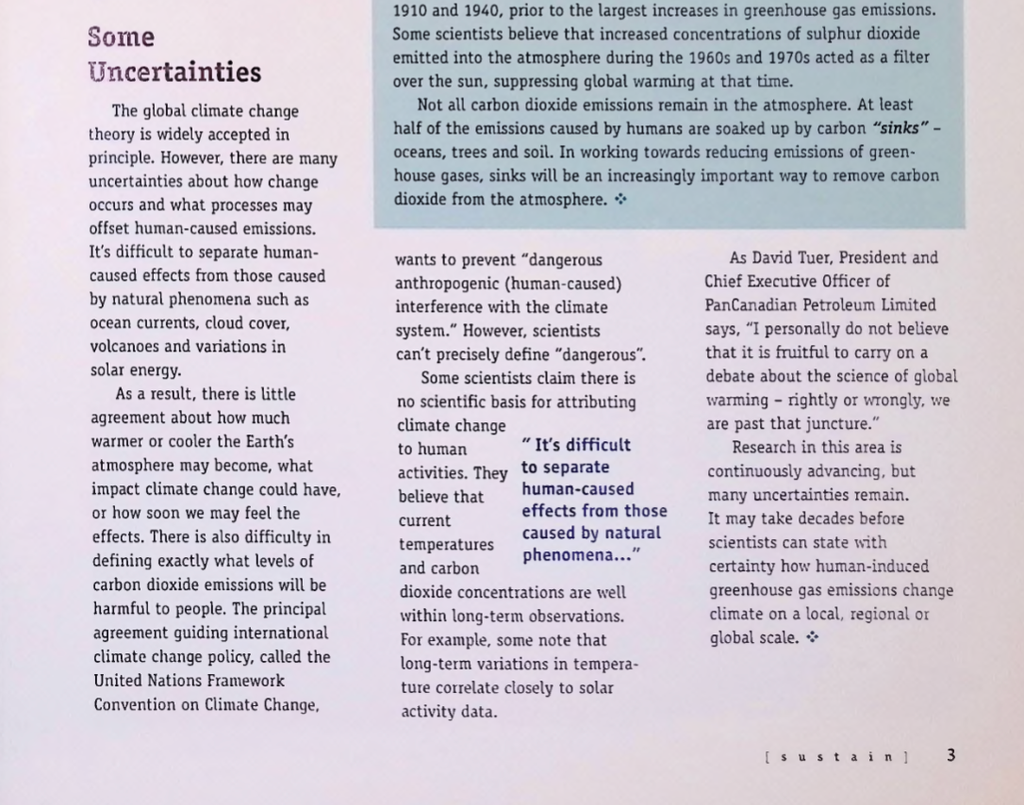
These materials reached a potentially wide audience. The PCFnoted that in 2001 alone it “distributed over 257,000 publications and education materials, through industry communications, schools, toll-free number and website to reach over 300,000 people in Alberta, Nova Scotia plus other parts of the country.”
The foundation received guidance about messaging from Earnscliffe Research & Communications, a major Canadian communications firm, which conducted a series of focus groups across the country with regular Canadians and shared the results in an August 1999 report. The firm, now called Earnscliffe Strategy Group, has maintained close ties to the oil and gas industry, including recent lobbying for clients such as ConocoPhillips Canada and Pathways Alliance.
Among its findings was that hedged and qualified language about the future impacts of climate change and scientific uncertainties “was demotivating” for people. One focus group participant stated that “when you find out for sure, come back and tell us, and then we’ll act.”
The focus group research also suggested a way to redirect people’s blame for climate change away from the industry and onto themselves. “Because many believe that industry is a main source of the problem, their sense is that industry must play a leading role,” the report read.
But once people were told that consumer activities such as driving and home heating made a large contribution to climate change “attitudes changed significantly.” It explained that “while some were skeptical, most others accepted the information as fact, and were more prepared to accept responsibility.”
Benefiting from Denial
When Boulder filed its original lawsuit against Suncor and Exxon in 2018, its complaint alleged that the companies “directed, participated in, and benefited from efforts to misleadingly cast doubt about the causes and consequences of climate change.”
The Colorado Supreme Court in its 2025 ruling denied a motion from the companies to dismiss legal claims related to that allegation, paving the way, potentially, for Boulder’s lawyers to present evidence that Suncor and Exxon profited from climate deception.
The current legal challenge from Suncor that will be heard before the U.S. Supreme Court next month aims to shut down the case before it can proceed — and it could have the effect of stopping dozens of climate liability cases nationwide, by establishing a legal precedent that would prevent those lawsuits from being heard in state courts.
But that is not necessarily a foregone conclusion, even with a conservative majority on the court and justice Samuel Alito personally owning millions of dollars worth of oil and gas holdings.
Legal experts argue it’s possible the Supreme Court decides it doesn’t have the jurisdiction to weigh in, sending the case back to Colorado state court. It could also offer only a limited ruling in favor of Suncor. “That would be a loss but not dismissal: the deception claims, which rest on marketing and concealment within Colorado, would survive, and plaintiffs could refocus on them,” the LegalPlanet summary reads.
Regardless of the Supreme Court’s decision, historic documents make clear that the oil and gas industry hoped to benefit financially from controlling the public narrative on emissions.
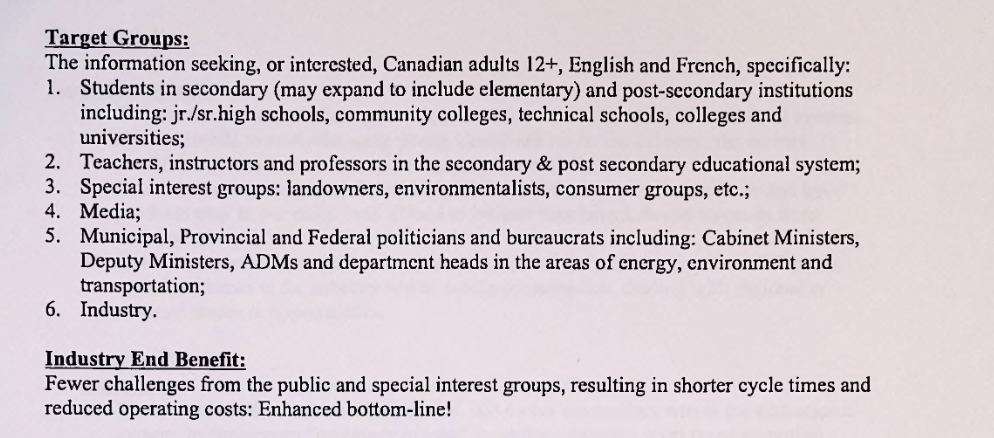
In 1999, the PCF, with a Suncor governor on its board, spelled out the “Industry End Benefit” of educating Canadians about issues related to oil and gas and climate change: “Fewer challenges from the public and special interest groups, resulting in shorter cycle times and reduced operating costs.”
The result, the foundation claimed, was “enhanced bottom-line!”