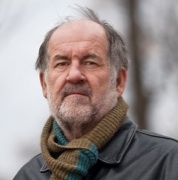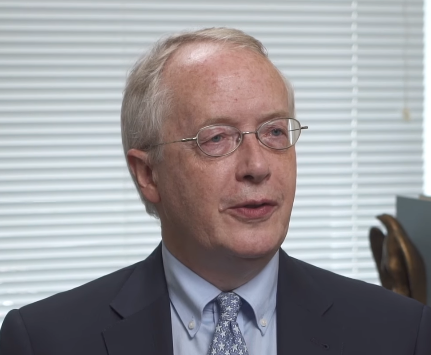
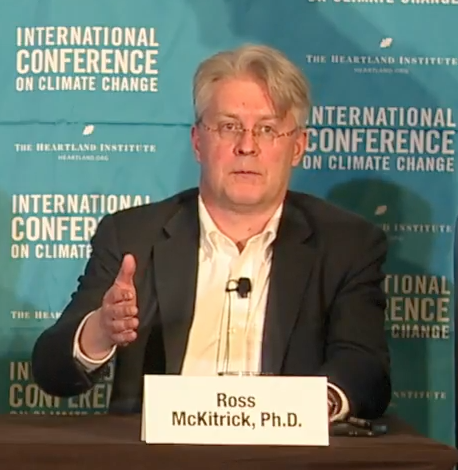
Ross McKitrick
Credentials
- Ph.D., Economics, University of British Columbia (1996).1“Curriculum Vitae” (PDF), Rossmcitrick.com, April 10, 2013. Archived .pdf on file at Desmog.
- M.A., Economics, University of British Columbia (1990).2“Curriculum Vitae” (PDF), Rossmcitrick.com, April 10, 2013. Archived .pdf on file at Desmog.
- B.A. (Hons), Economics, Queen’s University (1988).3“Curriculum Vitae” (PDF), Rossmcitrick.com, April 10, 2013. Archived .pdf on file at Desmog.
Background
Ross McKitrick is an Associate Professor of Economics at the University of Guelph. McKitrick is also a senior fellow at the Fraser Institute, a libertarian think tank based in Vancouver, British Columbia.4“Ross McKitrick: Professor of Economics,” University of Guelph. Archived October 8, 2016. Archive URL: https://archive.is/TStcT
According to his CV, McKitrick became an assistant professor of economics at the University of Guelph in 1996 and an associate professor of economics in 2001.5“Curriculum Vitae” (PDF), Rossmcitrick.com, April 10, 2013. Archived .pdf on file at Desmog.
McKitrick “has been actively studying climate change, climate policy and environmental economics since the mid-1990s,” and he “has also written policy analyses for numerous Canadian and international think tanks,” according to his Fraser Institute profile.6“Ross McKitrick,” Fraser Institute. Archived August 15, 2025. Archive URL: https://archive.ph/YxVFp
McKitrick is part of the U.S. Department of Energy (DOE) “Climate Working Group” assembled by Energy Secretary Chris Wright, the DOE announced in 2025. Other members included John Christy, Judith Curry, Steven E. Koonin, and Roy W. Spencer.7(Press Release). “Department of Energy Issues Report Evaluating Impact of Greenhouse Gasses on U.S. Climate, Invites Public Comment,” U.S. Department of Energy, July 29, 2025. Archived August 12, 2025. Archive URL: https://archive.ph/kyCEn
McKitrick co-authored the 2002 book Taken By Storm with fellow climate skeptic Christopher Essex. According to the book’s description, the “assumption that we know what is happening and how to control it” regarding climate change is false. The revised version was released in 2008.8“TAKEN BY STORM: The Troubled Science, Policy and Politics of Global Warming,” takenbystorm.info. Archived March 18, 2016. Archive URL: https://archive.is/QhvPJ
The book won the Donner Prize, awarded by The Donner Canadian Foundation, a nonprofit founded by steel industrialist William H. Donner. The foundation has given money to several groups promoting climate change skepticism, such as the Frontier Center for Public Policy, and it also gave a total of at least $5 million to the Fraser Institute, according to records from the CRA reviewed by DeSmog.9“DONNER CANADIAN FOUNDATION,” Government of Canada. Accessed August 15, 2025. Full records on file at DeSmog.
Stance on Climate Change
November 14, 2024
McKitrick wrote the following in a Financial Post op-ed titled “Trump 2.0 requires a rethink of climate and energy policies”:10Ross McKitrick. “Opinion: Trump 2.0 requires a rethink of climate and energy policies,” Financial Post, November 14, 2024. Archived November 14, 2024. Archive URL: https://archive.ph/vpSlm
“Both Canada and the U.S. need to extinguish climate liability in law. There is no good argument for letting the issue play out in the courts. The cases are prima facie preposterous: the emitters of carbon dioxide are the fuel users, not the producers, so liability, if any exists, should attach to consumers. But then we would have an unworkable situation where everyone is liable to everyone, each person equally a victim and a perpetrator. Climate policy belongs in legislatures, not courts. The ‘climate liability’ movement is a massive waste of time and resources that needs to be stopped.”
December 20, 2023
“Economists have been studying climate change for many decades and have never considered it grounds to phase out fossil fuels, micromanage society, manage gender relations and so on. Mainstream scientific findings, coupled with mainstream economic analysis, prescribe moderate emission-pricing policies that rely much more on adaptation than mitigation,” McKitrick wrote at the Financial Post in an article titled “The only thing wrong with the globalist climate agenda — the people won’t have it.”11“Ross McKitrick: The only thing wrong with the globalist climate agenda — the people won’t have it,” Financial Post, December 20, 2023. Archived May 27, 2024. Archive URL: https://archive.ph/bz9pC
He concluded:
“Globalists have co-opted the climate issue to try to sell a grotesque central planning agenda that the public has repeatedly rejected. If the UAE Consensus is the future of climate policy, climate policy’s failure is guaranteed.”
April 12, 2023
“In the real world the evidence against the alarmist predictions from overheated climate models is becoming unequivocal,” McKitrick claimed in a Financial Post op-ed.12“Ross McKitrick: The important climate study you won’t hear about,” Financial Post, April 12, 2023. Archived August 17, 2025. Archive URL: https://archive.ph/qZQ0x
December 7, 2022
“[C]ompared to everything else we’ll deal with this century, the impacts of climate change will be small,” McKitrick wrote at the Financial Post.13Ross McKitrick. “Opinion: The Parliamentary Budget Officer just debunked climate alarmism,” Financial Post, December 7, 2022. Archived June 18, 2024. Archive URL: https://archive.ph/g1RW2
October 13, 2022
“Don’t let anyone tell you ‘the science’ demands we simply accept the increasingly lethal climate policy agenda. It would fail a cost-benefit test even if ECS were 3 degrees C. But it’s even less justified with an ECS of 2 degrees C, which is the level the evidence seems to insist on,” McKitrick wrote a Financial Post article titled “Yet again, IPCC’s climate math doesn’t check out.”14Ross McKitrick. “Opinion: Yet again, IPCC’s climate math doesn’t check out,” Financial Post, October 13, 2022. Archived July 9, 2024. Archive URL: https://archive.ph/jbz6h
July 26, 2022
McKitrick wrote the following in a Financial Post op-ed titled “Why climate change is different than other environmental problems”:15“Ross McKitrick: Why climate change is different than other environmental problems,” Financial Post, July 26, 2022. Archived July 27, 2022. Archive URL: https://archive.ph/tNyoS
“Large-scale global emission reductions would require large-scale global cuts in fossil energy uses for which no feasible alternatives exist. And even aggressive emission reductions would barely affect the global CO2 concentration for a century due to the size and slow nature of the natural carbon cycle. Meanwhile, the socioeconomic costs of warming, notwithstanding green fearmongering, have turned out to be small, especially in comparison to the benefits of energy-driven economic growth. Climate models have overpredicted atmospheric warming for decades, while the IPCC (and many climate scientists) have been busted for using deliberately exaggerated emission forecast scenarios.”
June 23, 2021
“[F]or the world as a whole, there is no robust evidence that even the worst-case warming scenarios would cause overall economic losses,” McKitrick claimed in a Financial Post op-ed titled “Why climate change won’t hurt growth.”16“Ross McKitrick: Why climate change won’t hurt growth,” Financial Post, June 23, 2021. Archived September 2, 2025. Archive URL: https://archive.ph/VHJRI
June 23, 2020
McKitrick wrote the following in a Financial Post op-ed titled “The flaw in relying on worst-case-scenario climate model”:17“Ross McKitrick: The flaw in relying on worst-case-scenario climate model,” Financial Post, June 23, 2020. Archived July 29, 2024. Archive URL: https://archive.ph/I1OHj
“The purpose of global climate policy is to get us from the dangerous upper end of the forecast range down to the safe bottom end. But what users of climate projections need to understand is that we are already there. In fact, we never left it. We don’t need to kill the global economy to get onto an emissions path we’ve always been on. If we want to avoid the RCP8.5 future scenario all we have to do is stop feeding it into climate models, because that’s the only place it exists.”
March 4, 2020
“There’s an assumption out there that if you ‘accept’ the science of climate change, you are obliged to support drastic measures to cut greenhouse gas (GHG) emissions. This is not true. The one does not follow from the other. Mainstream science and economics do not support much of the current climate policy agenda and certainly not the radical extremes demanded by activist groups,” McKitrick wrote in a Financial Post op-ed titled “‘Believing the science’ on climate change doesn’t mean any policy goes.”18“Ross McKitrick: ‘Believing the science’ on climate change doesn’t mean any policy goes,” Financial Post, March 4, 2020. Archived July 4, 2024. Archive URL: https://archive.ph/AsHBf
March 28, 2018
“It is not rational to say that, because climate change might (in theory) create some problems for people a few decades from now, we should impose energy policies that will create much larger problems for them now. Unfortunately, that is what plans like the Paris treaty oblige us to do,” McKitrick wrote in a Financial Post op-ed titled “Doug Ford is about to change climate change policy for the whole country — and it’s about time.”19Ross McKitrick. “Doug Ford is about to change climate change policy for the whole country — and it’s about time,” Financial Post, March 28, 2018. Archived July 29, 2024. Archive URL: https://archive.ph/AVwTn
June 8, 2017
“The most effective strategy that we have is to learn adaptation. I mean the whole point of it being climate not weather is that these are long flow processes that you have a lot of lead time to think about and adapt to,” McKitrick concluded in a radio interview with ABC Radio. [00:13:44]20“Ross McKitrick discusses the Paris Climate Accord on ABC Radio’s Between The Lines with Tom Switzer (Australia),” Cato Institute. Archived .mp3 on file at DeSmog.
May 17, 2016
“Even if one accepts mainstream climate science as interpreted by the Intergovernmental Panel on Climate Change (IPCC), it does not imply that carbon dioxide emissions impose infinitely high costs and should be driven to zero. It only tells us that such emissions may impose modest external costs on other people that emitters should pay for. Nor does it tell us that those emission-related costs are greater than the costs of trying to stop climate change,“ McKitrick wrote at the Financial Post in an article titled “Climate crazy Ontari-ari-ario’s no place to grow, but to get the hell out of.”21“Ross McKitrick: Climate crazy Ontari-ari-ario’s no place to grow, but to get the hell out of,” Financial Post, May 17, 2016. Archived August 18, 2025. Archive URL: https://archive.ph/Tq3kT
November 25, 2015
“The ‘science’ does not tell us whether climate change is a greater challenge than, say, terrorism or the national debt, that’s something that citizens and elected officials have to sort out. As for the ‘two degrees’ slogan, this has always been a political construct, it doesn’t emerge from thermodynamics or meteorology,” McKitrick declared in a Financial Post article.22Ross McKitrick. “So much for the science, Trudeau government sticks to pre-determined climate agenda,” Financial Post, November 25, 2015. Archived September 8, 2025. Archive URL: https://archive.ph/d7lck
May 18, 2015
“[T]he ‘97%’ [consensus on climate change] mantra is untrue. It is nothing but a phony claim of unanimity meant to squelch debate and intimidate people into silence,” McKitrick wrote in a Townhall article titled “The Increasingly Elusive Climate Consensus.”23Ross McKitrick. “The Increasingly Elusive Climate Consensus,” Townhall, May 18, 2015. Archived September 16, 2024. Archive URL: https://archive.ph/iS5PX
January 2010
Ross McKitrick is an endorser of the Cornwall Alliance‘s “An Evangelical Declaration on Global Warming,” which states:24“Prominent Signers of An Evangelical Declaration on Global Warming,” The Cornwall Alliance. Last updated January 14, 2010. Archived June 12, 2011. Archive URL: https://archive.is/YLhIU
“We deny that carbon dioxide—essential to all plant growth—is a pollutant. Reducing greenhouse gases cannot achieve significant reductions in future global temperatures, and the costs of the policies would far exceed the benefits.”25“An Evangelical Declaration on Global Warming,” The Cornwall Alliance. Archived February 13, 2012. Archive URL: https://archive.is/2v2fv
Key Quotes
May 10, 2025
In a May 2025 email to the Climate Working Group (CWG) team, McKitrick charged that readers of the CWG report would likely believe that extreme weather events can be related to climate change. To combat this perceived issue, McKitrick suggested the report would need to include redundant attempts to refute that idea.26Ross McKitrick. Email to Judith Curry, May 10 , 2025. Cc: Steven Koonin; Ross McKitrick; Roy W. Spencer; Travis Fisher. “Re: Ch 8 Extreme Weather,” Attachment2 CWG Records (page 271). Archived .pdf on file at DeSmog.
“The extreme weather alarmism angle has been non-stop for years. People are saturated with the message that climate change = extreme weather and all scientists say it’s bad and getting worse due to GHGs. It will take a lot of hammering on the theme to convince people how much they’ve been misled. So I don’t mind if the first 15 pages of this chapter consists of mind-numbing repetition of the message that scientists don’t say this and have never said it. At this point I want to hold the readers’ faces in it until their limbs stop twitching and then they’ll be receptive to the rest of the material.”27Ross McKitrick. Email to Judith Curry, May 10 , 2025. Cc: Steven Koonin; Ross McKitrick; Roy W. Spencer; Travis Fisher. “Re: Ch 8 Extreme Weather,” Attachment2 CWG Records (page 271). Archived .pdf on file at DeSmog.
January 20, 2025
McKitrick commented on US President Donald Trump’s tariffs in an op-ed at the National Post titled “The usual tactics won’t work with Donald Trump”:28“Ross McKitrick: The usual tactics won’t work with Donald Trump,” National Post, January 20, 2025. Archived January 20, 2025.
“When Trump first threatened tariffs, he linked it to two demands: stop the fentanyl going into the United States from Canada and meet our NATO spending targets. We should have done both long ago. In response, Trudeau should have launched an immediate national action plan on military readiness, border security and crackdowns on fentanyl labs. His failure to do so invited escalation.”
January 16, 2025
“With carbon dioxide, it’s actually good for plants. It’s…the global greening that’s going on is spectacular with all this extra CO2 in the air and it’s improved agricultural productivity and it’s turning deserts into green spaces,” McKitrick declared on the Freedom Research podcast. [00:24:14]29“Podcast Professor Ross McKitrick: Ridiculous Climate Change Myths,” YouTube video uploaded by user “Freedom Research,” January 16, 2025. Archived .mp4 on file at DeSmog.
McKitrick went on:
“As the CO2 level is going up in the air, so is the incomes or the resources to deal with whatever challenges we encounter in the natural world, and weather vulnerability and things like that. So there’s another side even to that part.” [00:25:43]
He went on to discuss renewable energy:
“Yeah, if the slogans were true, if wind and solar really were the cheapest forms of energy, we would have been using them a long time ago, and you wouldn’t need government mandates to force utilities to put them into place,” he claimed. [00:33:44]
March 22, 2024
“If he [Pierre Poilievre] wants to be honest with Canadians, he must explain that the affordable options will not get us to the Paris target, let alone to net-zero, and even if they did, what Canada does will have no effect on the global climate because we’re such small players,” McKitrick wrote in a Financial Post op-ed titled “Wanted — a federal leader who will be honest about climate policy.”30Ross McKitrick. “Wanted — a federal leader who will be honest about climate policy,” Financial Post, March 22, 2024. Archived July 6, 2024. Archive URL: https://archive.ph/7J6Zi
March 19, 2024
Writing in the Financial Post, McKitrick referenced one of of Jordan Peterson’s articles in the National Post where, McKitrick said, Peterson “diagnosed the psychological grip woke activists have on ordinary people.”31Ross McKitrick. “Opinion: Western societies must stop the spread of Marxism,” Financial Post, March 19, 2024. Archived .pdf on file at DeSmog.
“Current economic and philosophical problems both originated in the same place — The Communist Manifesto by Karl Marx and Friedrich Engels — the seminal text of political economy, which became the handbook for bad economics and the woke movement alike,” McKitrick wrote.
He added, “… today’s woke revolution makes sense. The point is not to improve but to destroy. Think of any tradition or institution that has thus far escaped attention from woke radicals and make a note: Within a year you will learn it too is under siege.”
McKitrick concluded that “Coddled adults who embrace cultural Marxism and its seductive promise of victim status must not be allowed to exploit or misappropriate the compassion all decent people feel toward genuine victims of oppression.”
May 2023
“If emissions follow the RCP8.5 scenario (which they won’t), and if people don’t adapt to climate change (which they will), and if CO2 and warm weather stop being good for plants (which is unlikely), then the SCC could be five times larger than previously thought. More likely it isn’t, and very well could be much smaller,” McKitrick wrote in a Financial Post op-ed.32Ross McKitrick. “Junk Science Week — Ross McKitrick: The Social Cost of Carbon game,” Financial Post, May 25, 2023. Archived June 18, 2024. Archive URL: https://archive.ph/7TDDK
April 1, 2022
“[Y]ou can think of ERP [Emission Reduction Plan] as actually the ‘Enrich and Reward Putin’ plan. Current climate policies have never made economic sense, though that wasn’t enough to force the government to re-consider [sic]. But now we have war on Europe’s eastern edge and that isn’t enough, either. It’s beginning to look like a fanatical fixation,” McKitrick wrote in a Financial Post op-ed titled “The 2030 emissions plan: Canada’s gift to Putin.”33“Ross McKitrick: The 2030 emissions plan: Canada’s gift to Putin,” Financial Post, April 1, 2022. Archived July 2, 2024. Archive URL: https://archive.ph/CDFr7
November 23, 2021
“[H]aggle about the role of fossil fuels all you like but we’ve always had extreme weather and always will. Meanwhile governments declare abstract climate emergencies then fail to prepare for actual weather emergencies,” McKitrick wrote at the Financial Post in an article titled “B.C. floods expose hollow ’emergency’ declarations.”34“Ross McKitrick: B.C. floods expose hollow ’emergency’ declarations,” Financial Post, November 23, 2021. Archived October 29, 2022. Archive URL:https://archive.ph/45O7P
June 16, 2016
“Calculations behind the social cost of carbon need to reflect empirical evidence about low climate sensitivity, and when this is done, the numbers appear to be much lower than those currently in use.”35“Junk Science Week: What’s the right price for carbon? Take a guess (everyone else is),” Financial Post, June 16, 2016. Archived October 12, 2016. Archive URL: https://archive.is/Y2v2p
April 20, 2016
“Coal-fired power is to be phased out and everyone in the province will have to swallow a hike in energy costs. None of this will make any difference to the global climate, of course, nor will it have more than a minuscule effect on air pollution. But that was never the point. A display of provincial self-flagellation and adoption of the boilerplate alarmist climate rhetoric was the apparent fee for a social licence for new pipelines and continued expansion of the oilsands,” McKitrick wrote at the Financial Post. 36Ross McKitrick. “Let’s stop pretending ‘social licence’ is an actual thing,” Financial Post, April 20, 2016. Archived April 15, 2024. Archive URL: https://archive.ph/d7lck
July 10, 2015
“The coal death toll claim is absurd but it illustrates the government’s warped propaganda campaign that derailed sensible power planning discussions,“ McKitrick wrote in a Financial Post op-ed titled “Ontario’s job killer: Business sounds alarm over soaring electricity prices.”37Ross McKitrick. “Ontario’s job killer: Business sounds alarm over soaring electricity prices,” Financial Post, July 10, 2015. Archived August 18, 2025. Archive URL: https://archive.ph/Hey6s
May 11, 2015
“The phony claim of 97 per cent consensus is mere political rhetoric aimed at stifling debate and intimidating people into silence.”38Ross McKitrick. “The con in consensus: Climate change consensus among the misinformed is not worth much,” Financial Post, May 11, 2015. Archived October 12, 2016. Archive URL: https://archive.is/TCmNe
April 1, 2012
“I abhor Earth Hour. Abundant, cheap electricity has been the greatest source of human liberation in the 20th century. Every material social advance in the 20th century depended on the proliferation of inexpensive and reliable electricity.”39Ross McKitrick. “Earth Hour: A Dissent,” Mises.ca, April 1, 2012. Archived October 8, 2016. Archive URL: https://archive.is/Z75Jc
February 26, 2012
“The bottom line for Canada is that Kyoto will precipitate a recession that will cause a permanent reduction in employment, income and the size of our economy. And if global warming is going to happen Kyoto will do nothing whatsoever to prevent it or even slow it down. Why are we still considering it?”40“Kyoto’s Real Cost” (PDF), National Post, February 26, 2002. Archived .pdf on file at Desmog.
Key Actions
October 20, 2025
Records show McKitrick appeared as a witness at Canada’s Standing Committee on Environment and Sustainable Development as part of a study on the 2030 emissions reduction plan.41“Environment Committee on October 20, 2025,” Openparliament.ca, October 20, 2025. Archived February 9, 2026. Archived .pdf on file at DeSmog.
July 29, 2025
The U.S. Department of Energy (DOE) announced that John Christy, Judith Curry, Steven E. Koonin, Ross McKitrick, and Roy W. Spencer were members of the Department of Energy’s “2025 Climate Working Group” assembled by Energy Secretary Chris Wright.42(Press Release). “Department of Energy Issues Report Evaluating Impact of Greenhouse Gasses on U.S. Climate, Invites Public Comment,” U.S. Department of Energy, July 29, 2025. Archived August 12, 2025. Archive URL: https://archive.ph/kyCEn
Together, the working group co-authored the DOE report “A Critical Review of Impacts of Greenhouse Gas Emissions on the U.S. Climate.”43“A Critical Review of Impacts of Greenhouse Gas Emissions on the U.S. Climate” (PDF), United States Department of Energy, July 23, 2025. Archived .pdf on file at DeSmog.
The DOE summarized the report in a press release as “evaluating existing peer-reviewed literature and government data on climate impacts of Greenhouse Gas (GHG) Emissions and providing a critical assessment of the conventional narrative on climate change.”
“Among the key findings, the report concludes that CO2-induced warming appears to be less damaging economically than commonly believed, and that aggressive mitigation strategies may be misdirected. Additionally, the report finds that U.S. policy actions are expected to have undetectably small direct impacts on the global climate and any effects will emerge only with long delays,” the DOE noted in the press release.
“The rise of human flourishing over the past two centuries is a story worth celebrating. Yet we are told—relentlessly—that the very energy systems that enabled this progress now pose an existential threat,” said Chris Wright.
“Climate change is real, and it deserves attention. But it is not the greatest threat facing humanity. As someone who values data, I know that improving the human condition depends on expanding access to reliable, affordable energy,” Wright added.
The DOE website offered the following summary of the report:44“Climate,” U.S. Department of Energy. Archived August 12, 2025. Archive URL: https://archive.ph/fiTEj
“This report:
- “Reviews scientific certainties and uncertainties in how anthropogenic emissions of CO2 and other GHGs have affected, or will affect, the Nation’s climate, extreme weather events, and metrics of societal well-being.
- “Assesses the near-term impacts of elevated concentrations of CO2, including enhanced plant growth and reduced ocean alkalinity.
- “Evaluates data and projections regarding long-term impacts of elevated concentrations of CO2, including estimates of future warming.
- “Finds that claims of increased frequency or intensity of hurricanes, tornadoes, floods, and droughts are not supported by U.S. historical data.
- “Asserts that CO2-induced warming appears to be less damaging economically than commonly believed, and that aggressive mitigation policies could prove more detrimental than beneficial.
- “Finds that U.S. policy actions are expected to have undetectably small direct impacts on the global climate and any effects will emerge only with long delays.”
The full report claimed that “Elevated concentrations of CO2 directly enhance plant growth, globally contributing to ‘greening’ the planet and increasing agricultural productivity.”45“A Critical Review of Impacts of Greenhouse Gas Emissions on the U.S. Climate” (PDF), United States Department of Energy, July 23, 2025. Archived .pdf on file at DeSmog.
Authors concluded in the executive summary that “Both models and experience suggest that CO2-induced warming might be less damaging economically than commonly believed, and excessively aggressive mitigation policies could prove more detrimental than beneficial.”46“A Critical Review of Impacts of Greenhouse Gas Emissions on the U.S. Climate” (PDF), United States Department of Energy, July 23, 2025. Archived .pdf on file at DeSmog.
They added, “U.S. policy actions are expected to have undetectably small direct impacts on the global climate and any effects will emerge only with long delays.”47“A Critical Review of Impacts of Greenhouse Gas Emissions on the U.S. Climate” (PDF), United States Department of Energy, July 23, 2025. Archived .pdf on file at DeSmog.
May 21, 2025
As part of series titled Canada at a Crossroads that McKitrick began writing for the MacDonald Laurier Institute in February 2025, he wrote an MLI article titled “Canada at a Crossroads – Volume 6: Degrees of separation – Universities versus the public.”48Ross McKitrick. “Canada at a Crossroads – Volume 6: Degrees of separation – Universities versus the public,” MLI, May 21, 2025. Archived June 19, 2025. Archive URL: https://archive.ph/tdkvb
In the article, McKitrick claimed that universities “have become institutionally one-sided, highly partisan, and out of step with the public they serve” and that there is a “long-standing, deliberate process of preferential treatment within the academy for proponents of liberal and left-wing perspectives, and the codification of those preferences into programs and curricula.”
“[U]niversity administrators have encouraged it and have allowed their institutions to become systemically hostile environments for students with traditional or conservative views,” he alleged.
April 26, 2025
In an April 2025 email to the Climate Working Group team, McKitrick provided a list of people he thinks would be able to review the CWG report, some of whom are prominent climate change skeptics and deniers.49Ross McKitrick. Email to Judith Curry, April 26, 2025. Cc: Steven Koonin; John Christy; Roy Spencer; Travis Fisher. “Re: Document production issues,” Attachment3 CWG Records (page 263). Archived .pdf on file at DeSmog.
McKitrick wrote, “…I’d like to begin compiling a list of proposed reviewers. Also I’d like to offer anonymity. I recommend Nic Lewis, Will Happer, William van Wijngaarden, Peter Webster, James Davidson (Univ Exeter economics), Dick MeNider.”50Ross McKitrick. Email to Judith Curry, April 26, 2025. Cc: Steven Koonin; John Christy; Roy Spencer; Travis Fisher. “Re: Document production issues,” Attachment3 CWG Records (page 263). Archived .pdf on file at DeSmog.
February 11, 2025
McKitrick announced on his website he was starting a new series for the MacDonald-Laurier Institute titled Canada at a Crossroads.51Homepage, rossmckitrick.com. Archived August 12, 2025. Archive URL: https://archive.ph/FEWGd
McKitrick’s articles included:
- “Canada at a Crossroads Vol 1: The Housing Crunch” – February 11, 2025
- “Canada at a Crossroads Vol 2: Baby Steps: How to reverse Canada’s falling fertility rates” – March 6, 2025
- “Canada at a Crossroads – Volume 3: Dollars and sense: The case for cutting income taxes” – April 3, 2025
- “Canada at a Crossroads – Volume 4: Capital ideas – Attracting investment, boosting productivity” – April 10, 2025
- “Canada at a Crossroads – Volume 5: Proud and free – Rebuilding Canada’s heritage and national identity” – May 2, 2025
- “Canada at a Crossroads – Volume 6: Degrees of separation – Universities versus the public” – May 21, 2025
February 11, 2025
As part of his Canada at the Crossroads Series for the MacDonald-Laurier Institute, McKitrck wrote an article titled “The Housing Crunch.”52Ross McKitrick. “Canada at a Crossroads – Volume 1: The Housing Crunch,” MLI, February 11, 2025. Archived August 21, 2025. Archive URL: https://archive.ph/xKR8D
In this article, McKitrick declared it to be “essential that federal building codes be reformed to remove costly ‘green ideology’ provisions, and that provinces give municipalities greater flexibility to match housing types to demand.“53Ross McKitrick. “Canada at a Crossroads – Volume 1: The Housing Crunch,” MLI, February 11, 2025. Archived August 21, 2025. Archive URL: https://archive.ph/xKR8D
January 30, 2025
McKitrick wrote a Financial Post op-ed titled “Face reality. Net zero is neither affordable nor attainable”54“Opinion: Face reality. Net zero is neither affordable nor attainable,” Financial Post, January 30, 2025. Archived January 30, 2025. Archive URL: https://archive.ph/exCYi where he discussed his 2024 Fraser Institute study critical of the Canadian federal government’s emissions reductions plans through 2030.55Ross McKitrick. “The Economic Impact and GHG Effects of the Federal Government’s Emissions Reduction Plan through 2030” (PDF), Fraser Institute, 2024. Archived .pdf on file at DeSmog.
“Unless some miraculous new carbon-free energy technology emerges over the next 20 years, any net zero program will run into such prohibitive costs it’s doomed to failure,” McKitrick claimed at the Financial Post.56“Opinion: Face reality. Net zero is neither affordable nor attainable,” Financial Post, January 30, 2025. Archived January 30, 2025. Archive URL: https://archive.ph/exCYi
He concluded, “In Canada and throughout the western world, the declining political fortunes of parties that promoted aggressive climate action a decade ago reflect the reality that, despite all the green rhetoric, net zero wouldn’t be affordable even if it were attainable.”57“Opinion: Face reality. Net zero is neither affordable nor attainable,” Financial Post, January 30, 2025. Archived January 30, 2025. Archive URL: https://archive.ph/exCYi
January 16, 2025
McKitrick joined the Freedom Research Podcast to discuss “Ridiculous Climate Change Myths.”
McKitrick claimed that, on the left, “you have people that even if the climate issue had never come along, they’d be happy to be chanting revolutionary slogans and wanting to dismantle industrial capitalism.”58“Podcast Professor Ross McKitrick: Ridiculous Climate Change Myths,” YouTube video uploaded by user “Freedom Research,” January 16, 2025. Archived .mp4 on file at DeSmog.
He added, “Climate change is just a convenient horse to ride in that debate. But other people on the left actually seem to believe in the energy transition, and we should have renewable energy and this sort of stuff.” [00:16:29]
McKitrick discussed the role of CO2 in global warming, claiming that there is “very good evidence for a small effect” on climate change:
“We have no practical way of using fossils fuels without releasing CO2. So it is going into the atmosphere, and carbon dioxide is a greenhouse gas, so it does have this infrared absorbing property. So, that on its own, we expect there to be some warming of the atmosphere from adding CO2 to it. And that’s been known for 150 years.
“Then the question is, is it going to be a lot of warming or a little bit, and how will that affect our weather systems and life on Earth? And that is where all the uncertainties are. And most of those uncertainties are still quite large. There’s been very little progress in answering that question—Is it a large effect or a small effect? There’s very good evidence for a small effect. I think it’s actually stronger than evidence in the other way.” [00:19:52]
Regarding extreme weather, McKitrick claimed it’s been worse in the past and “not much of an issue”:
”The major forms of extreme weather, they’re not really trends, and we don’t really expect there to be as a result of CO2 emissions. So that’s not so much of an issue,” he said.[00:23:34]
He went on to say carbon dioxide is good for plants:
“With carbon dioxide, it’s actually good for plants. It’s…the global greening that’s going on is spectacular with all this extra CO2 in the air and it’s improved agricultural productivity and it’s turning deserts into green spaces.” [00:24:14]
November 14, 2024
Following Donald Trump’s re-election as president, McKitrick wrote an op-ed at Financial Post titled “Trump 2.0 requires a rethink of climate and energy policies,” where he suggested “Soon U.S. climate policy will no longer be a thing.”59Ross McKitrick. “Opinion: Trump 2.0 requires a rethink of climate and energy policies,” Financial Post, November 14, 2024. Archived November 14, 2024. Archive URL: https://archive.ph/vpSlm
According to McKitrick, “Now our own policy-makers must decide what to ask of Canadians in terms of shouldering the costs of climate policies.”60Ross McKitrick. “Opinion: Trump 2.0 requires a rethink of climate and energy policies,” Financial Post, November 14, 2024. Archived November 14, 2024. Archive URL: https://archive.ph/vpSlm
He suggested that “Both Canada and the U.S. need to extinguish climate liability in law,” and that “There is no good argument for letting the issue play out in the courts.”61Ross McKitrick. “Opinion: Trump 2.0 requires a rethink of climate and energy policies,” Financial Post, November 14, 2024. Archived November 14, 2024. Archive URL: https://archive.ph/vpSlm
“The cases are prima facie preposterous: the emitters of carbon dioxide are the fuel users, not the producers, so liability, if any exists, should attach to consumers,“ McKitrick said, adding “The ‘climate liability’ movement is a massive waste of time and resources that needs to be stopped.”62Ross McKitrick. “Opinion: Trump 2.0 requires a rethink of climate and energy policies,” Financial Post, November 14, 2024. Archived November 14, 2024. Archive URL: https://archive.ph/vpSlm
October 8, 2024
McKitrick wrote in the Financial Post that it would be a “mistake” for “the federal Conservatives to take a leadership position on climate and by extension make Canada a world leader on the journey to the low-carbon uplands of the future.”63“Ross McKitrick: No need for Tories to ‘lead’ on climate-change policy,” Financial Post, October 8, 2024. Archived December 11, 2024. Archive URL: https://archive.ph/4dnD2
According to McKitrick, while “There are genuine benefits to pursuing practical sensible improvements in the way we make and use fossil fuels” that “real leadership means being willing to do nothing when all available options yield negative net benefits.”64“Ross McKitrick: No need for Tories to ‘lead’ on climate-change policy,” Financial Post, October 8, 2024. Archived December 11, 2024. Archive URL: https://archive.ph/4dnD2
He suggested that “The next federal government should start by creating a new super-ministry of Energy, Resources and Climate where long-term thinking and planning can occur in a collaborative setting, not the current one where climate policy is positioned at odds with everything else.”65“Ross McKitrick: No need for Tories to ‘lead’ on climate-change policy,” Financial Post, October 8, 2024. Archived December 11, 2024. Archive URL: https://archive.ph/4dnD2
He added, “Meanwhile, the climate team should prepare another national climate assessment (the last was in 2019), one relying more on historical data that can help Canadians understand long-term patterns of temperature and precipitation and less on model simulations of the distant future under implausible emission scenarios.”66“Ross McKitrick: No need for Tories to ‘lead’ on climate-change policy,” Financial Post, October 8, 2024. Archived December 11, 2024. Archive URL: https://archive.ph/4dnD2
McKitrick also suggested that “The government should also move to extinguish ‘climate liability,’ a legal hook for dozens of costly nuisance lawsuits.”67“Ross McKitrick: No need for Tories to ‘lead’ on climate-change policy,” Financial Post, October 8, 2024. Archived December 11, 2024. Archive URL: https://archive.ph/4dnD2
July 26, 2024
McKitrick wrote a Fraser Institute study titled “The Economic Impact and GHG Effects of the Federal Government’s Emissions Reduction Plan through 2030,”68Ross McKitrick. “The Economic Impact and GHG Effects of the Federal Government’s Emissions Reduction Plan through 2030” (PDF), Fraser Institute, 2024. Archived .pdf on file at DeSmog. that he later discussed on Bridge City News.69“Liberal climate policies are hurting Canada | Ross McKitrick |,” YouTube video uploaded by user “Bridge City News,” July 26, 2024. Archived .mp4 on file at DeSmog.
“Even on their own reckoning of what the benefits are of reducing emissions, and I think that they’ve overstated the benefits, but even if we take that at face value, the package costs at least three times as much as the benefits that they say it will generate,” McKitrick claimed during the interview.
He also discussed the study in an op-ed at the Financial Post titled “Liberals’ emissions reduction plan will impose massive costs on Canadians,” where he claimed that “the package as a whole is so harmful to the economy it’s unlikely to be implemented — and it still wouldn’t reach the GHG goal even if it were.”70Ross McKitrick. “Opinion: Liberals’ emissions reduction plan will impose massive costs on Canadians,” Financial Post, July 25, 2024. Archived July 26, 2024. Archive URL: https://archive.ph/u6UdL
June 26, 2024
In a Financial Post article titled “EV mandates don’t make economic sense,” McKitrick argued that “an EV mandate by definition must make people worse off.”71“Junk Science Week — Ross McKitrick: EV mandates don’t make economic sense,” Financial Post, June 26, 2024. Archived September 2, 2025. Archive URL: https://archive.ph/PaNNA
“If it takes a mandate to force consumers to choose EVs over ICEVs, the mandate will destroy the Canadian auto industry,” he wrote.
April 30, 2024
“It is widely acknowledged that carbon taxes are the most efficient way to reduce greenhouse gas (GHG) emissions,” Mckitrick and Elmira Aliakbari wrote in a Financial Postop-ed, clarifying that “We believe Ottawa should reform the carbon tax to reduce its negative economic impacts.”72Ross McKitrick and Elmira Aliakbari. “Ross McKitrick: The carbon tax beats the alternatives — if done right. Here are 6 ways to fix it,” Financial Post, April 30, 2024. Archived April 30, 2024. Archive URL: https://archive.ph/XWIua
They summarized:
“according to current scientific understanding, GHG emissions are a negative externality generated by the production and consumption of fossil fuels. A carbon tax is the most flexible and cost-effective way to pursue society’s climate goals. The federal government should fix the shortcomings of its carbon tax plan and reduce its economic cost. By contrast, repealing the carbon tax while attempting to achieve the equivalent CO2 emission reductions would require more costly measures such as regulations, subsidies and tax breaks, which may be less visible than a carbon tax but are in fact more costly economically and would therefore not serve the best interests of Canadians.”73Ross McKitrick and Elmira Aliakbari. “Ross McKitrick: The carbon tax beats the alternatives — if done right. Here are 6 ways to fix it,” Financial Post, April 30, 2024. Archived April 30, 2024. Archive URL: https://archive.ph/XWIua
September–October 2023
McKitrick wrote in the Financial Post that he had written a report for Canadians for Affordable Energy (CAE) that “phasing out gas would cost Ontario households thousands of dollars per year and tens of thousands of jobs while producing only modest additional emission reductions.”74Ross McKitrick. “Opinion: Let’s turn out the lights on the gas phaseout proposal for Ontario electricity,” Financial Post, October 5, 2023. Archived October 7, 2023. Archive URL: https://archive.ph/DRReT
“The Independent Electricity System Operator (IESO) should therefore be instructed to ignore the gas phaseout campaign and continue using and developing its gas-fired generating capacity,” McKitrick added.
The link to the report, no longer active but available at the Internet Archive, goes to a September 26, 2023 report for LFX Associates titled “Costs and Benefits of Phasing Out Gas In Ontario’s Electricity Sector.”75Ross McKitrick. “Costs and Benefits of Phasing Out Gas in Ontario’s Electricity Sector,” LFX Associates, September 26, 2023.
CAE president Dan MacTeague wrote a press release claiming that the report showed “phasing out natural gas would achieve no net environmental benefit.”76(Press Release). “For Immediate Release – The Cost of Phasing out Natural Gas in Ontario,” Canadians for Affordable Energy, September 26, 2023. Archived September 3, 2025. Archive URL: https://archive.ph/gGvFH
“We’ve seen the baseless push from the green movement to eliminate natural gas from the grid and, as this report confirms, it is sheer madness,” McTeague claimed.77(Press Release). “For Immediate Release – The Cost of Phasing out Natural Gas in Ontario,” Canadians for Affordable Energy, September 26, 2023. Archived September 3, 2025. Archive URL: https://archive.ph/gGvFH
“Governments across Canada should heed the warnings laid out in this report,” McTeague added. “Canada’s grid is as reliable and affordable as it is because of fossil fuels. This push to remove natural gas from the grid is foolish and shortsighted.”78(Press Release). “For Immediate Release – The Cost of Phasing out Natural Gas in Ontario,” Canadians for Affordable Energy, September 26, 2023. Archived September 3, 2025. Archive URL: https://archive.ph/gGvFH
September 2023
McKitrick wrote a Fraser Institute report opposing new federal building energy efficiency mandates,79Ross McKitrick. “Wrong Move at the Wrong Time Economic Impacts of the New Federal Building Energy Efficiency Mandates” (PDF), Fraser Institute, 2023. Archived .pdf on file at DeSmog. and reported on it in an op-ed at the Financial Post where he claimed the efficiency mandates would raise home costs by 8%.80Ross McKitrick. “Opinion: Ottawa’s new ‘energy efficiency’ plan will raise new home costs 8%,” Financial Post, September 12, 2023. Archived November 23, 2024. Archive URL; https://archive.ph/vqQhO
“The radical energy-efficiency requirements in the federal Emission Reduction Plan will do the opposite [of fixing the housing crisis] while yielding virtually no environmental benefit,” McKitrick concluded in the Financial Post.
June 15, 2023
McKitrick wrote a Financial Post article titled “The truth about forest fires goes up in climate-change smoke,” where he claimed that “Science tells us forest fires are not becoming more common and the average area burned peaked 30 years ago.”81“Ross McKitrick: The truth about forest fires goes up in climate-change smoke,” Financial Post, June 15, 2023. Archived June 15, 2023. Archived .pdf on file at DeSmog.
February 24, 2023
McKitrick spoke on a panel at the Heartland Institute’s 15th International Conference on Climate Change on a panel titled “Understanding What’s Really Happening to the Climate.” Other panelists included Judith Curry, Richard Lindzen, and Anthony Watts.82“Panel 2A: Understanding What’s Really Happening to the Climate,” The Heartland Institute, February 2, 2023. Archived August 29, 2025. Archive URL: https://archive.ph/qOQrI
In his talk, McKitrick focused on the Social Cost of Carbon and discussed a 2020 paper he had co-authored with Kevin Dayaratna and the late Patrick J. Michaels as well as a more recent publication:83“Panel 2A: Understanding What’s Really Happening to the Climate,” The Heartland Institute, February 2, 2023. Archived August 29, 2025. Archive URL: https://archive.ph/qOQrI
“All right, so social cost of carbon. Love it or hate it, this number plays a big role in a lot of regulatory decisions. It’s basically why we can’t have nice things anymore,” he began. [00:01:04]
According to McKitrick, referencing a number of Social Cost of Carbon models, “You can’t justify any climate policies on cost benefit grounds using these kinds of numbers.” [00:14:05]
He added, “in our 2020 paper, we showed that updated empirical evidence yields social cost of carbon near zero, at least through 2050. We don’t agree with all of [Philip] Meyer’s recommendations, but if we take them at face value, the result is that the social cost of carbon remains very close to zero or below zero for many decades. And the resulting social cost of carbon number is well below any level that would justify current mitigation policies.” [00:14:22]
February 25, 2022
McKitrick wrote an article in the Financial Post titled “Don’t be afraid to debate climate science.”84“Ross McKitrick: Don’t be afraid to debate climate science,” Financial Post, February 25, 2022. Archived April 19, 2022.
“[T]here’s no way for any country to achieve net-zero without experiencing ruinous economic hardship,” McKitrick wrote. “These days it seems the only way to get elected is to commit to this goal and lie about your plan to get there.”
He added, “For large-C Conservatives who want a clever electoral strategy, an additional problem is that much of the base isn’t interested in playing this game. They believe, rightly, that climate change is not an existential crisis and that most public discussion of it is exaggerated fearmongering. And they have most mainstream science and economics on their side.”
He concluded, “Conservatives who want to lead on the climate issue must start by debating the extremists who currently dominate the discussion.”
January 4, 2022
Writing in the Financial Post, McKitrick claimed that the benefits to Ontario climate policy would be “basically zero”:85Ross McKitrick. “That other net-zero: The negligible benefits of Ontario’s climate policy,” Financial Post, January 4, 2022. Archive URL: https://archive.ph/4GnIW
“The benefits of climate policy are not equal to the entire climate damage estimate; they are equal to the reduction in expected damages attributable to the policy. For Ontario, that number is basically zero, however you do the measuring,” he wrote.86Ross McKitrick. “That other net-zero: The negligible benefits of Ontario’s climate policy,” Financial Post, January 4, 2022. Archive URL: https://archive.ph/4GnIW
October 16, 2021
McKitrick presented remotely at the Heartland Institute’s 14th International Conference on Climate Change (ICCC14). His presentation was titled “The IPCC’s GHG Attribution Method is Fundamentally Flawed.”87“UN’s IPCC Gets it Wrong on Greenhouse Gas Effect,” YouTube video uploaded by user “The Heartland Institute,” October 31, 2021. Archived .mp4 on file at DeSmog.
In the conclusion of his talk, McKitrick commented on a recent paper he had published:
“To summarize this new paper that I have published, it shows that the basis for claims of certainty around climate attribution is mathematically flawed and invalid,” he claimed [22:46].
August 10, 2021
Ross McKitrick published a study that the Epoch Times claimed “weakened the IPCC’s case that greenhouse gases cause climate change.”88McKitrick, R. “Checking for model consistency in optimal fingerprinting: a comment.” Clim Dyn (2021). 89Nathan Worcester. “Statistical Method Used to Link Climate Change to Greenhouse Gases Challenged,” The Epoch Times, September 6, 2021. Archived September 15, 2021. Archive URL: https://archive.md/sLXAV
He also discussed the study on Judith Curry‘s Blog, Climate Etc. McKitrick described his study as a critique of “Checking for model consistency in optimal fingerprinting” by Myles Allen and Simon Tett, which Climate Dynamics published in 1999.90Ross McKitrick. “The IPCC’s attribution methodology is fundamentally flawed,” Climate Etc. August 18, 2021. Archived September 15, 2021. Archive URL: https://archive.md/hi4wG
Economist and Global Warming Policy Foundation advisor Richard Tol backed McKitrick:91Nathan Worcester. “Statistical Method Used to Link Climate Change to Greenhouse Gases Challenged,” The Epoch Times, September 6, 2021. Archived September 15, 2021. Archive URL: https://archive.md/sLXAV
“McKitrick is right,” Tol said, claiming the previous paper by Allen and Tett had “made things worse, not better.”
“The implications are unclear. Many of the papers that use the fingerprinting method to detect the impact of climate change are simply wrong,” Tol claimed.
July 27, 2021
McKitrick co-authored an op-ed at the Financial Post with Robert Murphy titled “Global warming target of 1.5°C based on shaky economics.”92Robert Murphy and Ross McKitrick. “Opinion: Global warming target of 1.5°C based on shaky economics,” Financial Post, July 27, 2021. Archived September 2, 2024. Archive URL: https://archive.ph/s3gUG
Murphy and McKitrick claimed that “the target of limiting warming to 1.5°C will impose costs that far exceed its benefits, and that the emission reductions flowing from strict adherence to this target would be worse for the world than doing nothing at all.”93Robert Murphy and Ross McKitrick. “Opinion: Global warming target of 1.5°C based on shaky economics,” Financial Post, July 27, 2021. Archived September 2, 2024. Archive URL: https://archive.ph/s3gUG
May 12, 2021
McKitrick gave a Zoom presentation arranged by the Irish Climate Science Forum (ICSF) and Clintel titled “Climate Policy – When Emotion Meets Reality.”94“Professor Ross McKitrick: Climate Policy – When Emotion Meets Reality,” YouTube video uploaded by user “Climate & Energy Realists of Australia,” May 13, 2021. Archived .mp4 on file at DeSmog.
After referencing work by Bjorn Lomborg, McKitrick commented:
“We have to understand the benefit of a climate policy is the discounted value of a slight delay in reaching CO2 doubling or whatever co2 level you’re interested in looking at. All we’re ever going to be talking about is the value of a slight delay dated far out in the future. So it’s going to a small number compared to what people have in mind. [00:15:15]
Discussing data from the IPCC, McKitrick alleged, “the IPCC has a long track record of overestimating the range of likely warming because they overestimate the progress of CO2 accumulation in the atmosphere.” [00:22:26]
According to McKitrick, “The damages of CO2, leaving aside all the crazy rhetoric on this, the damages are highly uncertain, typically overstated and are unlikely to appear for decades and would probably be unmeasurable even if we had a good sense of what they were going to be.” [00:42:24]
McKitrick concluded:
“The damages of CO2, leaving aside all the crazy rhetoric on this, the damages are highly uncertain, typically overstated, and are unlikely to appear for decades, and would probably be unmeasurable even if we had a good sense of what they were going to be.” [00:42:24]
March 18, 2021
PressProgress reported that a Fraser Institute report by Ross McKitrick and Almira Aliakbari titled “Estimated Impacts of a $170 Carbon Tax in Canada” was uncritically cited by a major newspaper chain in British Columbia.95“Local BC Newspapers are Promoting Junk Research From the Fraser Institute’s Anti-Climate Science Expert,” PressProgress, March 18, 2021. Archive URL: https://archive.ph/mmZdT 96“ESTIMATED IMPACTS OF A $170 CARBON TAX IN CANADA” (PDF), Fraser Institute, 2021. Archived .pdf on file at DeSmog.
The report claimed a federal carbon tax of $170 per tonne by 2030 would “cause a 1.8% drop in Gross Domestic Product (GDP), which works out to about $1,540 in current dollars per employed person, and the loss of about 184,000 jobs nationwide.”97“ESTIMATED IMPACTS OF A $170 CARBON TAX IN CANADA” (PDF), Fraser Institute, 2021. Archived .pdf on file at DeSmog.
PressProgress noted that Victoria News columnist Tom Fletcher also cited the report. Fletcher suggested the tax would cost “more than 20,000 jobs” in BC.98“Local BC Newspapers are Promoting Junk Research From the Fraser Institute’s Anti-Climate Science Expert,” PressProgress, March 18, 2021. Archived September 22, 2025. Archive URL: https://archive.ph/mmZdT
February 2, 2021
McKitrick wrote a Financial Post op-ed opposing pushes for Ontario to stop using natural gas for electricity generation.99“Ross McKitrick: Natural gas is vital to fuelling Ontario,” Financial Post, February 2, 2021. Archived February 21, 2021. Archive URL: https://archive.ph/yc21X
“If we phase out gas, we risk creating intolerable costs and inconvenience for all electricity users in exchange for imperceptibly small environmental gains,” he concluded.100“Ross McKitrick: Natural gas is vital to fuelling Ontario,” Financial Post, February 2, 2021. Archived February 21, 2021. Archive URL: https://archive.ph/yc21X
“[A]nyone with surgery scheduled on a hot summer day would face the risk of ‘brownouts’ during the procedure,” McKitrick warned.101“Ross McKitrick: Natural gas is vital to fuelling Ontario,” Financial Post, February 2, 2021. Archived February 21, 2021. Archive URL: https://archive.ph/yc21X
He added, “City residents would lose their air conditioning and space heating just when they needed them most.“102“Ross McKitrick: Natural gas is vital to fuelling Ontario,” Financial Post, February 2, 2021. Archived February 21, 2021. Archive URL: https://archive.ph/yc21X
November 17, 2020
McKitrick wrote a Financial Postop-ed opposing a federal Clean Fuel Standard (CFS).103“Ross McKitrick: Ottawa’s clean fuel standard is overkill in your tank,” Financial Post, November 17, 2020. Archived June 22, 2021. Archive URL: https://archive.ph/TOdca
McKitrick noted he consulted on a LFX Associates analysis that found “the cost of emission cuts will be at least six times the benefits.”104“Ross McKitrick: Ottawa’s clean fuel standard is overkill in your tank,” Financial Post, November 17, 2020. Archived June 22, 2021. Archive URL: https://archive.ph/TOdca
He added, “In other words, for every dollar of environmental benefit from the CFS, we lose six dollars of income and wealth. It’s overkill.”105“Ross McKitrick: Ottawa’s clean fuel standard is overkill in your tank,” Financial Post, November 17, 2020. Archived June 22, 2021. Archive URL: https://archive.ph/TOdca
August 19, 2020
McKitrick wrote an op-ed at the Financial Post where he claimed that “the idea of coupling a post-pandemic recovery plan with any kind of Canadian Green New Deal is bound to be harmful.”106“Ross McKitrick: Ditch the fashionable green recovery plans,” Financial Post, August 19, 2020. Archived September 2, 2025. Archive URL: https://archive.ph/RooDk
In the article, titled “Ditch the fashionable green recovery plans,” McKitrick wrote that “Green technologies that were known money-losers before the pandemic are still money-losers today.”107“Ross McKitrick: Ditch the fashionable green recovery plans,” Financial Post, August 19, 2020. Archived September 2, 2025. Archive URL: https://archive.ph/RooDk
“When it comes to choosing good investments, the guiding principle is profit,“ he wrote.108“Ross McKitrick: Ditch the fashionable green recovery plans,” Financial Post, August 19, 2020. Archived September 2, 2025. Archive URL: https://archive.ph/RooDk
June 2, 2020
McKitrick wrote an article at the Financial Post discussing parallels between COVID-19 and climate change:109“Ross McKitrick: Reopening has risks. So did the Industrial Revolution,” Financial Post, June 2, 2020. Archived July 4, 2024. Archive URL: https://archive.ph/kgqpi
“Some commentators, searching for a parallel between COVID-19 and climate change, argue that the pandemic and lockdown show what we’re capable of if only we apply the same determination to the climate,” McKitrick began. He added, “This ruinous lockdown has thus provided a glimpse of what climate campaigners want our future to look like — permanently.”
In his conclusion, he went on:110“Ross McKitrick: Reopening has risks. So did the Industrial Revolution,” Financial Post, June 2, 2020. Archived July 4, 2024. Archive URL: https://archive.ph/kgqpi
“It will be better to mitigate the negative consequences of COVID in an economy that’s reliably generating prosperity and well-being than to achieve somewhat reduced infection rates at a cost of widespread long-lasting poverty and destitution.
“In the same way, the world was right to embrace fossil fuels.”
April 7, 2020
As reported at PressProgress, the Fraser Institute was among Koch-funded groups that used the COVID pandemic as a reason to promote the use of plastic bags over reusable bags. In an email with the title “Suddenly, plastic is looking pretty good again,” the Fraser Institute linked to a study by Ross McKitrick.111“Fraser Institute Uses Coronavirus Pandemic to Push Dubious Claims About the Health Benefits of Plastic Bags,” PressProgress, April 8, 2020. Archived April 9, 2020. Archive URL: https://archive.vn/4uD1d
The email reads:
“It is easy to forget that much of our reliance on plastic packaging was motivated by the need for public hygiene.
“The coronavirus reminds us that public hygiene remains an important priority. Just weeks after banning plastic bags, New York temporarily suspended implementation of the law, while urging people to remember to wash their reusable cloth bags.
“The Fraser Institute’s Ross McKitrick has a great article about this in today’s Financial Post. Check it out below or read it here and please be sure to share it with your friends and colleagues!”112“Fraser Institute Uses Coronavirus Pandemic to Push Dubious Claims About the Health Benefits of Plastic Bags,” PressProgress, April 8, 2020. Archived April 9, 2020. Archive URL: https://archive.vn/4uD1d
McKitrick’s full article appeared in the Financial Post on April 7.113Ross McKitrick: “Suddenly, plastic is looking pretty good again,” Financial Post, April 7, 2020. Archive URL: https://archive.vn/UmKYD
“Would you want to buy a toothbrush from a bin that a hundred people rummaged through? As for disposable plastic water bottles, this is surely one of the great public health inventions of the modern age. They are remarkably cheap and they save us the ordeal of shared public water fountains,” McKitrick wrote.
“Whether or not a ban on plastic bags has big implications for public health, the better question to ask is whether it (or similar bans on single-use plastics) will do any good for the world’s oceans,” McKitrick added. “The answer is no. Canada’s single-use plastics are not the source of ocean contamination. Banning them will impose costs and inconvenience here while doing nothing to fix the problem.”
“[F]or those who have lamented our use of plastic packaging over the years, it’s understandable, especially since the marketers sometimes make excessive use of the stuff. But the coronavirus shows that public hygiene was, and remains, an important priority, and we downplay it at our peril,” he concluded.
PressProgress notes that “the Fraser Institute’s claims about the health benefits of plastic bags miss their mark in significant ways,” including that “there have been no specific scientific studies looking into whether bags made of any material, cloth or plastic, are actually spreading COVID-19.”114“Fraser Institute Uses Coronavirus Pandemic to Push Dubious Claims About the Health Benefits of Plastic Bags,” PressProgress, April 8, 2020. Archived April 9, 2020. Archive URL: https://archive.vn/4uD1d
“In fact, a recent study found COVID-19 lives significantly longer on plastic surfaces than it does on paper or cloth, a point that would appear to contradict the premise of the Fraser Institute’s argument.”115“Fraser Institute Uses Coronavirus Pandemic to Push Dubious Claims About the Health Benefits of Plastic Bags,” PressProgress, April 8, 2020. Archived April 9, 2020. Archive URL: https://archive.vn/4uD1d
Looking at groups in the U.S., Mother Jones has suggested “the timing of these messages suggests a concerted public relations campaign by the plastic industry,” highlighting groups like the Manhattan Institute, Competitive Enterprise Institute, and Independent Women’s Forum.116Rebecca Leber. “How Big Plastic Is Using Coronavirus to Bring Back Wasteful Bags,” Mother Jones, March 27, 2020. Archived April 9, 2020. Archive URL: https://archive.vn/ROsCa
February 5, 2020
McKitrick wrote an article at Troy Media, where he claimed we must “fight climate extremists before they upend society.” In the article, McKitrick divided groups on the climate issue into the “A” group of “doubters. They don’t believe greenhouse gases (GHGs) do much harm and they don’t support expensive climate-policy interventions” the “B” group who “ believe, or say they believe, that GHG emissions are a problem and must be reduced” but are “vague on the question of how much and when,” and group “C” who “fear a climate catastrophe, they foresee a crisis and they want urgent action, regardless of cost, to stop it.”117Ross McKitrick. “Fight climate extremists before they upend society,” TroyMedia.com, February 5, 2020. Archived February 14, 2020. Archive URL: http://archive.is/wip/oa4dR
According to McKitrick, in the United States, “the Bs long ago recognized the true aspirations of the Cs and aligned themselves with the A crowd. They realized in the process that it’s a surprisingly large and energetic constituency, thus creating a coalition capable of keeping the U.S. energy sector alive and the economy growing.”
He adds that those in the B group “must win this fight” against those who think climate change is the most pressing problem.
“At stake are the livelihoods of millions of ordinary people whose jobs and living standards will be destroyed if C prevails, not to mention the hopes of billions of people who want to rise out of poverty.”
In conclusion, McKitrick added:
“Climate and energy policy has fallen into the hands of a worldwide movement that openly declares its extremism. The would-be moderates on this issue have pretended for 20 years they could keep the status quo without having to fight for it. Those days are over.”
September 17, 2019
McKitrick appeared on the Heartland Daily Podcast hosted by Anthony Watts.118“Finding Fault in the Hockey Stick (Guest: Dr. Ross McKitrick),” The Heartland Daily Podcast, September 17, 2019. Retrieved from SoundCloud. Archived .mp3 on file at DeSmog.
McKitrick dismissed the social cost of carbon, repeating a talking point that increasing atmospheric CO2 would provide a net benefit to agriculture:
“The social cost of carbon isn’t even necessarily a positive number when you use empirically estimated climate sensitivity numbers and you allow for, what we know to be the case, which is CO2 fertilization and productivity gains in agriculture.”119“Finding Fault in the Hockey Stick (Guest: Dr. Ross McKitrick),” The Heartland Daily Podcast, September 17, 2019. Retrieved from SoundCloud. Archived .mp3 on file at DeSmog.
While McKitrick conceded fossil fuel consumption increases CO2 in the atmosphere and concurrently raises overall temperatures, he concludes this is a good thing and we will adapt:
“We do put a lot of CO2 into the air. Using fossil fuels has led to a large amount of CO2 going into the atmosphere over a fairly short period of time. And I think in a sense we’ve dodged a bullet, because it turns out, from the evidence that I’ve seen and I think the evidence out there, that the effect of this extra CO2 is very much on the low end of the scale from what it could have been. […]
“Even if the upper end of the global warming projections turned out to be valid, we still might, on economic grounds, just say it’s still too good a deal to pass up.
“We’re going to live with the consequences and we’re going to keep using fossil fuels. But it’s even better than that. I think the best evidence says, no, we’ll probably get a bit of warming from CO2 but it’s going to be on the low end and it’s a mix of good and bad changes to the climate, and it’s also just stuff that we can adapt to over time.”
August 13, 2019
McKitrick appeared in a Nature Communications article that ranked 386 “climate change contrarians” based on media visibility. The article also ranked bona fide climate scientists and found that deniers had nearly 50 percent more visibility in the media than mainstream scientists.120Alexander Michael Petersen, Emmanuel M. Vincent, Anthony LeRoy Westerling. “Discrepancy in scientific authority and media visibility of climate change scientists and contrarians,” Nature Communications, August 13, 2019. Archived August 14, 2019. Archive URL: http://archive.is/WC84u. Archived .pdf on file at DeSmog.
McKitrick was ranked #41 among other noted deniers, including Marc Morano (#1), Sen. James Inhofe, Energy Secretary Rick Perry, Steven Hayward, Judith Curry, Freeman Dyson, John Hinderaker, and Roy Spencer.121Alexander Michael Petersen, Emmanuel M. Vincent, Anthony LeRoy Westerling. “Discrepancy in scientific authority and media visibility of climate change scientists and contrarians,” Nature Communications, August 13, 2019. Archived August 14, 2019. Archive URL: http://archive.is/WC84u. Archived .pdf on file at DeSmog.
July 23, 2019
In a Vancouver Sun article titled “Reality check — there is no ‘climate emergency’ in Vancouver,” McKitrick wrote that “Clearly, there’s no climate emergency in Metro Vancouver. Amid the ordinary variability of nature, today’s weather is about the same as it’s been for as far back as the records go.”122“Ross McKitrick: Reality check — there is no ‘climate emergency’ in Vancouver,” Vancouver Sun, July 23, 2019. Archived September 4, 2025. Archive URL: https://archive.ph/vYu1r
He concluded:123“Ross McKitrick: Reality check — there is no ‘climate emergency’ in Vancouver,” Vancouver Sun, July 23, 2019. Archived September 4, 2025. Archive URL: https://archive.ph/vYu1r
“Activists are convincing city councillors and parliamentarians around the world to, at best, waste time on meaningless symbolic declarations and, at worst, lay the groundwork for even more extreme and ill-advised climate policy misadventures. That’s the real emergency.”
June 2019
McKitrick wrote a June 7, 2019 Financial Post op-ed promoting the work of Roger Pielke Jr., claiming climate change was not leading to extreme weather, titled “This scientist proved climate change isn’t causing extreme weather — so politicians attacked.”124“Ross McKitrick: This scientist proved climate change isn’t causing extreme weather — so politicians attacked,” Financial Post, June 19, 2019. Archived March 2, 2025. Archive URL: https://archive.ph/fFAL8
“[Pielke] found convincing evidence that climate change was not leading to higher rates of weather-related damages worldwide, once you correct for increasing population and wealth,” McKitrick wrote.125“Ross McKitrick: This scientist proved climate change isn’t causing extreme weather — so politicians attacked,” Financial Post, June 19, 2019. Archived March 2, 2025. Archive URL: https://archive.ph/fFAL8
He added, “For his efforts, Pielke was subjected to a vicious, well-funded smear campaign backed by, among others, the Obama White House and leading Democratic congressmen, culminating in his decision in 2015 to quit the field.”126“Ross McKitrick: This scientist proved climate change isn’t causing extreme weather — so politicians attacked,” Financial Post, June 19, 2019. Archived March 2, 2025. Archive URL: https://archive.ph/fFAL8
McKitirck accused the Intergovernmental Panel on Climate Change (IPCC) of “cherry-picking one unpublished study” in a 2007 report “that suggested a link between greenhouse gases and storm-related damages.”127“Ross McKitrick: This scientist proved climate change isn’t causing extreme weather — so politicians attacked,” Financial Post, June 19, 2019. Archived March 2, 2025. Archive URL: https://archive.ph/fFAL8
“The bottom line is there’s no solid connection between climate change and many major indicators of extreme weather that politicians keep talking about, such as hurricanes, tornadoes, droughts, rainfall and floods, despite Trudeau’s claims to the contrary,” McKitrick concluded.128“Ross McKitrick: This scientist proved climate change isn’t causing extreme weather — so politicians attacked,” Financial Post, June 19, 2019. Archived March 2, 2025. Archive URL: https://archive.ph/fFAL8
McKitrick referenced his June 7 article in an open letter he wrote to Lisa Raitt, MP, who tweeted his article.129Ross McKitrick.“Dear Lisa” (PDF), retrieved from rossmckitrick.com. Archived .pdf on file at DeSmog.
“Roger Pielke Jr, whose research on climate change and extreme weather didn’t support many of the alarmist slogans on the subject,“ McKitrick wrote in the open letter.130Ross McKitrick.“Dear Lisa” (PDF), retrieved from rossmckitrick.com. Archived .pdf on file at DeSmog.
“How did the climate mob respond when you tweeted my article? As if to prove the point of the story, you were vilified, bullied and harassed into deleting your tweet. I’m sorry that happened to you, but do you now see the pattern?” McKitrick added.131Ross McKitrick.“Dear Lisa” (PDF), retrieved from rossmckitrick.com. Archived .pdf on file at DeSmog.
McKitrick concluded:132“Ross McKitrick: This scientist proved climate change isn’t causing extreme weather — so politicians attacked,” Financial Post, June 19, 2019. Archived March 2, 2025. Archive URL: https://archive.ph/fFAL8
“You have seen up close the cost people face when they try to rebut the climate emergency rhetoric that is driving ever more costly and extreme policy demands, and you now know why so few try. And you know from history what happens when everyone is bullied into silence.”
McKitrick further referenced both the open letter and his prior op-ed in a June 21, 2019 Financial Post op-ed titled “Apocalyptic rhetoric about extreme weather keeps ramping up. But experts say there’s no emergency,” where he wrote, “Apocalyptic rhetoric about extreme weather continues to ramp up as politicians try to menace Canadians into backing their climate policies. Clip out this column, keep it close at hand, and quote from the experts when the occasion arises. Just be prepared to be dismissed as a science denier.”133“Ross McKitrick: Apocalyptic rhetoric about extreme weather keeps ramping up. But experts say there’s no emergency,” Financial Post, June 21, 2019. Archived July 3, 2024. Archive URL: https://archive.ph/CL2Kg
April 26, 2019
Bridge City News hosted McKitrick as a guest in a segment where he discussed “Is Canada’s Climate Changing?”134“Is Canada’s Climate Changing? – Dr. Ross McKitrick (Guest),” YouTube video uploaded by user “Bridge City News,” April 26, 2019. Archived .mp4 on file at DeSmog.
During the segment, McKitrick claimed that Canada is not having more extreme weather events:135“Is Canada’s Climate Changing? – Dr. Ross McKitrick (Guest),” YouTube video uploaded by user “Bridge City News,” April 26, 2019. Archived .mp4 on file at DeSmog.
“Are we getting more forest fires than we used to? Are we get more extreme weather events than we use to? And that’s where the federal government’s own data makes it clear that, no, actually, we’re not,” he said. [00:05:11]
He went on to claim that “things pretty much got better” despite warming:136“Is Canada’s Climate Changing? – Dr. Ross McKitrick (Guest),” YouTube video uploaded by user “Bridge City News,” April 26, 2019. Archived .mp4 on file at DeSmog.
“Last summer we were told over and over if you cross 1.5 degrees of warming from compared to pre-industrial times that’s, that will be a catastrophe. We have to avoid it at all costs. Now we’re told oh we actually warned 1.7 degrees just since 1948. Was it a catastrophe?
Well no, actually the country got a lot better off over that time. Our incomes have gone up, population’s gone up, lifespan has gone up, health has improved. On every measure we have, things pretty much got better. So if that’s a catastrophe, I only wish every catastrophe looked like that,” he said. [00:06:59]
He discussed the 97% consensus on climate change:137“Is Canada’s Climate Changing? – Dr. Ross McKitrick (Guest),” YouTube video uploaded by user “Bridge City News,” April 26, 2019. Archived .mp4 on file at DeSmog.
“Obviously, on things like carbon dioxide as a greenhouse gas and that compared to the 1800s, the world is warmer today on many measures, a little bit warmer. But are humans the dominant cause, and looking to the future, is this gonna be a big problem that we should try to avoid? It’s much harder to find agreement on those issues.” [00:09:14]
He also focused on natural variability on climate change as opposed to man-made influence, arguments with variations that have been classified as common climate change myths.138“What does past climate change tell us about global warming?” Skeptical Science. Archived September 8, 2025. Archive URL: https://archive.ph/tzL3d
“It is known that there are long, long, slow, cyclical patterns and natural sources of variability in the climate system,” McKitrick said.139“Is Canada’s Climate Changing? – Dr. Ross McKitrick (Guest),” YouTube video uploaded by user “Bridge City News,” April 26, 2019. Archived .mp4 on file at DeSmog.
He added, “Long before there were any cars on the road or before people were using fossil fuels, we know that the climate went in and out of warm and cool periods and it’s there in the paleo record and the geological record, and obviously those are natural changes. They weren’t driven by greenhouse gasses.” [00:12:35]140“Is Canada’s Climate Changing? – Dr. Ross McKitrick (Guest),” YouTube video uploaded by user “Bridge City News,” April 26, 2019. Archived .mp4 on file at DeSmog.
January 15, 2019
McKitrick wrote an op-ed in The Province titled “Utopian ‘gangster mayors’ are trying to shake down energy companies.”141Ross McKitrick. “Utopian ‘gangster mayors’ are trying to shake down energy companies,” The Province, January 15, 2019. Archived August 13, 2019. Archive URL: https://archive.ph/yzDeo
In the article, McKitrick described a group of mayors and councillors asking oil companies to take on some of the costs associated with climate change as “gangster mayors.”142Ross McKitrick. “Utopian ‘gangster mayors’ are trying to shake down energy companies,” The Province, January 15, 2019. Archived August 13, 2019. Archive URL: https://archive.ph/yzDeo
“After more than a century of enjoying the immeasurable net benefits of fossil fuels, these tinpot mayors now want energy companies to reimburse cities for alleged costs (their precisely calculated climate damages are scientifically nonsensical, but leave that aside),” he wrote.143Ross McKitrick. “Utopian ‘gangster mayors’ are trying to shake down energy companies,” The Province, January 15, 2019. Archived August 13, 2019. Archive URL: https://archive.ph/yzDeo
He added, “These mayors live in an infantile dream world with only pluses, never minuses. Upsides and never downsides. And actions yield only risk-free benefits with no costs. People stuck in such utopian fantasies do not belong in public office.”144Ross McKitrick. “Utopian ‘gangster mayors’ are trying to shake down energy companies,” The Province, January 15, 2019. Archived August 13, 2019. Archive URL: https://archive.ph/yzDeo
McKitrick also claimed, “Nor is there any basis for claiming that fossil energy companies were secretly concealing knowledge of climate risks.“145Ross McKitrick. “Utopian ‘gangster mayors’ are trying to shake down energy companies,” The Province, January 15, 2019. Archived August 13, 2019. Archive URL: https://archive.ph/yzDeo
October 30, 2018
McKitrick gave a written submission to the Standing Committee on Social Policy regarding the Bill 34, “An Act to Repeal the Green Energy Act.”146Ross McKitrick. “Written submission to the Standing Committee on Social Policy re: Bill 34, An Act to Repeal the Green Energy Act” (PDF), October 30, 2018. Retrieved from rossmckitrick.com. Archived .pdf on file at DeSmog.
“Bill 34 is an important first step but is not sufficient,” McKitrick wrote.147Ross McKitrick. “Written submission to the Standing Committee on Social Policy re: Bill 34, An Act to Repeal the Green Energy Act” (PDF), October 30, 2018. Retrieved from rossmckitrick.com. Archived .pdf on file at DeSmog.
Among his recommendations was to repeal sections that would forbid the use of coal for electricity generation:148Ross McKitrick. “Written submission to the Standing Committee on Social Policy re: Bill 34, An Act to Repeal the Green Energy Act” (PDF), October 30, 2018. Retrieved from rossmckitrick.com. Archived .pdf on file at DeSmog.
“I also recommend repeal of Sections 59.1 to 59.4 of the Environmental Protection Act, which forbid the use of coal for electricity generation. Coal is an inexpensive and reliable fuel that from time to time may be the best option,” he wrote.
“Appliance efficiency standards amount to bureaucrats pretending to know more than households about what they need. They arise out of a dreadful conceit of governments and planners that people are too dumb to make their own consumer choices and need government experts to do it for them,” McKitrick claimed.
He also suggested that renewable energy projects should not be supported: “The sections that give privileged status to renewable energy projects (such as 25.35.1 (1)—(3)) should be repealed, not simply transferred to the Electricity Act. There is no reason to accept the premise that renewables are beneficial and ought to be promoted in Ontario,” he wrote.
November 9, 2017
McKitrick was a speaker at the Heartland Institute’s “America First Energy Conference” at the Marriott Hotel in Houston, Texas.149“ROSS MCKITRICK,” America First Energy Conference. Archived November 21, 2017. Archive URL: http://archive.is/4Ye30 150“America First Energy Conference – Breakout Sessions,” The Heartland Institute YouTube Channel. Archived August 18, 2025.
- See the PDF and PowerPoint of the presentation.
The event description read as follows:151“About,” America First Energy. Archived October 11, 2017. Archive URL: https://archive.is/8bTTJ
“At the America First Energy Conference, we plan to examine—one year and one day after Trump’s shocking Election Day victory—the following:
“Where does Trump’s America First Energy Plan stand?
“How much progress has been made in implementing it, and what remains to be done?
“What scientific and economic evidence is there that the plan is putting the nation on the right path for economic growth, environmental protection, or both?”152“About,” America First Energy. Archived October 11, 2017. Archive URL: https://archive.is/8bTTJ
In a fundraising letter obtained by DeSmog, Fred Palmer had promoted the event as having the goal to “review the scientific and economic evidence that exposes the fraud inherent in the Obama-era regulation regime” while discussing “the overwhelming benefits of fossil fuels to us all.”153October 2017 Fundraising letter by Fred Palmer. On file at DeSmog.
Many of the other speakers have regularly spoken at the Heartland Institute’s past ICCCs. Notable speakers listed so far include Joe Bast, Fred Palmer, Roger Bezdek, H. Sterling Burnett, Hal Doiron, Paul Driessen, John Dale Dunn, Myron Ebell, Heartland’s new President Tim Huelskamp, Craig Idso, David Legates, Jay Lehr, Anthony Lupo, Ross McKitrick, Steve Milloy, Todd Myers, John Nothdurt, David Schnare, and numerous others.154“SPEAKERS,” America First Energy. Archived October 10, 2017. Archive URL: https://archive.is/OJWeX
October 4, 2017
“Historical hurricane records do not reveal a new pattern attributable to GHGs. And market data shows that the so-called social damages of climate change are part of a package of weather conditions perceived as a net benefit by many people experiencing it,” McKitrick wrote in a Financial Post op-ed titled “Americans have made hurricane destruction worse (but not with carbon emissions).”155Ross McKitrick. “Americans have made hurricane destruction worse (but not with carbon emissions),” Financial Post, October 4, 2017. Archived September 24, 2021. Archive URL: https://archive.ph/JGgnO
June 21, 2017
In a Financial Post op-ed titled “Pollution doesn’t really cost Canada $39B yearly, but it’d still be good news even if it did,” McKitrick criticized a International Institute for Sustainable Development (IISD) report estimating the cost of pollution in Canada.
McKitrick claimed there “ample reason to doubt the validity of many of the report’s claims.”
He wrote, “people benefit from the activities that generate pollution, such as driving, running factories and heating our homes. The question is whether we would derive enough benefits at the margin from cutting polluting activities to justify the costs of new policies.“
McKitrick concluded to “Add it to the large pile of environmental scare stories that confuse and mislead, rather than providing reliable guidance for public debates about pollution policy.”
Ross McKitrick. “Junk Science Week: Pollution doesn’t really cost Canada $39B yearly, but it’d still be good news even if it did,” Financial Post, June 20, 2017. Archived October 17, 2021. Archive URL: https://archive.ph/0NHS2
June 8, 2017
McKitrick discussed the Paris Climate Accord on ABC Radio’s Between The Lines with Tom Switzer.156“Ross McKitrick discusses the Paris Climate Accord on ABC Radio’s Between The Lines with Tom Switzer (Australia),” Cato Institute. Archived .mp3 on file at DeSmog.
“In the case of the Paris Accord, it’s very important to remember that this is based on computer model projections that say global warming is going to be a big problem. Those same models say that Paris will do nothing to change that,” McKitrick claimed on the program.157“Ross McKitrick discusses the Paris Climate Accord on ABC Radio’s Between The Lines with Tom Switzer (Australia),” Cato Institute. Archived .mp3 on file at DeSmog.
He added, “At a cost of hundreds of trillions of dollars, it doesn’t change the underlying trajectory of global warming. So it’s a very flawed policy approach for that reason.”158“Ross McKitrick discusses the Paris Climate Accord on ABC Radio’s Between The Lines with Tom Switzer (Australia),” Cato Institute. Archived .mp3 on file at DeSmog.
McKitrick argued that adaptation is the best strategy regarding climate change:159“Ross McKitrick discusses the Paris Climate Accord on ABC Radio’s Between The Lines with Tom Switzer (Australia),” Cato Institute. Archived .mp3 on file at DeSmog.
“The most effective strategy that we have is to learn adaptation. I mean the whole point of it being climate not weather is that these are long flow processes that you have a lot of lead time to think about and adapt to,” McKitrick concluded. [00:13:44]
April 26, 2017
McKitrick criticized the Paris Agreement on Climate Change at the Cato Institute’s blog in an article titled ”The Case for Pulling the U.S. Out of the Paris Climate Accord“:160Ross McKitrick. “The Case for Pulling the U.S. Out of the Paris Climate Accord,“ Cato at Liberty (Cato Institute blog), April 26, 2017. Archived January 19, 2021. Archive URL: https://archive.ph/cy2GY
“Paris, like Kyoto, cost too much to implement while yielding unmeasurably small benefits. Subsequent steps will only be worse. It is a bad first step on a road to nowhere.
Pulling out of the Paris treaty would send a signal that the U.S. will not bind itself to bad deals based on hype and empty slogans. If this is the best global climate diplomacy could come up with then it is time to pursue other options.”161Ross McKitrick. “The Case for Pulling the U.S. Out of the Paris Climate Accord,“ Cato at Liberty (Cato Institute blog), April 26, 2017. Archived January 19, 2021. Archive URL: https://archive.ph/cy2GY
March 23, 2017
McKitrick was a speaker at the Heartland Institute‘s 12th International Conference on Climate Change (ICCC12), appearing on a panel on “Cost-Benefit Analysis.”162“ROSS MCKITRICK,” Climateconference.heartland.org. Archived April 7, 2017. Archive URL: https://archive.is/4pMNT 163“Ross McKitrick, ICCC-12 (Panel 2B Cost-Benefit Analysis and The Social Cost of Carbon),” The Heartland Institute YouTube channel. April 5, 2017. 164“ICCC-12 Panel 2B Q&A “Cost-Benefit Analysis and The Social Cost of Carbon),” The Heartland Institute YouTube channel, April 5, 2017.
Panel 2B: Cost-Benefit Analysis
Panel 2B Q&A
February 7, 2017
Ross McKitrick was a speaker at the Fourth Santa Fe Conference on Global & Regional Climate Change. According to the conference program (PDF), McKitrick’s speech was titled “Empirically-Constrained Climate Sensitivity and the Social Cost of Carbon.”165“Fourth Santa Fe Conference on Global & Regional Climate Change: Confirmed Speakers,” Cvent.com. Archived February 16, 2017. Archive URL: https://archive.is/OpWNT 166“Program: Fourth Santa Fe Conference on Global and Regional Climate Change” (PDF), February 3, 2017. Retrieved from Cvent.com. Archived .pdf on file at DeSmog.
The Fourth Santa Fe Conference was sponsored by the Los Alamos National Laboratory’s Center for Earth and Space Science and co-sponsored by the American Meteorological Society.167“Fourth Santa Fe Conference on Global & Regional Climate Change,” Cvent.com. Archived February 16, 2017. Archive.is URL: https://archive.is/cxZpk
It was the fourth in a series of conferences with the stated purpose of bringing together researchers “with varied interpretations of current and past global and regional climate change, to present the latest research results (observations, modeling and analysis), and to provide speaking and listening opportunities to top climate experts and students.” The first conference took place in Halifax, Nova Scotia, in 2001. Both the second and the third were in Santa Fe, New Mexico, in 2006 and 2011, respectively.168“Fourth Santa Fe Conference on Global & Regional Climate Change,” Cvent.com. Archived February 16, 2017. Archive URL: https://archive.is/cxZpk
View a complete copy of McKitrick’s abstract here.169Ross McKitrick. “Empirically-Constrained Climate Sensitivity and the Social Cost of Carbon” (.docx), November 8, 2016. Retrieved from Cvent.com. Archived .docx on file at DeSmog.
January 17, 2017
In an Financial Post op-ed titled “Turns out Ontario’s painful coal phase-out didn’t help pollution — and Queen’s Park even knew it wouldn’t,” McKitrick argued that “ ample data at the time showed that coal use had little effect on Ontario air quality.”170“Ross McKitrick: Turns out Ontario’s painful coal phase-out didn’t help pollution — and Queen’s Park even knew it wouldn’t,” Financial Post, January 24, 2017. Archived September 8, 2025. Archive URL: https://archive.ph/X8cEW
“We did not look at greenhouse gases because they are not local air pollutants, they only matter on a global level and these emissions could be offset by purchasing credits anywhere in the world. The climate issue was, and remains, a red herring in the discussion about the costs and benefits of eliminating coal,” he added.171“Ross McKitrick: Turns out Ontario’s painful coal phase-out didn’t help pollution — and Queen’s Park even knew it wouldn’t,” Financial Post, January 24, 2017. Archived September 8, 2025. Archive URL: https://archive.ph/X8cEW
September 27, 2016
Ross McKitrick presented to a Committee of the Canadian Senate (PDF), where he advocated for the development of oil pipelines in Canada. He claimed that “activists […] exploit the natural monopoly of pipelines to impose an environmental agenda that failed to obtain support through the environmental policymaking process.”172“Presentation to the Transport and Communications Committee of the Senate of Canada” (PDF), Rossmckitrick.com. Archived .pdf on file at DeSmog.
“[B]lockading pipeline resource development is neither a smart nor sustainable approach to pursuing environmental goals,” McKitrick said. “Completion of an interprovincial pipeline would be a boost for national unity and economic development, and it would be entirely consistent with the smart, technology-driven approach to environmental management that we have successfully pursued for many decades.”173“Presentation to the Transport and Communications Committee of the Senate of Canada” (PDF), Rossmckitrick.com. Archived .pdf on file at DeSmog.
July 2016
Herb Pinder published an article in the Regina Post Leader citing Ross McKitrick as having “discredited conceptually, mathematically” the models of climate scientist Michael Mann. Pinder quotes McKitrick as saying, “there has been no statistically significant temperature change for the past 15-20 years.”174Herb Pinder. “Climate change alarmists ignore nature’s role,” Regina Post Leader, July 16, 2016. Archived October 13, 2016. Archive URL: https://archive.is/E5VwK
Michael Mann posted a response in the same paper, noting that Herb Pinder is associated with the free market advocacy group the Fraser Institute, and saying Pinder “did a disservice to your readers by promoting falsehoods about climate change and making untruthful statements about my own scientific work.”175Michael E. Mann. “Michael E. Mann says this is no time for a fake debate on climate change,” Regina Leader-Post, July 19, 2016. Archive.is URL: https://archive.is/Fw8oJ
Mann writes:
“In attempting to malign my own work, Pinder cites fellow Fraser Institute climate change denier Ross McKitrick, someone with no scientific credentials whose specious claims have been rejected by actual scientists.
[…]
“McKitrick’s attacks have nothing at all to do with climate models. Instead they concern the well-known “hockey stick” temperature curve I published in the late 1990s that demonstrates recent warming to be unprecedented in at least 1,000 years.”
In a third article, also in Regina Leader-Post, Ross McKitrick responded:176Ross Mckitrick. “Let’s have a cool, civil debate about global climate change,” Regina Leader-Post, July 25, 2016. Archived October 13, 2016. Archive URL: https://archive.is/spJ7H
“Mann said of me that I have ‘no scientific credentials’ and that my work is ‘specious’ and has been ‘rejected by actual scientists.’ I have published dozens of studies in the field, including in many leading climate science journals.”
May 31, 2016
McKitrick wrote an article at the Financial Post defending changes made to laws governing navigable waters in Canada made by the Harper government.177Ross McKitrick. “No, the Harper government didn’t ‘gut’ laws protecting our waterways,” Financial Post, May 31, 2016. Archived August 26, 2025. Archive URL: https://archive.ph/pDIBv
“There were valid reasons to update and streamline the NWPA, and it makes sense to check that the new rules are working as intended. But it is wrong to claim that they stripped away the entire structure of water-pollution regulation,“ he wrote.178Ross McKitrick. “No, the Harper government didn’t ‘gut’ laws protecting our waterways,” Financial Post, May 31, 2016. Archived August 26, 2025. Archive URL: https://archive.ph/pDIBv
May 18, 2016
Ross McKitrick was a signatory to a full-page color advertisement in The New York Times titled “Abuse of Power” (PDF) sponsored by The Competitive Enterprise Institute (CEI). The ad serves as an open letter from 43 signatories, including organizations and individuals, in response to New York Attorney General Eric Schneiderman, U.S. Virgin Islands Attorney General Claude Walker, and the coalition of Attorneys General investigating groups denying human-made climate change.179“CEI Runs ‘Abuse of Power’ Ad In New York Times,” Competitive Enterprise Institute, May 18, 2016. Archived May 31, 2016. Archive.is URL: https://archive.is/DF7gW 180“Abuse of Power: All Americans have the right to support causes they believe in” (PDF), Competitive Enterprise Institute. Archived .pdf on file at DeSmog.
“Attempts to intimidate CEI and our allies and silence our policy research are unconstitutional,” said CEI president Kent Lassman. “The First Amendment protects us and everyone has a duty to respect it – even state attorneys general. CEI will continue to fight for all Americans to support the causes in which they believe.”181“CEI Runs ‘Abuse of Power’ Ad In New York Times,” Competitive Enterprise Institute, May 18, 2016. Archived May 31, 2016. Archive.is URL: https://archive.is/DF7gW
The Competitive Enterprise Institute received a subpoena from AG Walker on April 7, 2016. On April 20, CEI filed an objection to the subpoena, calling it “offensive,” “un-American,” and “unlawful,” and is contending that AG Walker is “violating CEI’s First Amendment rights.”182“CEI Runs ‘Abuse of Power’ Ad In New York Times,” Competitive Enterprise Institute, May 18, 2016. Archived May 31, 2016. Archive URL: https://archive.is/DF7gW
ExxonMobil’s legal team echoed the “freedom of speech” argument, as did numerous other conservative groups, including the Pacific Legal Foundation, the Heritage Foundation, and the recently formed Free Speech in Science Project, a group created by the same lawyers who defended the Competitive Enterprise Institute in the past.183Steve Horn. “Exxon’s Lawyer in Climate Science Probe Has History Helping Big Tobacco and NFL Defend Against Health Claims,” DeSmog, May 10, 2016.
The CEI letter lists the following signatories:
- Kent Lassman — President & CEO, Competitive Enterprise Institute
- C. Boyden Gray — Former White House Counsel
- Andrew C. McCarthy — Former Chief Assistant United States Attorney, Southern District of New York
- Michael B. Mukasey — U.S. Attorney General, 2007-2009; U.S. District Judge, 1988-2006
- Ross McKitrick — Professor of Economics, University of Guelph
- Ronald D. Rotunda — Distinguished Professor of Jurisprudence, Chapman University
- Richard S. Lindzen — Professor Emeritus of Atmospheric Sciences, MIT
- William Happer — Emeritus Professor of Physics, Princeton University
- Jim DeMint — President, The Heritage Foundation
- James H. Amos, Jr. — President & CEO, National Center for Policy Analysis
- John A. Baden — Chairman, Foundation for Research on Economics & the Environment
- Lisa B. Nelson — CEO, American Legislative Exchange Council
- Paul Driessen — Author & Energy Policy Analyst
- Thomas J. Pyle — President, Institute for Energy Research
- Steven J. Allen — Vice President & Chief Investigative Officer, Capital Research Center
- David Ridenour — President, National Center for Public Policy Research
- Steven J. Milloy — Publisher, JunkScience.com
- Brooke Rollins — President & CEO, Texas Public Policy Foundation
- Paul Gessing — President, Rio Grande Foundation
- Ron Arnold — Researcher & Author
- William Perry Pendley — President, Mountain States Legal Foundation
- Adam Brandon — President & CEO, FreedomWorks
- Hank Campbell — President, American Council on Science and Health
- Craig Rucker — Executive Director, Committee for a Constructive Tomorrow
- Tom McCabe — CEO, Freedom Foundation
- Richard B. Belzer — Economist
- Heather R. Higgins — President & CEO, Independent Women’s Voice
- Joseph G. Lehman — President, Mackinac Center for Public Policy
- Sabrina Schaeffer — Executive Director, Independent Women’s Forum
- Joseph Bast — President, The Heartland Institute
- John C. Eastman — Founding Director, The Claremont Institute’s Center for Constitutional Jurisprudence
- Robert Alt — President & CEO, The Buckeye Institute
- Michael Pack — President & CEO, The Claremont Institute
- Josh Blackman — Assistant Professor, South Texas College of Law
- Lynn Taylor — President, Tertium Quids
- David Rothbard — President, Committee for a Constructive Tomorrow
- Tracie Sharp — President & CEO, State Policy Network
- Kenneth Haapala — President, Science and Environmental Policy Project
- Tim Phillips — President, Americans for Prosperity
- Myron Ebell — Director of the Center for Energy & Environment, Competitive Enterprise Institute
- George Landrith — President, Frontiers of Freedom
- John Tillman — CEO, Illinois Policy Institute
- Craig D. Idso — Chairman, Center for the Study of Carbon Dioxide and Global Change
May 13, 2016
Ross McKitrick participated in a debate at the University of Toronto (Scarborough Campus) for high school students on the topic of climate change. The resolution was: “Should we be skeptical about the science suggesting that GHG emissions are the primary cause of global climate change?”184“Climate Change” (YouTube Video) uploaded by user UTSC IITS, June 2, 2016. Archived .MP4 on file at DeSmog.
McKitrick argued for the “Yes” position against his opponent, Dr. Tanzina Mohsin, a climate scientist at the University of Toronto. Video below.185“Climate Change” (YouTube Video) uploaded by user UTSC IITS, June 2, 2016. Archived .MP4 on file at DeSmog.
Source: UTSC IITS YouTube channel
March 29, 2016
Ross McKitrick was a featured speaker at a conference titled “The Climate Surprise: Why CO2 Is Good for the Earth” hosted by the CO2 Coalition and The New Criterion in New York City.186“The Climate Surprise: Why CO2 is Good for the Earth,” CO2 Coalition, April 25, 2016. Archived June 2, 2016. Archive URL: https://archive.is/BWkqz
According to the event description, “Members of the CO2 Coalition and many other experts argue that carbon dioxide enrichment of the atmosphere provides manifold benefits for humanity. And observed surface warmings are much smaller than predicted by climate models. Economic models that fail to include the benefits of CO2 and the serious exaggerations of climate models and are being used to advocate “cures” that are much worse than the non-existent disease.”187“The Climate Surprise: Why CO2 is Good for the Earth,” CO2 Coalition, April 25, 2016. Archived June 2, 2016. Archive URL: https://archive.is/BWkqz 188“The Major Problem at the Heart of Climate Models Forecasting Warming,” The New Criterion YouTube channel, April 25, 2016.
Other videos of the conference are available at The New Criterion‘s YouTube page. Featured speakers listed at the event included the following:189“The Climate Surprise: Why CO2 is Good for the Earth,” CO2 Coalition, April 25, 2016. Archived June 2, 2016. Archive URL: https://archive.is/BWkqz
May 11, 2015
Ross McKitrick publishes a comment piece in the Financial Post titled, “The con in consensus: Climate change consensus among the misinformed is not worth much.” Within the piece, McKitrick writes that “massive activist pressure is on all governments, especially Canada’s, to fall in line with the global warming agenda and accept emission targets that could seriously harm [Canada’s] economy.”190Ross McKitrick, “The con in consensus: Climate change consensus among the misinformed is not worth much,” Financial Post, May 11, 2015. Archive URL: https://archive.is/QJ13w
March 1, 2015
McKitrick continues by calling the 97 percent consensus, that “climate-warming trends over the past century are very likely due to human activities,” among peer-reviewed climate science literature, “a fabrication,” and that it would be a “tragedy” to “throw Canada’s economy under the climate change bandwagon.”191“Consensus: 97% of climate scientists agree,” NASA, Updated May 18, 2015. Archive URL: https://archive.is/r9mER 192Ross McKitrick, “The con in consensus: Climate change consensus among the misinformed is not worth much,” Financial Post, May 11, 2015. Archive URL: https://archive.is/QJ13w
A Global Warming Policy Foundation (GWPF) briefing paper titled “The Small Print: What the Royal Society Left Out“ that accused the Royal Society of “presenting a misleading picture of climate science,” listed McKitrick as a writer/endorser.193“THE SMALL PRINT: What the Royal Society Left Out” (PDF), Global Warming Policy Foundation, 2015. 194(Press Release). “Royal Society Misrepresents Climate Science,” Global Warming Policy Foundation, January 3, 2015. Archived August 17, 2014. Archive URL: https://archive.is/BvDj3
“As an example, the Royal Society addresses the question of why Antarctic sea ice is growing,” said Prof Ross McKitrick, the chairman of the GWPF’s Academic Advisory Council, “but in doing so they present a recently proposed hypothesis as if it were settled science. Failing to admit when the answer to an important question is simply not known does a disservice to the public. We believe that this new paper does a much better job of presenting the whole picture to the public.”195“THE SMALL PRINT: What the Royal Society Left Out” (PDF), Global Warming Policy Foundation, 2015.
The paper was written/endorsed by the following “experts”:196“THE SMALL PRINT: What the Royal Society Left Out” (PDF), Global Warming Policy Foundation, 2015.
- Prof Robert Carter
- Prof Vincent Courtillot
- Prof Freeman Dyson
- Prof Christopher Essex
- Dr Indur Goklany
- Prof Will Happer
- Prof Richard Lindzen
- Prof Ross McKitrick
- Prof Ian Plimer
- Dr Matt Ridley
- Sir Alan Rudge
- Prof Nir Shaviv
December 2014
Ross McKitrick is a contributor to the book Climate Change: The Facts, published by the Institute of Public Affairs and featuring “22 essays on the science, politics and economics of the climate change debate.” The Institute of Public Affairs, while not revealing most of its funders, is known to have received funding from mining magnate Gina Rinehart and at least one major tobacco company.197“Institute of Public Affairs,” SourceWatch. Accessed May 27, 2015. Archive.is URL: https://archive.is/RtEoe
The book includes essays and articles from a range of climate change skeptics, with contributors including the following:
- Alan Moran
- Andrew Bolt
- Anthony Watts
- Christopher Essex
- Bernard Lewin
- Donna Laframboise
- Garth W. Paltridge
- Ian Plimer
- J. Scott Armstrong
- James Delingpole
- Jennifer Marohasy
- Joanne Nova
- John Abbot
- Kesten Green
- Mark Steyn
- Nigel Lawson
- Patrick J. Michaels
- Richard S. Lindzen
- Robert M. Carter
- Ross McKitrick
- Rupert Darwall
- Stewart Franks
- Willie Soon
According to Editor Alan Moran in a post at Catallaxy Files blog on Climate Change: the facts 2014, Ross McKitrick “addresses the trials he and Steve McIntyre went through in puncturing the newly coined late twentieth century myth that temperatures are now higher than at any time in the past millennium.”198Alan Moran. “Climate Change: the facts 2014,” Catallaxy Files (blog), December 16, 2014. Archived October 12, 2016. Archive.is URL: https://archive.is/tCUVU
October 30, 2014
Ross McKitrick was the co-author of a Fraser Institute report titled “What Goes Up,” which recommends that the government look at a moratorium and new wind and solar power facilities, as well as re-open four coal-burning power plants to curb increases in electricity prices. See the whole report here (PDF).199Ross McKitrick and Tom Adams. “What Goes Up…Ontario’s Soaring Electricity Prices and How to Get Them Down” (PDF), Fraser Institute, October 2014. Archived at DeSmog.
The Toronto Sun reports how the provincial government did not heed the Fraser Institute’s report and continues to pursue wind and solar energy projects.200Antonella Artuso. “Energy minister won’t heed Fraser Institute report,” Toronto Sun, October 30, 2014. Archived September 23, 2025. Archive URL: https://archive.is/tb1Fy
October 8, 2014
McKitrick wrote a Fraser Institute study titled “Climate Policy Implications of the Hiatus in Global Warming,”201Ross McKitrick. “Climate Policy Implications of the Hiatus in Global Warming,” Fraser Institute, October 2014. Archived .pdf on file at DeSmog. which he summarized in a October 8, 2014 Financial Post op-ed202Ross McKitrick. “Guy at Broadbent Institute is pretty sure he rebutted report he hasn’t read,” Financial Post, October 8, 2014. Archived August 18, 2025. Archive URL: https://archive.ph/yBXRN:
“As the title implies, it is a study about climate policy. In a nutshell, I point out that the economic models used to generate climate policy plans are calibrated to match climate models, not climate data, and the models have been diverging from the data for the past two decades,“ McKitrick claimed at the Financial Post.203Ross McKitrick. “Guy at Broadbent Institute is pretty sure he rebutted report he hasn’t read,” Financial Post, October 8, 2014. Archived August 18, 2025. Archive URL: https://archive.ph/yBXRN:
Among those he cited in the Fraser Institute report are William Nordhaus, Steven McIntyre (in a study he co-authored with McKitrick), Judith Curry, and several of his own studies largely in economics- and statistics-related journals.204Ross McKitrick. “Climate Policy Implications of the Hiatus in Global Warming,” Fraser Institute, October 2014. Archived .pdf on file at DeSmog.
September 18, 2014
“The arguments for hasty action on greenhouse gases do not hold up. This is a case where there is a positive value to waiting for the policy-relevant scientific information we know will be emerging in the next few years, before committing to a long-term course of action,” McKitrick wrote at The Orange County Register.205“Ross McKitrick: Climate change and the false case for haste,” The Orange County Register, September 18, 2014. Archived June 12, 2024. Archive URL: https://archive.ph/ssH8a
May 2010
Ross McKitrick spoke at the Heartland Institute‘s Fourth International Conference on Climate Change (ICCC4). His speech was titled “Models versus Observations: An Updated Comparison”:206“Ross McKitrick, ICCC4,” International Conferences on Climate Change. Archived September 23, 2025. Archive URL: https://archive.is/nrhEx
March 9, 2009
Ross McKitrick spoke at the Heartland Institute’s 2009 International Conference on Climate Change:207“2009 International Conference on Climate Change,” The Heartland Institute, February 1, 2009. Archived October 12, 2016. Republished by Instituto Liberdade. Archive URL: https://archive.is/AVBHL
DeSmog researched the funding and found that sponsor organizations had received over $47 million from energy companies and right-wing foundations, with 78 percent of that total coming from the Scaife Family of foundations.208“Heartland Institute’s 2009 Climate Conference in New York: funding history of the sponsors,” DeSmog.
March 3, 2008
Ross McKitrick spoke at the Heartland Institute’s 2008 International Conference on Climate Change (ICCC1) on the topic “Quantifying the Influence of Anthropogenic Surface Processes on Gridded Global Climate Data”:209“Ross McKitrick, ICCC1,” International Conferences on Climate Change. Archive.is URL: https://archive.is/Wj5mv
February 2007
McKitrick was the “coordinator” for the Fraser Institute‘s “Independent Summary for Policymakers” (ISPM) of the IPCC’s Fourth Assessment Report.210“Independent Summary for Policymakers: IPCC Fourth Assessment Report” (PDF), The Fraser Institute, March 2, 2007. Archived .pdf on file at DeSmog.
The ISPM concludes that “there will remain an unavoidable element of uncertainty as to the extent that humans are contributing to future climate change, and indeed whether or not such change is a good or bad thing.”211“Independent Summary for Policymakers: IPCC Fourth Assessment Report” (PDF), The Fraser Institute, March 2, 2007. Archived .pdf on file at DeSmog.
Other authors included well-known global warming skeptics such as Joseph D’aleo, Madhav Khandekar, William Kininmonth, Christopher Essex, Wibjorn Karlen, and Tad Murty.212“Independent Summary for Policymakers: IPCC Fourth Assessment Report” (PDF), The Fraser Institute, March 2, 2007. Archived .pdf on file at DeSmog.
2006
McKitrick was a co-author of a paper published by the Interfaith Stewardship Alliance (Now the Cornwall Alliance for the Stewardship of Creation) titled “A Call to Truth, Prudence and the Protection of the Poor: An Evangelical Response to Global Warming.” Authors of the paper included prominent deniers Calvin Beisner, Paul K. Driessen, and Roy W. Spencer.213E. Calvin Beisner, Paul K. Driessen, Ross McKitrick, and Roy W. Spencer. “A Call to Truth, Prudence, and Protection of the Poor: An Evangelical Response to Global Warming” (PDF), The Cornwall Alliance, 2006. Archived .pdf on file at Desmog.
The Cornwall Alliance’s paper was a response to an open letter titled “Climate Change: An Evangelical Call to Action,” which was created by a group titled the Evangelical Climate Initiative.
“An Evangelical Call to Action” concludes that:214E. Calvin Beisner, Paul K. Driessen, Ross McKitrick, and Roy W. Spencer. “A Call to Truth, Prudence, and Protection of the Poor: An Evangelical Response to Global Warming” (PDF), The Cornwall Alliance, 2006. Archived .pdf on file at Desmog.
- Climate Change is Real.
- The Consequences of Climate Change Will Be Significant, and Will Hit the Poor the Hardest.
- Christian Moral Convictions Demand Our Response to the Climate Change Problem.
- The need to act now is urgent. Governments, businesses, churches, and individuals all have a role to play in addressing climate change—starting now.
The Cornwall Alliance’s paper contends that “All of these assumptions…are false, probably false, or exaggerated.”
January 27, 2005
Ross McKitrick and Steve McIntyre state their “research shows fundamental flaws in the ‘hockey stick graph’ used by the Intergovernmental Panel on Climate Change,” in a “backgrounder” produced to summarize their recently published articles:215Ross McKitrick and Steve McIntyre. “Backgrounder” (PDF), Hockey Stick Project, January 27, 2005. Archived .pdf on file at Desmog.
“The main error affects a step called principal component analysis (PCA). We showed that the PCA method as used by Mann et al. effectively mines a data set for hockey stick patterns. Even from meaningless random data (red noise), it nearly always produces a hockey stick.”216Ross McKitrick and Steve McIntyre. “Backgrounder” (PDF), Hockey Stick Project, January 27, 2005. Archived .pdf on file at Desmog.
2005
McKitrick appeared on a Friends of Science (FoS) video titled Climate Catastrophe Cancelled. Other prominent climate change skeptics are featured, including Tim Ball, Sallie L. Baliunas, and Tim Patterson.
The FoS website includes a description of Climate Catastrophe Cancelled:217“Climate Catastrophe Cancelled: What You’re Not Being Told About the Science of Climate Change” (2nd Edition. Sept. 13, 2007.), Friends of Science. Archived October 12, 2016. Archive.is URL: https://archive.is/o1nCM
“Contrary to claims that the science of climate change has been settled, the causes of the past century’s modest warming is highly contested in the climate science community. The climate experts presenting in the video demonstrate that science is quickly diverging away from the hypothesis that the human release of greenhouse gases, specifically carbon dioxide, is having a significant impact on global climate. ‘There is absolutely no convincing scientific evidence that human-produced greenhouse gases are driving global climate change,’ stated climatologist, Dr. Tim Ball. He added that the Canadian government’s plan to designate carbon dioxide as a ‘toxic’ [sic] under CEPA is irresponsible and without scientific merit. ‘Carbon dioxide is a staff of life, plain and simple. It makes up less than 4% of greenhouse gases and it is not a toxic.'[sic]”
According to SourceWatch, the recovered costs by FoS from the University of Calgary for “video production” in 2005 amounted to $80,731.218“Friends of Science,” SourceWatch. Archive URL: https://archive.is/gZiQy
2003
McKitrick and Christopher Essex organized a press conference with the Cooler Heads Coalition in 2003 to publicize their new book, Taken By Storm.219“Cooler Heads Coalition Briefing With Christopher Essex And Ross McKitrick,” Competitive Enterprise Institute, February 26, 2003. Archived September 9, 2015. Archive.is URL: https://archive.is/dfnqN
Copies of the book were provided “compliments of the Competitive Enterprise Institute.”220“Cooler Heads Coalition Briefing With Christopher Essex And Ross McKitrick,” Competitive Enterprise Institute, February 26, 2003. Archived September 9, 2015. Archive URL: https://archive.is/dfnqN
2002
Ross McKitrick and Christopher Essex publish Taken By Storm: The Troubled Science, Policy and Politics of Global Warming. The book won the 2002 Donner Book Prize, a $10K award “paid for in part by the Donner Canadian Foundation, which contributed $20K toward writing the book in 2002.”221“Ross McKitrick,” SourceWatch. Archive URL: https://archive.is/szooz
October 11, 2001
McKitrick spoke at a briefing at the US Congress sponsored by the Cooler Heads Coalition (CHC). His presentation was titled “What’s Wrong With Regulating Carbon Dioxide Emissions?”222Ross McKitrick. “What’s Wrong With Regulating Carbon Dioxide Emissions?” (PDF), retrieved from uoguelph.ca. Archived .pdf on file at DeSmog.
According to the briefing document, McKitrick summarized that “In sum: sound reasoning rejects all forms of regulations on CO2 emissions for the foreseeable future.”223Ross McKitrick. “What’s Wrong With Regulating Carbon Dioxide Emissions?” (PDF), retrieved from uoguelph.ca. Archived .pdf on file at DeSmog.
“Even taking global warming predictions at face value, economists find little evidence of significant economic costs, and ample evidence that the costs of CO2 abatement exceed any benefits. Furthermore, it is becoming apparent that models overpredict warming. This only strengthens the case against CO2 regulation,” McKitrick said, according to the briefing paper.224Ross McKitrick. “What’s Wrong With Regulating Carbon Dioxide Emissions?” (PDF), retrieved from uoguelph.ca. Archived .pdf on file at DeSmog.
October 2000
McKitrick attended an October 2000 briefing organized by the Cooler Heads Coalition, where he joined other sceptics in criticizing the Third Assessment Report (TAR) of the United Nations’ Intergovernmental Panel on Climate Change (IPCC).225“Ross McKitrick,” SourceWatch. Archive URL: https://archive.is/szooz
The Cooler Heads coalition is a project of the National Consumers Coalition, which is comprised of 23 free-market think tanks, many of them with ties to the oil industry, including the Heartland Institute, the Committee For A Constructive Tomorrow, the Pacific Research Institute, and the George C. Marshall Institute.
The Cooler Heads Coalition was originally a project of the Competitive Enterprise Institute (CEI), which has received large donations from major corporations and industry foundations. For example, the CEI has received $2,005,000 from ExxonMobil since 1998.226“FACTSHEET: COMPETITIVE ENTERPRISE INSTITUTE, CEI,” ExxonSecrets. Archived March 13, 2014. Archive URL: https://archive.is/C1FSK
September 2000
McKitrick wrote a letter (PDF) to the “Joint Standing Committee on Treaties Inquiry into the Kyoto Protocol, Parliament of Australia.” McKitrick summarizes his points as follows:227“Submission to the Joint Standing Committee on Treaties Inquiry into the Kyoto Protocol Parliament of Australia” (PDF) Dr. Ross McKitrick, September 26, 2000. Archived October 12, 2016. Archived .pdf on file at DeSmog.
“I advise the Joint Standing Committee to recommend that Australia not ratify the Kyoto Protocol. This stance is justified on four grounds.
- “The relative effect of GHG emissions on the global climate is subject to considerable uncertainty.
- “Even if GHG emissions cause some warming, it will be slow and largely benign.
- “Even if some aspect of global warming is harmful, the Kyoto Protocol will not stop it.
- The costs of the Kyoto Protocol exceed any identifiable benefits.”
November 22, 1999
The Fraser Institute released a report in 1999 that disputed the Committee on the Status of Wildlife in Canada’s claim that there were 339 endangered species. Instead, the Fraser Institute preferred its own conservative estimate of 91 endangered species.228Laura Jones and Liv Fredricksen. “Crying Wolf?: Public Policy on Endangered Species,” The Fraser Institute, October 1999. Archived October 12, 2016. Archive URL: https://archive.is/OEH18
In a Canadian Press article, Stephen Legault, the spokesperson for Alberta Wilderness Association, described the report as “another effort at fearmongering and misinformation by a right-wing think tank.”229“Ross McKitrick,” SourceWatch. Archive URL: https://archive.is/szooz
Sourcewatch reports that McKitrick sent a letter to the editor of the Guelph Mercury newspaper that accuses Legault of being “blinded by ideology.” McKitrick claimed that the U.S. Endangered Species Act “imposes draconian restrictions on use of private land on which rare species are present. Since these rules destroy property value, landowners across the U.S. now work to make their lands inhospitable to endangered species.”230“Ross McKitrick,” SourceWatch. Archive URL: https://archive.is/szooz
Affiliations
- Fraser Institute — “Senior Fellow” and contributor.231“Who We Are: Staff,” The Fraser Institute. Archived August 23, 2015. Archive URL: https://archive.is/Df2d5 232“Topic Experts,” The Fraser Institute. Archived October 12, 2016. Archive URL: https://archive.is/Zn3dq
- U.S. Department of Energy (DOE) “Climate Working Group” — McKitrick is part of “a group of five independent scientists assembled by Energy Secretary Chris Wright,” according to the DOE press release.233(Press Release). “Department of Energy Issues Report Evaluating Impact of Greenhouse Gasses on U.S. Climate, Invites Public Comment,” U.S. Department of Energy, July 29, 2025. Archived August 12, 2025. Archive URL: https://archive.ph/kyCEn
- Fontier Center for Public Policy (FCPP) — A 2016 Financial Post article identified McKitrick as “research chair” of the Frontier Center’s “Energy, Ecology and Prosperity program.”234Ross McKitrick and Elmira Aliakbari. “No, the Harper government didn’t ‘gut’ laws protecting our waterways,” Financial Post, May 31, 2016. Archived August 26, 2025. Archive URL: https://archive.ph/pDIBv
- George C. Marshall Institute — “Expert.”235“Dr. Ross McKitrick,” George C. Marshall Institute. Archived November 2, 2012. Archive URL: https://archive.is/KzoGN
- Cooler Heads Coalition — Helped publicize McKitrick’s book, Taken By Storm.236“Cooler Heads Coalition Briefing With Christopher Essex And Ross McKitrick,” Competitive Enterprise Institute, February 26, 2003. Archived September 9, 2015. Archive URL: https://archive.is/dfnqN
- Competitive Enterprise Institute (CEI) — Promoted Taken By Storm.237“Cooler Heads Coalition Briefing With Christopher Essex And Ross McKitrick,” Competitive Enterprise Institute, February 26, 2003. Archived September 9, 2015. Archive URL: https://archive.is/dfnqN
- Interfaith Stewardship Alliance (now The Cornwall Alliance for the Stewardship of Creation) — Co-author of “A Call to Truth, Prudence and the Protection of the Poor: An Evangelical Response to Global Warming.”238E. Calvin Beisner, Paul K. Driessen, Ross McKitrick, and Roy W. Spencer. “A Call to Truth, Prudence, and Protection of the Poor: An Evangelical Response to Global Warming” (PDF), The Cornwall Alliance, 2006. Archived October 12, 2016. Archived .pdf on file at Desmog.
- The Global Warming Policy Foundation (GWPF) — Member, “Academic Advisory Council” as of 2025.239“Who We Are,” The Global Warming Policy Foundation. Archived August 29, 2025. Archive URL: https://archive.ph/7ey84 GWPF has described him as “instrumental in exposing the fatal flaws of the so-called Hockey Stick.”240“Academic Advisory Council,” The Global Warming Policy Foundation, October 2016. Archived October 12, 2016. Archive URL: https://archive.is/KhgKU
Social Media
- @RossMcKitrick on Twitter.
Publications
According to a search of 22,000 academic journals, McKtrick has published peer-reviewed articles mainly in the area of economics and more recently on the topic of “Mann’s hockey stick.” A complete list of McKitrick’s publications is available here.241“Publications and Papers,” Ross McKitrick. Archived October 12, 2016. Archive.is URL: https://archive.is/RF5i7
Sample Articles
Other Journal Publications
- McIntyre, Stephen, and Ross McKitrick (2011) Discussion of: A Statistical Analysis of Multiple Temperature Proxies: Are Reconstructions of Surface Temperatures Over the Last 1000 Years Reliable? Annals of Applied Statistics. Vol. 5, No. 1, 56-6 DOI: 10.1214/10-AOAS398L.
- McKitrick, Ross R., Stephen McIntyre, and Chad Herman (2010) Panel and Multivariate Methods for Tests of Trend Equivalence in Climate Data Sets. Atmospheric Science Letters. DOI: 10.1002/asl.290.
- McIntyre, Stephen, and Ross R. McKitrick (2009) Proxy Inconsistency and Other Problems in Millennial Paleoclimate Reconstructions. Proceedings of the National Academy of Sciences, February 10, 2009, doi: 10.1073/pnas.0812509106.
- McKitrick, Ross R. and Patrick J. Michaels. (2007) Quantifying the influence of anthropogenic surface processes and inhomogeneities on gridded surface climate data. Journal of Geophysical Research-Atmospheres 112, D24S09, doi:10.1029/2007JD008465.
- Essex, Christopher, Andresen, Bjarne, and Ross McKitrick. (2007) Does a Global Temperature Exist? Journal of Nonequilibrium Thermodynamics, Vol. 32, No. 1
Books
- Christopher Essex and Ross McKitrick. TAKEN BY STORM: The Troubled Science, Policy and Politics of Global Warming. Key Porter Books, Toronto, 2002.
- Shattered Consensus: The True State of Global Warming (2006). Co wrote with Patrick Michaels.
- “Endangered Species Act dangerous,” Guelph Mercury (Ontario, Canada), November 22, 1999; page A5.
Other Resources
Profile image Ross McKitrick speaking at the Heartland Institute’s 12th International Conference on Climate Change, screenshot via YouTube.
Resources
- 1“Curriculum Vitae” (PDF), Rossmcitrick.com, April 10, 2013. Archived .pdf on file at Desmog. ↩︎
- 2“Curriculum Vitae” (PDF), Rossmcitrick.com, April 10, 2013. Archived .pdf on file at Desmog. ↩︎
- 3“Curriculum Vitae” (PDF), Rossmcitrick.com, April 10, 2013. Archived .pdf on file at Desmog. ↩︎
- 4“Ross McKitrick: Professor of Economics,” University of Guelph. Archived October 8, 2016. Archive URL: https://archive.is/TStcT ↩︎
- 5“Curriculum Vitae” (PDF), Rossmcitrick.com, April 10, 2013. Archived .pdf on file at Desmog. ↩︎
- 6“Ross McKitrick,” Fraser Institute. Archived August 15, 2025. Archive URL: https://archive.ph/YxVFp ↩︎
- 7(Press Release). “Department of Energy Issues Report Evaluating Impact of Greenhouse Gasses on U.S. Climate, Invites Public Comment,” U.S. Department of Energy, July 29, 2025. Archived August 12, 2025. Archive URL: https://archive.ph/kyCEn ↩︎
- 8“TAKEN BY STORM: The Troubled Science, Policy and Politics of Global Warming,” takenbystorm.info. Archived March 18, 2016. Archive URL: https://archive.is/QhvPJ ↩︎
- 9“DONNER CANADIAN FOUNDATION,” Government of Canada. Accessed August 15, 2025. Full records on file at DeSmog. ↩︎
- 10Ross McKitrick. “Opinion: Trump 2.0 requires a rethink of climate and energy policies,” Financial Post, November 14, 2024. Archived November 14, 2024. Archive URL: https://archive.ph/vpSlm ↩︎
- 11“Ross McKitrick: The only thing wrong with the globalist climate agenda — the people won’t have it,” Financial Post, December 20, 2023. Archived May 27, 2024. Archive URL: https://archive.ph/bz9pC ↩︎
- 12“Ross McKitrick: The important climate study you won’t hear about,” Financial Post, April 12, 2023. Archived August 17, 2025. Archive URL: https://archive.ph/qZQ0x ↩︎
- 13Ross McKitrick. “Opinion: The Parliamentary Budget Officer just debunked climate alarmism,” Financial Post, December 7, 2022. Archived June 18, 2024. Archive URL: https://archive.ph/g1RW2 ↩︎
- 14Ross McKitrick. “Opinion: Yet again, IPCC’s climate math doesn’t check out,” Financial Post, October 13, 2022. Archived July 9, 2024. Archive URL: https://archive.ph/jbz6h ↩︎
- 15“Ross McKitrick: Why climate change is different than other environmental problems,” Financial Post, July 26, 2022. Archived July 27, 2022. Archive URL: https://archive.ph/tNyoS ↩︎
- 16“Ross McKitrick: Why climate change won’t hurt growth,” Financial Post, June 23, 2021. Archived September 2, 2025. Archive URL: https://archive.ph/VHJRI ↩︎
- 17“Ross McKitrick: The flaw in relying on worst-case-scenario climate model,” Financial Post, June 23, 2020. Archived July 29, 2024. Archive URL: https://archive.ph/I1OHj ↩︎
- 18“Ross McKitrick: ‘Believing the science’ on climate change doesn’t mean any policy goes,” Financial Post, March 4, 2020. Archived July 4, 2024. Archive URL: https://archive.ph/AsHBf ↩︎
- 19Ross McKitrick. “Doug Ford is about to change climate change policy for the whole country — and it’s about time,” Financial Post, March 28, 2018. Archived July 29, 2024. Archive URL: https://archive.ph/AVwTn ↩︎
- 20“Ross McKitrick discusses the Paris Climate Accord on ABC Radio’s Between The Lines with Tom Switzer (Australia),” Cato Institute. Archived .mp3 on file at DeSmog. ↩︎
- 21“Ross McKitrick: Climate crazy Ontari-ari-ario’s no place to grow, but to get the hell out of,” Financial Post, May 17, 2016. Archived August 18, 2025. Archive URL: https://archive.ph/Tq3kT ↩︎
- 22Ross McKitrick. “So much for the science, Trudeau government sticks to pre-determined climate agenda,” Financial Post, November 25, 2015. Archived September 8, 2025. Archive URL: https://archive.ph/d7lck ↩︎
- 23Ross McKitrick. “The Increasingly Elusive Climate Consensus,” Townhall, May 18, 2015. Archived September 16, 2024. Archive URL: https://archive.ph/iS5PX ↩︎
- 24“Prominent Signers of An Evangelical Declaration on Global Warming,” The Cornwall Alliance. Last updated January 14, 2010. Archived June 12, 2011. Archive URL: https://archive.is/YLhIU ↩︎
- 25“An Evangelical Declaration on Global Warming,” The Cornwall Alliance. Archived February 13, 2012. Archive URL: https://archive.is/2v2fv ↩︎
- 26Ross McKitrick. Email to Judith Curry, May 10 , 2025. Cc: Steven Koonin; Ross McKitrick; Roy W. Spencer; Travis Fisher. “Re: Ch 8 Extreme Weather,” Attachment2 CWG Records (page 271). Archived .pdf on file at DeSmog. ↩︎
- 27Ross McKitrick. Email to Judith Curry, May 10 , 2025. Cc: Steven Koonin; Ross McKitrick; Roy W. Spencer; Travis Fisher. “Re: Ch 8 Extreme Weather,” Attachment2 CWG Records (page 271). Archived .pdf on file at DeSmog. ↩︎
- 28“Ross McKitrick: The usual tactics won’t work with Donald Trump,” National Post, January 20, 2025. Archived January 20, 2025. ↩︎
- 29“Podcast Professor Ross McKitrick: Ridiculous Climate Change Myths,” YouTube video uploaded by user “Freedom Research,” January 16, 2025. Archived .mp4 on file at DeSmog. ↩︎
- 30Ross McKitrick. “Wanted — a federal leader who will be honest about climate policy,” Financial Post, March 22, 2024. Archived July 6, 2024. Archive URL: https://archive.ph/7J6Zi ↩︎
- 31Ross McKitrick. “Opinion: Western societies must stop the spread of Marxism,” Financial Post, March 19, 2024. Archived .pdf on file at DeSmog. ↩︎
- 32Ross McKitrick. “Junk Science Week — Ross McKitrick: The Social Cost of Carbon game,” Financial Post, May 25, 2023. Archived June 18, 2024. Archive URL: https://archive.ph/7TDDK ↩︎
- 33“Ross McKitrick: The 2030 emissions plan: Canada’s gift to Putin,” Financial Post, April 1, 2022. Archived July 2, 2024. Archive URL: https://archive.ph/CDFr7 ↩︎
- 34“Ross McKitrick: B.C. floods expose hollow ’emergency’ declarations,” Financial Post, November 23, 2021. Archived October 29, 2022. Archive URL:https://archive.ph/45O7P ↩︎
- 35“Junk Science Week: What’s the right price for carbon? Take a guess (everyone else is),” Financial Post, June 16, 2016. Archived October 12, 2016. Archive URL: https://archive.is/Y2v2p ↩︎
- 36Ross McKitrick. “Let’s stop pretending ‘social licence’ is an actual thing,” Financial Post, April 20, 2016. Archived April 15, 2024. Archive URL: https://archive.ph/d7lck ↩︎
- 37Ross McKitrick. “Ontario’s job killer: Business sounds alarm over soaring electricity prices,” Financial Post, July 10, 2015. Archived August 18, 2025. Archive URL: https://archive.ph/Hey6s ↩︎
- 38Ross McKitrick. “The con in consensus: Climate change consensus among the misinformed is not worth much,” Financial Post, May 11, 2015. Archived October 12, 2016. Archive URL: https://archive.is/TCmNe ↩︎
- 39Ross McKitrick. “Earth Hour: A Dissent,” Mises.ca, April 1, 2012. Archived October 8, 2016. Archive URL: https://archive.is/Z75Jc ↩︎
- 40“Kyoto’s Real Cost” (PDF), National Post, February 26, 2002. Archived .pdf on file at Desmog. ↩︎
- 41“Environment Committee on October 20, 2025,” Openparliament.ca, October 20, 2025. Archived February 9, 2026. Archived .pdf on file at DeSmog. ↩︎
- 42(Press Release). “Department of Energy Issues Report Evaluating Impact of Greenhouse Gasses on U.S. Climate, Invites Public Comment,” U.S. Department of Energy, July 29, 2025. Archived August 12, 2025. Archive URL: https://archive.ph/kyCEn ↩︎
- 43“A Critical Review of Impacts of Greenhouse Gas Emissions on the U.S. Climate” (PDF), United States Department of Energy, July 23, 2025. Archived .pdf on file at DeSmog. ↩︎
- 44“Climate,” U.S. Department of Energy. Archived August 12, 2025. Archive URL: https://archive.ph/fiTEj ↩︎
- 45“A Critical Review of Impacts of Greenhouse Gas Emissions on the U.S. Climate” (PDF), United States Department of Energy, July 23, 2025. Archived .pdf on file at DeSmog. ↩︎
- 46“A Critical Review of Impacts of Greenhouse Gas Emissions on the U.S. Climate” (PDF), United States Department of Energy, July 23, 2025. Archived .pdf on file at DeSmog. ↩︎
- 47“A Critical Review of Impacts of Greenhouse Gas Emissions on the U.S. Climate” (PDF), United States Department of Energy, July 23, 2025. Archived .pdf on file at DeSmog. ↩︎
- 48Ross McKitrick. “Canada at a Crossroads – Volume 6: Degrees of separation – Universities versus the public,” MLI, May 21, 2025. Archived June 19, 2025. Archive URL: https://archive.ph/tdkvb ↩︎
- 49Ross McKitrick. Email to Judith Curry, April 26, 2025. Cc: Steven Koonin; John Christy; Roy Spencer; Travis Fisher. “Re: Document production issues,” Attachment3 CWG Records (page 263). Archived .pdf on file at DeSmog. ↩︎
- 50Ross McKitrick. Email to Judith Curry, April 26, 2025. Cc: Steven Koonin; John Christy; Roy Spencer; Travis Fisher. “Re: Document production issues,” Attachment3 CWG Records (page 263). Archived .pdf on file at DeSmog. ↩︎
- 51
- 52Ross McKitrick. “Canada at a Crossroads – Volume 1: The Housing Crunch,” MLI, February 11, 2025. Archived August 21, 2025. Archive URL: https://archive.ph/xKR8D ↩︎
- 53Ross McKitrick. “Canada at a Crossroads – Volume 1: The Housing Crunch,” MLI, February 11, 2025. Archived August 21, 2025. Archive URL: https://archive.ph/xKR8D ↩︎
- 54“Opinion: Face reality. Net zero is neither affordable nor attainable,” Financial Post, January 30, 2025. Archived January 30, 2025. Archive URL: https://archive.ph/exCYi ↩︎
- 55Ross McKitrick. “The Economic Impact and GHG Effects of the Federal Government’s Emissions Reduction Plan through 2030” (PDF), Fraser Institute, 2024. Archived .pdf on file at DeSmog. ↩︎
- 56“Opinion: Face reality. Net zero is neither affordable nor attainable,” Financial Post, January 30, 2025. Archived January 30, 2025. Archive URL: https://archive.ph/exCYi ↩︎
- 57“Opinion: Face reality. Net zero is neither affordable nor attainable,” Financial Post, January 30, 2025. Archived January 30, 2025. Archive URL: https://archive.ph/exCYi ↩︎
- 58“Podcast Professor Ross McKitrick: Ridiculous Climate Change Myths,” YouTube video uploaded by user “Freedom Research,” January 16, 2025. Archived .mp4 on file at DeSmog. ↩︎
- 59Ross McKitrick. “Opinion: Trump 2.0 requires a rethink of climate and energy policies,” Financial Post, November 14, 2024. Archived November 14, 2024. Archive URL: https://archive.ph/vpSlm ↩︎
- 60Ross McKitrick. “Opinion: Trump 2.0 requires a rethink of climate and energy policies,” Financial Post, November 14, 2024. Archived November 14, 2024. Archive URL: https://archive.ph/vpSlm ↩︎
- 61Ross McKitrick. “Opinion: Trump 2.0 requires a rethink of climate and energy policies,” Financial Post, November 14, 2024. Archived November 14, 2024. Archive URL: https://archive.ph/vpSlm ↩︎
- 62Ross McKitrick. “Opinion: Trump 2.0 requires a rethink of climate and energy policies,” Financial Post, November 14, 2024. Archived November 14, 2024. Archive URL: https://archive.ph/vpSlm ↩︎
- 63“Ross McKitrick: No need for Tories to ‘lead’ on climate-change policy,” Financial Post, October 8, 2024. Archived December 11, 2024. Archive URL: https://archive.ph/4dnD2 ↩︎
- 64“Ross McKitrick: No need for Tories to ‘lead’ on climate-change policy,” Financial Post, October 8, 2024. Archived December 11, 2024. Archive URL: https://archive.ph/4dnD2 ↩︎
- 65“Ross McKitrick: No need for Tories to ‘lead’ on climate-change policy,” Financial Post, October 8, 2024. Archived December 11, 2024. Archive URL: https://archive.ph/4dnD2 ↩︎
- 66“Ross McKitrick: No need for Tories to ‘lead’ on climate-change policy,” Financial Post, October 8, 2024. Archived December 11, 2024. Archive URL: https://archive.ph/4dnD2 ↩︎
- 67“Ross McKitrick: No need for Tories to ‘lead’ on climate-change policy,” Financial Post, October 8, 2024. Archived December 11, 2024. Archive URL: https://archive.ph/4dnD2 ↩︎
- 68Ross McKitrick. “The Economic Impact and GHG Effects of the Federal Government’s Emissions Reduction Plan through 2030” (PDF), Fraser Institute, 2024. Archived .pdf on file at DeSmog. ↩︎
- 69“Liberal climate policies are hurting Canada | Ross McKitrick |,” YouTube video uploaded by user “Bridge City News,” July 26, 2024. Archived .mp4 on file at DeSmog. ↩︎
- 70Ross McKitrick. “Opinion: Liberals’ emissions reduction plan will impose massive costs on Canadians,” Financial Post, July 25, 2024. Archived July 26, 2024. Archive URL: https://archive.ph/u6UdL ↩︎
- 71“Junk Science Week — Ross McKitrick: EV mandates don’t make economic sense,” Financial Post, June 26, 2024. Archived September 2, 2025. Archive URL: https://archive.ph/PaNNA ↩︎
- 72Ross McKitrick and Elmira Aliakbari. “Ross McKitrick: The carbon tax beats the alternatives — if done right. Here are 6 ways to fix it,” Financial Post, April 30, 2024. Archived April 30, 2024. Archive URL: https://archive.ph/XWIua ↩︎
- 73Ross McKitrick and Elmira Aliakbari. “Ross McKitrick: The carbon tax beats the alternatives — if done right. Here are 6 ways to fix it,” Financial Post, April 30, 2024. Archived April 30, 2024. Archive URL: https://archive.ph/XWIua ↩︎
- 74Ross McKitrick. “Opinion: Let’s turn out the lights on the gas phaseout proposal for Ontario electricity,” Financial Post, October 5, 2023. Archived October 7, 2023. Archive URL: https://archive.ph/DRReT ↩︎
- 75Ross McKitrick. “Costs and Benefits of Phasing Out Gas in Ontario’s Electricity Sector,” LFX Associates, September 26, 2023. ↩︎
- 76(Press Release). “For Immediate Release – The Cost of Phasing out Natural Gas in Ontario,” Canadians for Affordable Energy, September 26, 2023. Archived September 3, 2025. Archive URL: https://archive.ph/gGvFH ↩︎
- 77(Press Release). “For Immediate Release – The Cost of Phasing out Natural Gas in Ontario,” Canadians for Affordable Energy, September 26, 2023. Archived September 3, 2025. Archive URL: https://archive.ph/gGvFH ↩︎
- 78(Press Release). “For Immediate Release – The Cost of Phasing out Natural Gas in Ontario,” Canadians for Affordable Energy, September 26, 2023. Archived September 3, 2025. Archive URL: https://archive.ph/gGvFH ↩︎
- 79Ross McKitrick. “Wrong Move at the Wrong Time Economic Impacts of the New Federal Building Energy Efficiency Mandates” (PDF), Fraser Institute, 2023. Archived .pdf on file at DeSmog. ↩︎
- 80Ross McKitrick. “Opinion: Ottawa’s new ‘energy efficiency’ plan will raise new home costs 8%,” Financial Post, September 12, 2023. Archived November 23, 2024. Archive URL; https://archive.ph/vqQhO ↩︎
- 81“Ross McKitrick: The truth about forest fires goes up in climate-change smoke,” Financial Post, June 15, 2023. Archived June 15, 2023. Archived .pdf on file at DeSmog. ↩︎
- 82“Panel 2A: Understanding What’s Really Happening to the Climate,” The Heartland Institute, February 2, 2023. Archived August 29, 2025. Archive URL: https://archive.ph/qOQrI ↩︎
- 83“Panel 2A: Understanding What’s Really Happening to the Climate,” The Heartland Institute, February 2, 2023. Archived August 29, 2025. Archive URL: https://archive.ph/qOQrI ↩︎
- 84“Ross McKitrick: Don’t be afraid to debate climate science,” Financial Post, February 25, 2022. Archived April 19, 2022. ↩︎
- 85Ross McKitrick. “That other net-zero: The negligible benefits of Ontario’s climate policy,” Financial Post, January 4, 2022. Archive URL: https://archive.ph/4GnIW ↩︎
- 86Ross McKitrick. “That other net-zero: The negligible benefits of Ontario’s climate policy,” Financial Post, January 4, 2022. Archive URL: https://archive.ph/4GnIW ↩︎
- 87“UN’s IPCC Gets it Wrong on Greenhouse Gas Effect,” YouTube video uploaded by user “The Heartland Institute,” October 31, 2021. Archived .mp4 on file at DeSmog. ↩︎
- 88McKitrick, R. “Checking for model consistency in optimal fingerprinting: a comment.” Clim Dyn (2021). ↩︎
- 89Nathan Worcester. “Statistical Method Used to Link Climate Change to Greenhouse Gases Challenged,” The Epoch Times, September 6, 2021. Archived September 15, 2021. Archive URL: https://archive.md/sLXAV ↩︎
- 90Ross McKitrick. “The IPCC’s attribution methodology is fundamentally flawed,” Climate Etc. August 18, 2021. Archived September 15, 2021. Archive URL: https://archive.md/hi4wG ↩︎
- 91Nathan Worcester. “Statistical Method Used to Link Climate Change to Greenhouse Gases Challenged,” The Epoch Times, September 6, 2021. Archived September 15, 2021. Archive URL: https://archive.md/sLXAV ↩︎
- 92Robert Murphy and Ross McKitrick. “Opinion: Global warming target of 1.5°C based on shaky economics,” Financial Post, July 27, 2021. Archived September 2, 2024. Archive URL: https://archive.ph/s3gUG ↩︎
- 93Robert Murphy and Ross McKitrick. “Opinion: Global warming target of 1.5°C based on shaky economics,” Financial Post, July 27, 2021. Archived September 2, 2024. Archive URL: https://archive.ph/s3gUG ↩︎
- 94“Professor Ross McKitrick: Climate Policy – When Emotion Meets Reality,” YouTube video uploaded by user “Climate & Energy Realists of Australia,” May 13, 2021. Archived .mp4 on file at DeSmog. ↩︎
- 95
- 96“ESTIMATED IMPACTS OF A $170 CARBON TAX IN CANADA” (PDF), Fraser Institute, 2021. Archived .pdf on file at DeSmog. ↩︎
- 97“ESTIMATED IMPACTS OF A $170 CARBON TAX IN CANADA” (PDF), Fraser Institute, 2021. Archived .pdf on file at DeSmog. ↩︎
- 98
- 99“Ross McKitrick: Natural gas is vital to fuelling Ontario,” Financial Post, February 2, 2021. Archived February 21, 2021. Archive URL: https://archive.ph/yc21X ↩︎
- 100“Ross McKitrick: Natural gas is vital to fuelling Ontario,” Financial Post, February 2, 2021. Archived February 21, 2021. Archive URL: https://archive.ph/yc21X ↩︎
- 101“Ross McKitrick: Natural gas is vital to fuelling Ontario,” Financial Post, February 2, 2021. Archived February 21, 2021. Archive URL: https://archive.ph/yc21X ↩︎
- 102“Ross McKitrick: Natural gas is vital to fuelling Ontario,” Financial Post, February 2, 2021. Archived February 21, 2021. Archive URL: https://archive.ph/yc21X ↩︎
- 103“Ross McKitrick: Ottawa’s clean fuel standard is overkill in your tank,” Financial Post, November 17, 2020. Archived June 22, 2021. Archive URL: https://archive.ph/TOdca ↩︎
- 104“Ross McKitrick: Ottawa’s clean fuel standard is overkill in your tank,” Financial Post, November 17, 2020. Archived June 22, 2021. Archive URL: https://archive.ph/TOdca ↩︎
- 105“Ross McKitrick: Ottawa’s clean fuel standard is overkill in your tank,” Financial Post, November 17, 2020. Archived June 22, 2021. Archive URL: https://archive.ph/TOdca ↩︎
- 106“Ross McKitrick: Ditch the fashionable green recovery plans,” Financial Post, August 19, 2020. Archived September 2, 2025. Archive URL: https://archive.ph/RooDk ↩︎
- 107“Ross McKitrick: Ditch the fashionable green recovery plans,” Financial Post, August 19, 2020. Archived September 2, 2025. Archive URL: https://archive.ph/RooDk ↩︎
- 108“Ross McKitrick: Ditch the fashionable green recovery plans,” Financial Post, August 19, 2020. Archived September 2, 2025. Archive URL: https://archive.ph/RooDk ↩︎
- 109“Ross McKitrick: Reopening has risks. So did the Industrial Revolution,” Financial Post, June 2, 2020. Archived July 4, 2024. Archive URL: https://archive.ph/kgqpi ↩︎
- 110“Ross McKitrick: Reopening has risks. So did the Industrial Revolution,” Financial Post, June 2, 2020. Archived July 4, 2024. Archive URL: https://archive.ph/kgqpi ↩︎
- 111“Fraser Institute Uses Coronavirus Pandemic to Push Dubious Claims About the Health Benefits of Plastic Bags,” PressProgress, April 8, 2020. Archived April 9, 2020. Archive URL: https://archive.vn/4uD1d ↩︎
- 112“Fraser Institute Uses Coronavirus Pandemic to Push Dubious Claims About the Health Benefits of Plastic Bags,” PressProgress, April 8, 2020. Archived April 9, 2020. Archive URL: https://archive.vn/4uD1d ↩︎
- 113Ross McKitrick: “Suddenly, plastic is looking pretty good again,” Financial Post, April 7, 2020. Archive URL: https://archive.vn/UmKYD ↩︎
- 114“Fraser Institute Uses Coronavirus Pandemic to Push Dubious Claims About the Health Benefits of Plastic Bags,” PressProgress, April 8, 2020. Archived April 9, 2020. Archive URL: https://archive.vn/4uD1d ↩︎
- 115“Fraser Institute Uses Coronavirus Pandemic to Push Dubious Claims About the Health Benefits of Plastic Bags,” PressProgress, April 8, 2020. Archived April 9, 2020. Archive URL: https://archive.vn/4uD1d ↩︎
- 116Rebecca Leber. “How Big Plastic Is Using Coronavirus to Bring Back Wasteful Bags,” Mother Jones, March 27, 2020. Archived April 9, 2020. Archive URL: https://archive.vn/ROsCa ↩︎
- 117Ross McKitrick. “Fight climate extremists before they upend society,” TroyMedia.com, February 5, 2020. Archived February 14, 2020. Archive URL: http://archive.is/wip/oa4dR ↩︎
- 118“Finding Fault in the Hockey Stick (Guest: Dr. Ross McKitrick),” The Heartland Daily Podcast, September 17, 2019. Retrieved from SoundCloud. Archived .mp3 on file at DeSmog. ↩︎
- 119“Finding Fault in the Hockey Stick (Guest: Dr. Ross McKitrick),” The Heartland Daily Podcast, September 17, 2019. Retrieved from SoundCloud. Archived .mp3 on file at DeSmog. ↩︎
- 120Alexander Michael Petersen, Emmanuel M. Vincent, Anthony LeRoy Westerling. “Discrepancy in scientific authority and media visibility of climate change scientists and contrarians,” Nature Communications, August 13, 2019. Archived August 14, 2019. Archive URL: http://archive.is/WC84u. Archived .pdf on file at DeSmog. ↩︎
- 121Alexander Michael Petersen, Emmanuel M. Vincent, Anthony LeRoy Westerling. “Discrepancy in scientific authority and media visibility of climate change scientists and contrarians,” Nature Communications, August 13, 2019. Archived August 14, 2019. Archive URL: http://archive.is/WC84u. Archived .pdf on file at DeSmog. ↩︎
- 122“Ross McKitrick: Reality check — there is no ‘climate emergency’ in Vancouver,” Vancouver Sun, July 23, 2019. Archived September 4, 2025. Archive URL: https://archive.ph/vYu1r ↩︎
- 123“Ross McKitrick: Reality check — there is no ‘climate emergency’ in Vancouver,” Vancouver Sun, July 23, 2019. Archived September 4, 2025. Archive URL: https://archive.ph/vYu1r ↩︎
- 124“Ross McKitrick: This scientist proved climate change isn’t causing extreme weather — so politicians attacked,” Financial Post, June 19, 2019. Archived March 2, 2025. Archive URL: https://archive.ph/fFAL8 ↩︎
- 125“Ross McKitrick: This scientist proved climate change isn’t causing extreme weather — so politicians attacked,” Financial Post, June 19, 2019. Archived March 2, 2025. Archive URL: https://archive.ph/fFAL8 ↩︎
- 126“Ross McKitrick: This scientist proved climate change isn’t causing extreme weather — so politicians attacked,” Financial Post, June 19, 2019. Archived March 2, 2025. Archive URL: https://archive.ph/fFAL8 ↩︎
- 127“Ross McKitrick: This scientist proved climate change isn’t causing extreme weather — so politicians attacked,” Financial Post, June 19, 2019. Archived March 2, 2025. Archive URL: https://archive.ph/fFAL8 ↩︎
- 128“Ross McKitrick: This scientist proved climate change isn’t causing extreme weather — so politicians attacked,” Financial Post, June 19, 2019. Archived March 2, 2025. Archive URL: https://archive.ph/fFAL8 ↩︎
- 129Ross McKitrick.“Dear Lisa” (PDF), retrieved from rossmckitrick.com. Archived .pdf on file at DeSmog. ↩︎
- 130Ross McKitrick.“Dear Lisa” (PDF), retrieved from rossmckitrick.com. Archived .pdf on file at DeSmog. ↩︎
- 131Ross McKitrick.“Dear Lisa” (PDF), retrieved from rossmckitrick.com. Archived .pdf on file at DeSmog. ↩︎
- 132“Ross McKitrick: This scientist proved climate change isn’t causing extreme weather — so politicians attacked,” Financial Post, June 19, 2019. Archived March 2, 2025. Archive URL: https://archive.ph/fFAL8 ↩︎
- 133“Ross McKitrick: Apocalyptic rhetoric about extreme weather keeps ramping up. But experts say there’s no emergency,” Financial Post, June 21, 2019. Archived July 3, 2024. Archive URL: https://archive.ph/CL2Kg ↩︎
- 134“Is Canada’s Climate Changing? – Dr. Ross McKitrick (Guest),” YouTube video uploaded by user “Bridge City News,” April 26, 2019. Archived .mp4 on file at DeSmog. ↩︎
- 135“Is Canada’s Climate Changing? – Dr. Ross McKitrick (Guest),” YouTube video uploaded by user “Bridge City News,” April 26, 2019. Archived .mp4 on file at DeSmog. ↩︎
- 136“Is Canada’s Climate Changing? – Dr. Ross McKitrick (Guest),” YouTube video uploaded by user “Bridge City News,” April 26, 2019. Archived .mp4 on file at DeSmog. ↩︎
- 137“Is Canada’s Climate Changing? – Dr. Ross McKitrick (Guest),” YouTube video uploaded by user “Bridge City News,” April 26, 2019. Archived .mp4 on file at DeSmog. ↩︎
- 138“What does past climate change tell us about global warming?” Skeptical Science. Archived September 8, 2025. Archive URL: https://archive.ph/tzL3d ↩︎
- 139“Is Canada’s Climate Changing? – Dr. Ross McKitrick (Guest),” YouTube video uploaded by user “Bridge City News,” April 26, 2019. Archived .mp4 on file at DeSmog. ↩︎
- 140“Is Canada’s Climate Changing? – Dr. Ross McKitrick (Guest),” YouTube video uploaded by user “Bridge City News,” April 26, 2019. Archived .mp4 on file at DeSmog. ↩︎
- 141Ross McKitrick. “Utopian ‘gangster mayors’ are trying to shake down energy companies,” The Province, January 15, 2019. Archived August 13, 2019. Archive URL: https://archive.ph/yzDeo ↩︎
- 142Ross McKitrick. “Utopian ‘gangster mayors’ are trying to shake down energy companies,” The Province, January 15, 2019. Archived August 13, 2019. Archive URL: https://archive.ph/yzDeo ↩︎
- 143Ross McKitrick. “Utopian ‘gangster mayors’ are trying to shake down energy companies,” The Province, January 15, 2019. Archived August 13, 2019. Archive URL: https://archive.ph/yzDeo ↩︎
- 144Ross McKitrick. “Utopian ‘gangster mayors’ are trying to shake down energy companies,” The Province, January 15, 2019. Archived August 13, 2019. Archive URL: https://archive.ph/yzDeo ↩︎
- 145Ross McKitrick. “Utopian ‘gangster mayors’ are trying to shake down energy companies,” The Province, January 15, 2019. Archived August 13, 2019. Archive URL: https://archive.ph/yzDeo ↩︎
- 146Ross McKitrick. “Written submission to the Standing Committee on Social Policy re: Bill 34, An Act to Repeal the Green Energy Act” (PDF), October 30, 2018. Retrieved from rossmckitrick.com. Archived .pdf on file at DeSmog. ↩︎
- 147Ross McKitrick. “Written submission to the Standing Committee on Social Policy re: Bill 34, An Act to Repeal the Green Energy Act” (PDF), October 30, 2018. Retrieved from rossmckitrick.com. Archived .pdf on file at DeSmog. ↩︎
- 148Ross McKitrick. “Written submission to the Standing Committee on Social Policy re: Bill 34, An Act to Repeal the Green Energy Act” (PDF), October 30, 2018. Retrieved from rossmckitrick.com. Archived .pdf on file at DeSmog. ↩︎
- 149“ROSS MCKITRICK,” America First Energy Conference. Archived November 21, 2017. Archive URL: http://archive.is/4Ye30 ↩︎
- 150“America First Energy Conference – Breakout Sessions,” The Heartland Institute YouTube Channel. Archived August 18, 2025. ↩︎
- 151
- 152
- 153October 2017 Fundraising letter by Fred Palmer. On file at DeSmog. ↩︎
- 154“SPEAKERS,” America First Energy. Archived October 10, 2017. Archive URL: https://archive.is/OJWeX ↩︎
- 155Ross McKitrick. “Americans have made hurricane destruction worse (but not with carbon emissions),” Financial Post, October 4, 2017. Archived September 24, 2021. Archive URL: https://archive.ph/JGgnO ↩︎
- 156“Ross McKitrick discusses the Paris Climate Accord on ABC Radio’s Between The Lines with Tom Switzer (Australia),” Cato Institute. Archived .mp3 on file at DeSmog. ↩︎
- 157“Ross McKitrick discusses the Paris Climate Accord on ABC Radio’s Between The Lines with Tom Switzer (Australia),” Cato Institute. Archived .mp3 on file at DeSmog. ↩︎
- 158“Ross McKitrick discusses the Paris Climate Accord on ABC Radio’s Between The Lines with Tom Switzer (Australia),” Cato Institute. Archived .mp3 on file at DeSmog. ↩︎
- 159“Ross McKitrick discusses the Paris Climate Accord on ABC Radio’s Between The Lines with Tom Switzer (Australia),” Cato Institute. Archived .mp3 on file at DeSmog. ↩︎
- 160Ross McKitrick. “The Case for Pulling the U.S. Out of the Paris Climate Accord,“ Cato at Liberty (Cato Institute blog), April 26, 2017. Archived January 19, 2021. Archive URL: https://archive.ph/cy2GY ↩︎
- 161Ross McKitrick. “The Case for Pulling the U.S. Out of the Paris Climate Accord,“ Cato at Liberty (Cato Institute blog), April 26, 2017. Archived January 19, 2021. Archive URL: https://archive.ph/cy2GY ↩︎
- 162“ROSS MCKITRICK,” Climateconference.heartland.org. Archived April 7, 2017. Archive URL: https://archive.is/4pMNT ↩︎
- 163“Ross McKitrick, ICCC-12 (Panel 2B Cost-Benefit Analysis and The Social Cost of Carbon),” The Heartland Institute YouTube channel. April 5, 2017. ↩︎
- 164“ICCC-12 Panel 2B Q&A “Cost-Benefit Analysis and The Social Cost of Carbon),” The Heartland Institute YouTube channel, April 5, 2017. ↩︎
- 165“Fourth Santa Fe Conference on Global & Regional Climate Change: Confirmed Speakers,” Cvent.com. Archived February 16, 2017. Archive URL: https://archive.is/OpWNT ↩︎
- 166“Program: Fourth Santa Fe Conference on Global and Regional Climate Change” (PDF), February 3, 2017. Retrieved from Cvent.com. Archived .pdf on file at DeSmog. ↩︎
- 167“Fourth Santa Fe Conference on Global & Regional Climate Change,” Cvent.com. Archived February 16, 2017. Archive.is URL: https://archive.is/cxZpk ↩︎
- 168“Fourth Santa Fe Conference on Global & Regional Climate Change,” Cvent.com. Archived February 16, 2017. Archive URL: https://archive.is/cxZpk ↩︎
- 169Ross McKitrick. “Empirically-Constrained Climate Sensitivity and the Social Cost of Carbon” (.docx), November 8, 2016. Retrieved from Cvent.com. Archived .docx on file at DeSmog. ↩︎
- 170“Ross McKitrick: Turns out Ontario’s painful coal phase-out didn’t help pollution — and Queen’s Park even knew it wouldn’t,” Financial Post, January 24, 2017. Archived September 8, 2025. Archive URL: https://archive.ph/X8cEW ↩︎
- 171“Ross McKitrick: Turns out Ontario’s painful coal phase-out didn’t help pollution — and Queen’s Park even knew it wouldn’t,” Financial Post, January 24, 2017. Archived September 8, 2025. Archive URL: https://archive.ph/X8cEW ↩︎
- 172“Presentation to the Transport and Communications Committee of the Senate of Canada” (PDF), Rossmckitrick.com. Archived .pdf on file at DeSmog. ↩︎
- 173“Presentation to the Transport and Communications Committee of the Senate of Canada” (PDF), Rossmckitrick.com. Archived .pdf on file at DeSmog. ↩︎
- 174Herb Pinder. “Climate change alarmists ignore nature’s role,” Regina Post Leader, July 16, 2016. Archived October 13, 2016. Archive URL: https://archive.is/E5VwK ↩︎
- 175Michael E. Mann. “Michael E. Mann says this is no time for a fake debate on climate change,” Regina Leader-Post, July 19, 2016. Archive.is URL: https://archive.is/Fw8oJ ↩︎
- 176Ross Mckitrick. “Let’s have a cool, civil debate about global climate change,” Regina Leader-Post, July 25, 2016. Archived October 13, 2016. Archive URL: https://archive.is/spJ7H ↩︎
- 177Ross McKitrick. “No, the Harper government didn’t ‘gut’ laws protecting our waterways,” Financial Post, May 31, 2016. Archived August 26, 2025. Archive URL: https://archive.ph/pDIBv ↩︎
- 178Ross McKitrick. “No, the Harper government didn’t ‘gut’ laws protecting our waterways,” Financial Post, May 31, 2016. Archived August 26, 2025. Archive URL: https://archive.ph/pDIBv ↩︎
- 179“CEI Runs ‘Abuse of Power’ Ad In New York Times,” Competitive Enterprise Institute, May 18, 2016. Archived May 31, 2016. Archive.is URL: https://archive.is/DF7gW ↩︎
- 180“Abuse of Power: All Americans have the right to support causes they believe in” (PDF), Competitive Enterprise Institute. Archived .pdf on file at DeSmog. ↩︎
- 181“CEI Runs ‘Abuse of Power’ Ad In New York Times,” Competitive Enterprise Institute, May 18, 2016. Archived May 31, 2016. Archive.is URL: https://archive.is/DF7gW ↩︎
- 182“CEI Runs ‘Abuse of Power’ Ad In New York Times,” Competitive Enterprise Institute, May 18, 2016. Archived May 31, 2016. Archive URL: https://archive.is/DF7gW ↩︎
- 183Steve Horn. “Exxon’s Lawyer in Climate Science Probe Has History Helping Big Tobacco and NFL Defend Against Health Claims,” DeSmog, May 10, 2016. ↩︎
- 184“Climate Change” (YouTube Video) uploaded by user UTSC IITS, June 2, 2016. Archived .MP4 on file at DeSmog. ↩︎
- 185“Climate Change” (YouTube Video) uploaded by user UTSC IITS, June 2, 2016. Archived .MP4 on file at DeSmog. ↩︎
- 186“The Climate Surprise: Why CO2 is Good for the Earth,” CO2 Coalition, April 25, 2016. Archived June 2, 2016. Archive URL: https://archive.is/BWkqz ↩︎
- 187“The Climate Surprise: Why CO2 is Good for the Earth,” CO2 Coalition, April 25, 2016. Archived June 2, 2016. Archive URL: https://archive.is/BWkqz ↩︎
- 188“The Major Problem at the Heart of Climate Models Forecasting Warming,” The New Criterion YouTube channel, April 25, 2016. ↩︎
- 189“The Climate Surprise: Why CO2 is Good for the Earth,” CO2 Coalition, April 25, 2016. Archived June 2, 2016. Archive URL: https://archive.is/BWkqz ↩︎
- 190Ross McKitrick, “The con in consensus: Climate change consensus among the misinformed is not worth much,” Financial Post, May 11, 2015. Archive URL: https://archive.is/QJ13w ↩︎
- 191“Consensus: 97% of climate scientists agree,” NASA, Updated May 18, 2015. Archive URL: https://archive.is/r9mER ↩︎
- 192Ross McKitrick, “The con in consensus: Climate change consensus among the misinformed is not worth much,” Financial Post, May 11, 2015. Archive URL: https://archive.is/QJ13w ↩︎
- 193“THE SMALL PRINT: What the Royal Society Left Out” (PDF), Global Warming Policy Foundation, 2015. ↩︎
- 194(Press Release). “Royal Society Misrepresents Climate Science,” Global Warming Policy Foundation, January 3, 2015. Archived August 17, 2014. Archive URL: https://archive.is/BvDj3 ↩︎
- 195“THE SMALL PRINT: What the Royal Society Left Out” (PDF), Global Warming Policy Foundation, 2015. ↩︎
- 196“THE SMALL PRINT: What the Royal Society Left Out” (PDF), Global Warming Policy Foundation, 2015. ↩︎
- 197“Institute of Public Affairs,” SourceWatch. Accessed May 27, 2015. Archive.is URL: https://archive.is/RtEoe ↩︎
- 198Alan Moran. “Climate Change: the facts 2014,” Catallaxy Files (blog), December 16, 2014. Archived October 12, 2016. Archive.is URL: https://archive.is/tCUVU ↩︎
- 199Ross McKitrick and Tom Adams. “What Goes Up…Ontario’s Soaring Electricity Prices and How to Get Them Down” (PDF), Fraser Institute, October 2014. Archived at DeSmog. ↩︎
- 200Antonella Artuso. “Energy minister won’t heed Fraser Institute report,” Toronto Sun, October 30, 2014. Archived September 23, 2025. Archive URL: https://archive.is/tb1Fy ↩︎
- 201Ross McKitrick. “Climate Policy Implications of the Hiatus in Global Warming,” Fraser Institute, October 2014. Archived .pdf on file at DeSmog. ↩︎
- 202Ross McKitrick. “Guy at Broadbent Institute is pretty sure he rebutted report he hasn’t read,” Financial Post, October 8, 2014. Archived August 18, 2025. Archive URL: https://archive.ph/yBXRN ↩︎
- 203Ross McKitrick. “Guy at Broadbent Institute is pretty sure he rebutted report he hasn’t read,” Financial Post, October 8, 2014. Archived August 18, 2025. Archive URL: https://archive.ph/yBXRN ↩︎
- 204Ross McKitrick. “Climate Policy Implications of the Hiatus in Global Warming,” Fraser Institute, October 2014. Archived .pdf on file at DeSmog. ↩︎
- 205“Ross McKitrick: Climate change and the false case for haste,” The Orange County Register, September 18, 2014. Archived June 12, 2024. Archive URL: https://archive.ph/ssH8a ↩︎
- 206“Ross McKitrick, ICCC4,” International Conferences on Climate Change. Archived September 23, 2025. Archive URL: https://archive.is/nrhEx ↩︎
- 207“2009 International Conference on Climate Change,” The Heartland Institute, February 1, 2009. Archived October 12, 2016. Republished by Instituto Liberdade. Archive URL: https://archive.is/AVBHL ↩︎
- 208
- 209“Ross McKitrick, ICCC1,” International Conferences on Climate Change. Archive.is URL: https://archive.is/Wj5mv ↩︎
- 210“Independent Summary for Policymakers: IPCC Fourth Assessment Report” (PDF), The Fraser Institute, March 2, 2007. Archived .pdf on file at DeSmog. ↩︎
- 211“Independent Summary for Policymakers: IPCC Fourth Assessment Report” (PDF), The Fraser Institute, March 2, 2007. Archived .pdf on file at DeSmog. ↩︎
- 212“Independent Summary for Policymakers: IPCC Fourth Assessment Report” (PDF), The Fraser Institute, March 2, 2007. Archived .pdf on file at DeSmog. ↩︎
- 213E. Calvin Beisner, Paul K. Driessen, Ross McKitrick, and Roy W. Spencer. “A Call to Truth, Prudence, and Protection of the Poor: An Evangelical Response to Global Warming” (PDF), The Cornwall Alliance, 2006. Archived .pdf on file at Desmog. ↩︎
- 214E. Calvin Beisner, Paul K. Driessen, Ross McKitrick, and Roy W. Spencer. “A Call to Truth, Prudence, and Protection of the Poor: An Evangelical Response to Global Warming” (PDF), The Cornwall Alliance, 2006. Archived .pdf on file at Desmog. ↩︎
- 215Ross McKitrick and Steve McIntyre. “Backgrounder” (PDF), Hockey Stick Project, January 27, 2005. Archived .pdf on file at Desmog. ↩︎
- 216Ross McKitrick and Steve McIntyre. “Backgrounder” (PDF), Hockey Stick Project, January 27, 2005. Archived .pdf on file at Desmog. ↩︎
- 217“Climate Catastrophe Cancelled: What You’re Not Being Told About the Science of Climate Change” (2nd Edition. Sept. 13, 2007.), Friends of Science. Archived October 12, 2016. Archive.is URL: https://archive.is/o1nCM ↩︎
- 218
- 219“Cooler Heads Coalition Briefing With Christopher Essex And Ross McKitrick,” Competitive Enterprise Institute, February 26, 2003. Archived September 9, 2015. Archive.is URL: https://archive.is/dfnqN ↩︎
- 220“Cooler Heads Coalition Briefing With Christopher Essex And Ross McKitrick,” Competitive Enterprise Institute, February 26, 2003. Archived September 9, 2015. Archive URL: https://archive.is/dfnqN ↩︎
- 221
- 222Ross McKitrick. “What’s Wrong With Regulating Carbon Dioxide Emissions?” (PDF), retrieved from uoguelph.ca. Archived .pdf on file at DeSmog. ↩︎
- 223Ross McKitrick. “What’s Wrong With Regulating Carbon Dioxide Emissions?” (PDF), retrieved from uoguelph.ca. Archived .pdf on file at DeSmog. ↩︎
- 224Ross McKitrick. “What’s Wrong With Regulating Carbon Dioxide Emissions?” (PDF), retrieved from uoguelph.ca. Archived .pdf on file at DeSmog. ↩︎
- 225
- 226“FACTSHEET: COMPETITIVE ENTERPRISE INSTITUTE, CEI,” ExxonSecrets. Archived March 13, 2014. Archive URL: https://archive.is/C1FSK ↩︎
- 227“Submission to the Joint Standing Committee on Treaties Inquiry into the Kyoto Protocol Parliament of Australia” (PDF) Dr. Ross McKitrick, September 26, 2000. Archived October 12, 2016. Archived .pdf on file at DeSmog. ↩︎
- 228Laura Jones and Liv Fredricksen. “Crying Wolf?: Public Policy on Endangered Species,” The Fraser Institute, October 1999. Archived October 12, 2016. Archive URL: https://archive.is/OEH18 ↩︎
- 229
- 230
- 231“Who We Are: Staff,” The Fraser Institute. Archived August 23, 2015. Archive URL: https://archive.is/Df2d5 ↩︎
- 232“Topic Experts,” The Fraser Institute. Archived October 12, 2016. Archive URL: https://archive.is/Zn3dq ↩︎
- 233(Press Release). “Department of Energy Issues Report Evaluating Impact of Greenhouse Gasses on U.S. Climate, Invites Public Comment,” U.S. Department of Energy, July 29, 2025. Archived August 12, 2025. Archive URL: https://archive.ph/kyCEn ↩︎
- 234Ross McKitrick and Elmira Aliakbari. “No, the Harper government didn’t ‘gut’ laws protecting our waterways,” Financial Post, May 31, 2016. Archived August 26, 2025. Archive URL: https://archive.ph/pDIBv ↩︎
- 235“Dr. Ross McKitrick,” George C. Marshall Institute. Archived November 2, 2012. Archive URL: https://archive.is/KzoGN ↩︎
- 236“Cooler Heads Coalition Briefing With Christopher Essex And Ross McKitrick,” Competitive Enterprise Institute, February 26, 2003. Archived September 9, 2015. Archive URL: https://archive.is/dfnqN ↩︎
- 237“Cooler Heads Coalition Briefing With Christopher Essex And Ross McKitrick,” Competitive Enterprise Institute, February 26, 2003. Archived September 9, 2015. Archive URL: https://archive.is/dfnqN ↩︎
- 238E. Calvin Beisner, Paul K. Driessen, Ross McKitrick, and Roy W. Spencer. “A Call to Truth, Prudence, and Protection of the Poor: An Evangelical Response to Global Warming” (PDF), The Cornwall Alliance, 2006. Archived October 12, 2016. Archived .pdf on file at Desmog. ↩︎
- 239“Who We Are,” The Global Warming Policy Foundation. Archived August 29, 2025. Archive URL: https://archive.ph/7ey84 ↩︎
- 240“Academic Advisory Council,” The Global Warming Policy Foundation, October 2016. Archived October 12, 2016. Archive URL: https://archive.is/KhgKU ↩︎
- 241“Publications and Papers,” Ross McKitrick. Archived October 12, 2016. Archive.is URL: https://archive.is/RF5i7 ↩︎