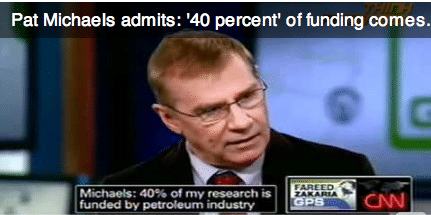
Notorious climate skeptic Pat Michaels of the CATO Institute finally admitted openly on CNN this weekend that 40 percent of his funding comes from – wait for it – Big Oil.
DeSmogBlog readers have known for years about Michaels’ long-time association with a network of at least eleven think tanks and industry front groups funded by ExxonMobil. Many of these same outlets have received funding from other oil interests like the Koch Family Foundations.
Michaels’ admission that he receives around 40 percent – his guess – of his funding from Big Oil is important, because he is quoted widely in the media for his skepticism about manmade climate change. As the ExxonSecrets profile of Pat Michaels sums up well, he is “possibly the most prolific and widely-quoted climate change skeptic scientist.”
Fareed Zakaria deserves a round of applause for challenging Michaels directly to cough up a figure for how much oil money he receives to defend the status quo fossil fuel addiction and to confuse the public about the threat of climate change. Far too few journalists bother to ask that question, and Zakaria has sent a much needed reminder to journalists – it is your job to expose the potential conflicts of interest among your interviewees. Zakaria gets an A+ for outing Michaels’ oily funding.
H/T to Brad Johnson at ThinkProgress for the transcript and video of Michaels’ CNN appearance below.
ThinkProgresss reports:
In a telling exchange with CNN’s Fareed Zakaria yesterday, long-time polluter apologist Pat Michaels admitted that “40 percent” of his funding comes from the oil industry. Michaels, introduced as “a scientist who now works for the Cato Institute, the libertarian think tank that strongly opposes caps to carbon dioxide,” has promoted global warming denial for decades, funded by a network of oil and coal companies and their ideological allies. Michaels initially denied that he is funded by the petroleum industry, but backtracked under steady interrogation by Zakaria:
ZAKARIA: Let me ask you what people wonder about, advocates like you. They say —
MICHAELS: I’m advocating for efficiency.
ZAKARIA: Right. But people say that you’re advocating also for the current petroleum-based industry to stand pat, to stay as it is, and that a lot of your research is funded by these industries.
MICHAELS: Oh, no, no. First of all, what I’m saying is —
ZAKARIA: Well, is your research funded by these industries?
MICHAELS: Not largely. The fact of the matter is —
ZAKARIA: Can I ask you what percentage of your work is funded by the petroleum industry?
MICHAELS: I don’t know. 40 percent? I don’t know.
Watch it:
As ThinkProgress reader zxbe notes in the comments section over there:
“That’s a good investment by the oil industry. They put up 40% of the funds, and get to use 100% of the junk science.”