
This is a guest post by Brad Johnson, cross-posted with permission from Hill Heat.
In a New York Times Earth Day story, the usually excellent Coral Davenport grossly misrepresents the Keystone XL tar-sands pipeline’s true impact on global warming, and questions the wisdom of pipeline opponents like the activists now encamped on the National Mall.
The pipeline is intended to ship upwards of 830,000 barrels of tar-sands crude a day for a 40-year lifespan. The pipeline will add 120-200 million tons of carbon-dioxide-equivalent to the atmosphere annually, with a lifetime footprint of 6 to 8 billion tons CO2e. That’s as much greenhouse pollution as 40 to 50 average U.S. coal-fired power plants. Furthermore the Keystone XL pipeline is recognized by the tar-sands industry as a key spigot for the future development of the Alberta tar sands, which would emit 840 billion tons CO2e if fully exploited.
Interviewing Washington insiders who have offered various forms of support for the Keystone XL project, Davenport claims instead that “Keystone’s political symbolism vastly outweighs its policy substance.” To support the claim, Davenport then erroneously underestimates the global warming footprint of the pipeline by a factor of ten.
Davenport’s crucial error is to contrast the actual carbon footprint of existing fossil-fuel projects — such as US electric power plants (2.8 billion tons) and tailpipe emissions (1.9 billion) — to the impact of the pipeline’s oil being dirtier than traditional petroleum, without explaining that she was switching measurements:
Consider the numbers: In 2011, the most recent year for which comprehensive international data is available, the global economy emitted 32.6 billion metric tons of carbon [dioxide] pollution. The United States was responsible for 5.5 billion tons of that (coming in second to China, which emitted 8.7 billion tons). Within the United States, electric power plants produced 2.8 billion tons of those greenhouse gases, while vehicle tailpipe emissions from burning gasoline produced 1.9 billion tons.
By comparison, the oil that would move through the Keystone pipeline would add 18.7 million metric tons of carbon [dioxide] to the atmosphere annually, the E.P.A. estimated.
[There are two side errors in the passage: Davenport uses “tons of carbon” where she means “tons of carbon dioxide equivalent”. One ton of carbon is the equivalent of 3.67 tons of carbon dioxide. All of her numbers refer to tons of carbon dioxide-equivalent. Secondly, the estimate was not made by the E.P.A. but by a State Department contractor hired by TransCanada; the E.P.A. cited that analysis but did not make the calculations.]
What the oil-industry contractor for the State Department actually calculated is that the oil that would move through the Keystone pipeline would add 147-168 million metric tons of carbon dioxide to the atmosphere annually, 1.3 to 27.4 million of which (central estimate 18.7 million from the draft assessment) are because tar-sands crude is dirtier than other petroleum sources. Those 18.7 million tons are the “incremental” or “additional” footprint of the pipeline, not the full 160 million-ton footprint.
Based on this order-of-magnitude measurement-switching error, Davenport incorrectly concludes that “the carbon emissions produced by oil that would be moved in the Keystone pipeline would amount to less than 1 percent of United States greenhouse gas emissions, and an infinitesimal slice of the global total.”
In fact, the carbon dioxide emissions produced by oil that would be moved in this single pipeline would amount to 3 percent of U.S. greenhouse gas emissions, and half a percent of the global carbon footprint. Only thirty-two countries have larger annual footprints than this single tar-sands project.
Climate scientist John Abraham made this point in The Guardian last week. “People who think Keystone is a minor issue don’t understand science and they sure don’t understand economics,” he wrote.
Putting aside any possible political and economic motivations to support the intentions of the global petroleum industry, the intellectual failure rests on an obvious error made subtle through convolution.How on earth could Davenport and the pipeline supporters she cites — Michael Levi of the Council on Foreign Relations, Kevin Book of the fossil-industry consultancy ClearView Energy Partners, former Obama White House climate advisor Jason Bordoff of Columbia University’s Center on Global Energy Policy, Adele Morris of the Brookings Institution, and fossil-industry lobbyist David Goldwyn (a former advisor for Secretary of State Hillary Clinton and also a Brookings fellow) — make this basic and outsized mistake?
Whether one is looking at actual or incremental footprints of carbon-infrastructure projects, the results should be equivalent from a policy standpoint, although the numbers would be different. Why, then, does the incremental analysis used by the EPA and the State Department’s oil-industry contractors appear to give the absurd result that the Keystone XL impact is “infinitesimal”?
The methodology of incremental footprint analysis assumes a baseline of future projected carbon pollution, and then looks whether a given project would increase or decrease the baseline. The validity of incremental-footprint analysis thus depends on the baseline.
In line with scientific warnings, President Barack Obama and the U.S. State Department have committed to limiting global warming to below 2°C above pre-industrial levels. In the International Energy Agency’s 2°C scenario, global oil consumption would fall by 50 percent from current levels by 2050, within the intended operating lifetime of the Keystone XL pipeline.
The Keystone XL final environmental impact statement instead assumes that global oil demand will increase over that time period. The baseline used is the Energy Information Administration’s 2013 Annual Energy Outlook, which projects that global oil consumption will increase by 30 to 40 percent by 2040. In that scenario, the world would be on a pathway for rapid and catastrophic global warming of 4 to 6°C (or greater) by 2100.
No matter the analysis, the Keystone XL pipeline is incompatible with climate security. The global-warming impact of constructing Keystone XL is only “infinitesimal” if you assume catastrophic global warming is inevitable and that the signed climate pledges of the United States government are worthless.
Perhaps Ms. Davenport should ask Levi, Book, Bordoff, Morris, and Goldwyn if that is their assumption.
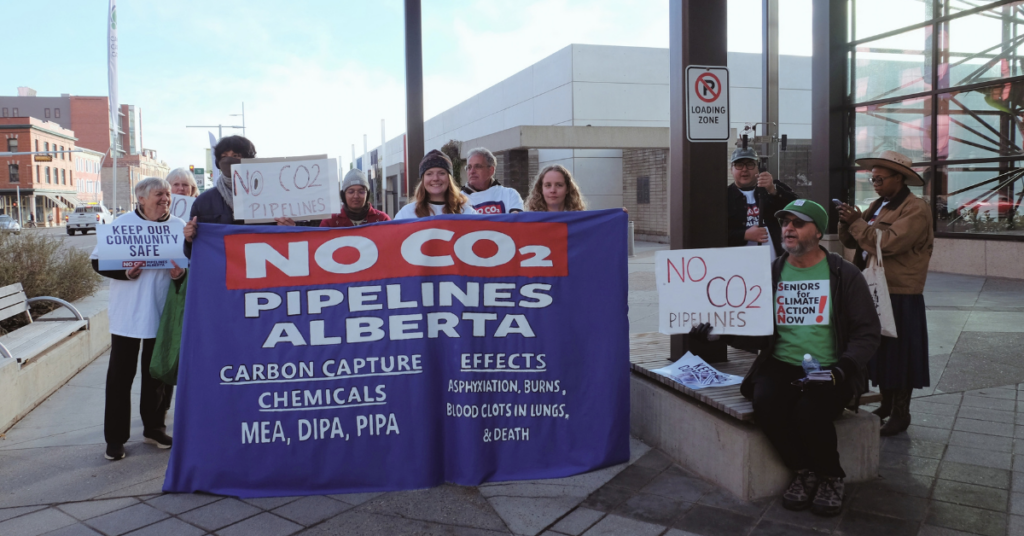
Image credit: Keystone XL protesters at the White House, by Rena Schild via Shutterstock.