

In December 2025, former B.C. Premier Christy Clark gave an interview on Global News where she described Canada’s west coast ban on oil tankers as a “ridiculous” constraint on the Canadian economy.
A clip of Clark’s interview then began to circulate online, where it was shared by several Canadian conservative influencers and aggregator accounts on platforms including X and Facebook with captions including “reality check,” “huge truth bomb” and “economic self-sabotage.”
Within days, the interview clip was spreading across the social media feeds of people in B.C. and beyond, eventually surpassing 1.6 million views.
But this was not necessarily a case of west coast residents suddenly deciding organically they wanted to overturn the ban on coastal oil tanker traffic brought in by former Liberal Prime Minister Justin Trudeau.
The digital media amplification of Clark’s comments was orchestrated in part by Canada Action, a pro-oil industry advocacy organization partly funded by Cenovus Energy, Canada’s third-largest oil and gas company.
It was one example of “showcasing Canada Action’s content leadership influencing the public discussion,” according to an internal slidedeck from the Calgary-based group. That slidedeck, which hasn’t yet been reported on, was obtained by Greenpeace Canada and published in its October 2026 report Manufacturing Petro-Populism.
These and other presentation slides from Canada Action demonstrate how fossil fuel interests manufacture the appearance of consent for increased oil and gas production in Canada, according to experts who study the spread of climate disinformation online.
“Most people can pretty easily see through messages coming directly from the Canadian Association of Petroleum Producers (CAPP) or industry CEOs,” said Shane Gunster, a professor at Simon Fraser University’s School of Communications, in a statement to DeSmog.
“But when the message comes from people in their social network, local business leaders, their family and friends, they’re far more likely to engage with it and maybe even be persuaded by it. And this is especially true for growing segments of the public that don’t consume a lot of news.”
Canada Action didn’t respond to DeSmog’s questions about the slidedeck.
‘Snipped And Posted’
Canada Action was founded in 2012 by Cody Battershill, a Calgary-based realtor. Though Canada Action claims to be a grassroots effort, it has numerous reported ties to the fossil fuel sector and its lobbyists. According to the Greenpeace report, Canada Action spent $1.9 million CAD on marketing in 2024, and $1.5 million CAD in 2023.
The presentations were made in the context of a funder session for the group Canadian Energy Prosperity (CEP), through its Energy in Action (EIA) initiative, and held at the Calgary Petroleum Club in January 2026.
According to the Greenpeace report, Energy in Action is an oil-industry backed network of thirty organizations that advocate for the fossil fuel sector, including front groups, charitable organizations, companies, media organizations and lobby groups. EIA is itself funded by Canadian Energy Prosperity.
Though neither of these are public facing organizations, members of EIA’s network are prominent pro-oil and gas voices in Canada. They include, among others, the Fraser Institute, Canada Action, Energy United, Debunk, Canadians for Affordable Energy, Young Canadians for Resources, Resource Works, Energy Creates, and The News Forum.
Two of those organizations, Resource Works and Energy United, prepared a slidedeck for the Calgary Petroleum Club event describing environmental groups as “opponents” and Indigenous rights as a “problem,” as reported previously in the Narwhal.
Many of the groups that are funded by CEP also receive funding from Gwyn Morgan, a Canadian fracking magnate who has financed a climate misinformation ecosystem with nearly $10 million in funding to right wing anti-regulation lobby groups. Morgan is also linked to Cenovus (which has funded Canada Action), as well as Second Street, a libertarian advocacy organization.
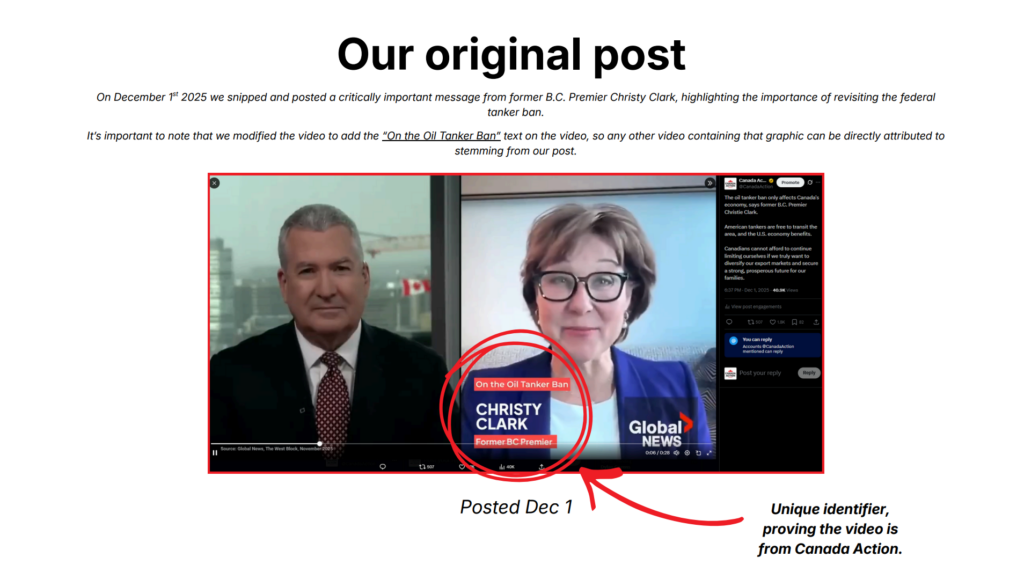
In its presentation to CEP, Canada Action explained how it was able to manufacture viral pro-oil content online from a December 1 interview former B.C. Premier Clark gave to Global News.
First, Canada Action explained, “we snipped and posted a critically important message from former B.C. Premier Christy Clark, highlighting the importance of revisiting the federal tanker ban.”
Then, the group “modified the video to add the ‘On the Oil Tanker Ban’ text on the video, so any other video containing that graphic can be directly attributed to stemming from our post.”
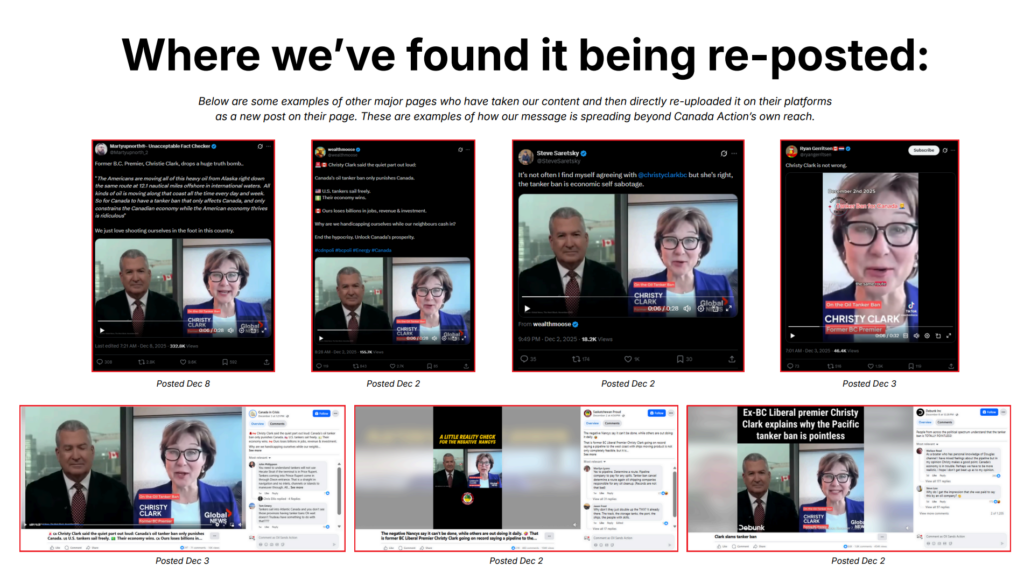
Canada Action carefully tracked “other major pages who have taken our content and then directly re-uploaded it on their platforms as a new post on their page.”
One of these reposts was from the page Debunk, Inc., which characterized Clark’s comments as explaining “why the Pacific tanker bank is pointless.” That post garnered thousands of likes and comments. In a separate slide presentation obtained by Greenpeace, Debunk stated that “the energy narrative is ours to shape. With your continued support we will continue to challenge the myths, engage Canadians, and advocate for the energy future our country deserves.”
All told, the Clark clip generated 1,614,000 views across Canada Action’s social media pages as well as “unattributed traffic” due to the video being shared by third-party accounts, according to metrics shared by the group.
In a separate slide deck, titled “Digital Reach Report: April 2026 Social Media & Website Views & Impression”, Canada Action indicated its social media content received over 37.5 million views. The bulk of its monthly impressions came from one of its three Twitter accounts — @LNGAction, @OilSandsAction, and @CanadaAction — which together brought in over 25 million views.
Amplification Machine
Canada Action has considerable social media reach, noting in its presentation that its Facebook and Instagram posts “are being reached and interacted with by millions of unique Canadians.” Indeed, according to its presentation slides, the Canada Action Facebook page drew 2.8 million unique people while the Oil Sands Action Facebook page drew 1.4 million. On Instagram, Canada Action claimed to have attracted 559,000 while Oil Sands Action drew 476,000.
Canada Action uses its sizable digital imprint to amplify other groups in the CEP network, including Young Canadians for Resources, its youth advocacy arm.
The Canada Action presentation also highlights a partnership with Resource Works “to amplify the economic leadership of 5 Mayors from the Alliance of Resource Communities,” an effort to build public support for oil and gas and other natural resource projects in B.C. “We can now say that we are the LNG capital of Canada,” Kitimat mayor Phil Germuth stated in one Facebook post. At the time the screenshot was taken, that post had garnered 6,600 likes, 490 comments, and was forwarded 274 times.
Resource Works is also identified in the Greenpeace report as an organization with ties to the fossil fuel sector. DeSmog has previously reported that the organization has been involved in other influence campaigns, including an astroturf campaign to oppose a ban on natural gas that involved template comments for restaurant owners, hospitality workers and residents of Vancouver.
Gunster argues that the sorts of digital campaigns led by Canada Action and its allies have influenced how Canadians think and feel about the oil and gas sector.
“Look at the big swings in public opinion in favour of oil and gas projects over the past year-and-a-half,” said Gunster. “Some of that is obviously Trump and the trade war, and some of that is the Carney government. But I have no doubt that the kinds of campaigns described in this [Greenpeace] report are also having a significant impact, saturating our social media feeds with pro-industry messaging.”
DeSmog reached out to Christy Clark and Global News to determine whether Canada Action had asked permission to use the video clip and still images in their promotional materials. Neither responded.