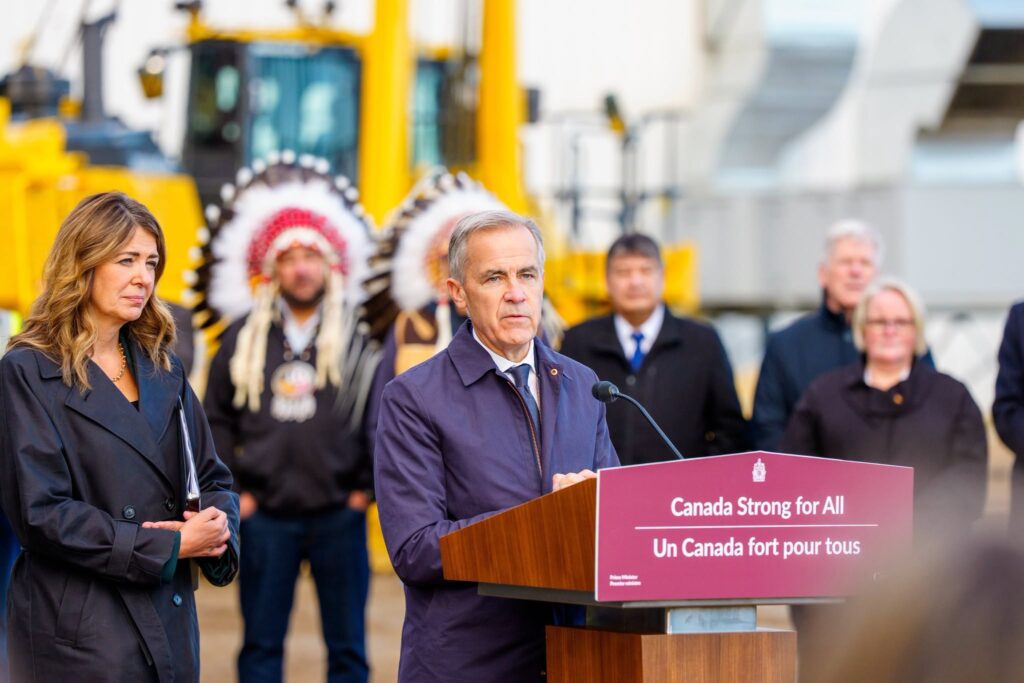

Canada’s already battered reputation on curbing climate emissions has become drastically worse under the leadership of Prime Minister Mark Carney according to a recent report card from Climate Action Tracker, approaching levels of inaction comparable to the “drill baby drill” Trump Administration.
“Prime Minister Mark Carney has so far been unwilling to recommit to either the 2030 or 2035 targets and has conceded that, under his energy plan, Canada’s emissions will be higher in the near term than previously projected,” warned the report. “If Canada were to officially abandon its 2030 and 2035 targets, it would be the first country after the United States to do so.”
The emissions watchdog didn’t mince words about the pace and scale of Canada’s climate rollbacks.
“What is shocking to us is the true extent to which Prime Minister Carney has rolled back climate policies, largely in favour of the fossil fuel industry,” Bill Hare, CEO of Climate Analytics, a CAT partner, said in a release.
“This Carney climate carnage, while not quite as bad as Trump’s, is rapidly heading in the same direction, despite the country being hit by record wildfires and other devastating climate impacts,” he added.
While Canada’s planned policies were expected to cut emissions by 30 percent below 2005 levels by 2030 two years ago, since Carney has come into office Climate Action Tracker estimates this planned reduction has been cut in half. Current policies are on track to only deliver a 14 percent decrease in emissions.
Carney’s oil-friendly government has swept aside a suite of climate regulations aimed at reducing the massive and growing emissions from the oil sands, which have ballooned by 178 percent since 2005 and now almost equal the entire passenger transport sector.
Perhaps the single fig leaf remaining to cover this naked climate failure is the long-touted and still not-built Pathways carbon capture and storage (CCS) project.
But this project is nothing more than a boondoggle in waiting, with rapidly diminishing expectations of what Pathways would accomplish and growing estimates of what it would cost.
“These technologies are nowhere near the scale and commercial viability needed to deliver on the needed emission reductions,” Climate Action Tracker concluded.
Pathways was originally hyped by bitumen producers as the largest CCS project in the world that would eliminate 68 million tonnes (MT) of emissions a year, or three-quarters of the oil sands’ entire output. That dubious goal has since been quietly rolled back to 16 MT by 2050, a decline of 76 percent.
The first phase of the Pathways project was supposed to be completed by 2030 to store 22 MT per year, now revised down to 6 MT sometime after 2032. Dilling bravely characterized these massive decreases in sequestered emissions as “slightly smaller”.
Six years into this alleged climate saving megaproject, no design proposals have been made public and not a single shovel has been stuck in the ground. The only things that have tangibly changed are the steadily diminishing projections about what Pathways could achieve if it ever gets built, and the mounting costs of doing so.
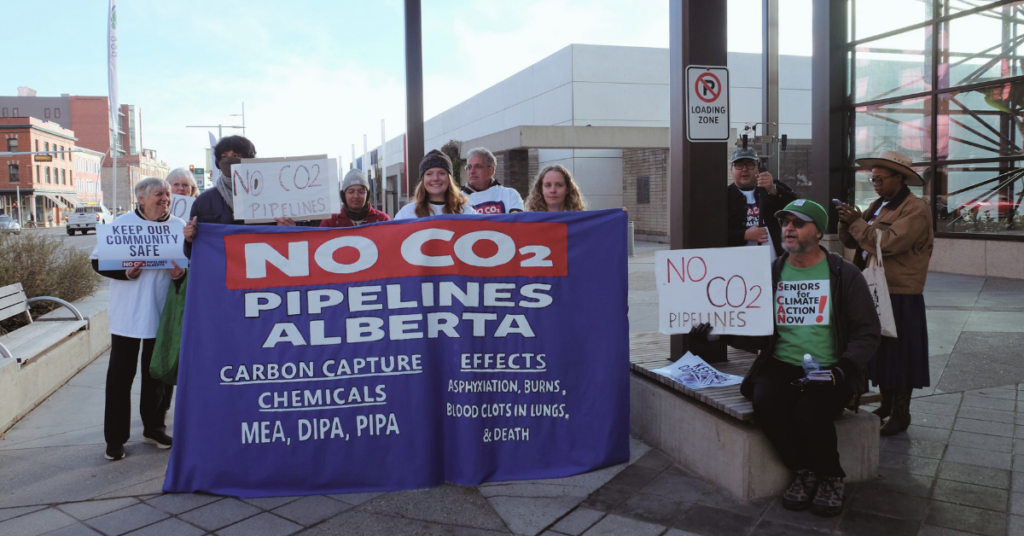
Originally budgeted at $16.5 billion, the current costs of building a potentially dangerous 650 km CO2 pipeline to Cold Lake and injecting CO2 into an underground reservoir three times larger than Prince Edward Island have ballooned to as high as $30 billion. Guess what? The same companies that are on track to pocket $100 billion in war-related profits this year expect the Canadian taxpayer to foot most of the bill.
It is increasingly clear that the Pathways project is less about carbon sequestration and more about political leverage. The so-called grand bargain between Ottawa and Alberta explicitly links Pathways with a new pipeline approval to the west coast to further boost bitumen production that has already increased almost 40 percent since 2015, undoing any climate benefits.
“The Pathways project… will not come close to compensating for the new west coast oil pipeline, which could add up to 28 MTA of greenhouse gas emissions every year,” Aly Hyder Ali, Environmental Defence Canada’s senior program manager for oil and gas told DeSmog. “It will require tens of billions of dollars in public support, while capturing only a small portion of the emissions from oil sands production.”
Carbon capture and storage has long been held up as a way to slow down climate consequences while still burning fossil fuels. Despite much industry-funded hype and $40 billion so far spent around the world, CCS only sequesters a puny proportion of global greenhouse gases.
A recent peer-reviewed study of the technology warned, “continued reliance on CCS is a high-cost gamble that risks delaying the deployment of truly effective climate solutions… Despite decades of promotion and investment, [CCS] remains technologically constrained, economically inefficient, and strategically misapplied.”
Even if Pathways worked perfectly it would do nothing to mitigate the tailpipe emissions once bitumen is refined into transportation fuel, which are four times higher than production emissions.
The Pathways project is a diminishing technological fix for a problem that industry has refused to deal with. Alberta oil sands operators have repeatedly stalled taking action, demanded more taxpayer largess, and allowed their emissions to grow north of 92 MT per year – an increase of more than three percent over the previous year due to ballooning production.
The oil patch is Canada’s biggest climate laggard while banking massive profits. Alberta’s bitumen producers raked in $13.3 billion in the first three months of 2026. Yet such wealthy companies still expect the beleaguered Canadian taxpayer to foot most of the bill for another pipeline to the Pacific and the expensive CCS project that makes the pipeline politically possible. Perhaps oil patch lobbyists deserve a raise. To gaslight a country into shelling out billions in subsidies to a wildly profitable sector that is also fuelling an accelerating climate crisis is no small feat. Pathways’ diminishing targets and mounting costs make this outlandish accomplishment even more outrageous.