SOME processes of cause and effect are relatively easy to get your head around.
For example, if I smash the end of my thumb with a hammer then the effect will be extreme sharp pain, followed by a short burst of f****** swearing and then probably one of those under-the-nail bruises that stick around for months.
An equally simple process to understand is that burning fossil fuels like oil, coal and gas releases extra carbon dioxide into the atmosphere, which causes temperatures to rise. The extra CO2 sticks around for a century or so, perhaps longer.
Now this is of course a hugely oversimplified version of the greenhouse effect. There’s lots of “noise” in the climate system, but the fundamentals are there. This brings us to the Arctic. No honestly, it really does.
Earlier this week, the US Government’s National Snow and Ice Data Center declared that more sea ice melted away this year than at any other time since records began in 1979.
Sea ice extent fell to 3.41 million square kilometers (1.32 million square miles), now the lowest summer minimum extent in the satellite record…. This year’s minimum follows a record-breaking summer of low sea ice extents in the Arctic. Sea ice extent fell to 4.10 million square kilometers (1.58 million square miles) on August 26, breaking the lowest extent on record set on September 18, 2007 of 4.17 million square kilometers (1.61 million square miles). On September 4, it fell below 4.00 million square kilometers (1.54 million square miles), another first in the 33-year satellite record.
This new minimum, NSIDC explained earlier this week, is 3.29 million square kilometres below the 1979-2000 average. Now that’s a difficult number to visualise.
 Instead imagine losing the states of Queensland, New South Wales and Victoria and then, while you’re at it, also wipe New Zealand off your map. At that point, you’re almost up to 3.29m sq km.
For US fans of melting ice, we’re talking about an area the combined size of Texas, Alaska, Oregon, California and Minnesota.
For an alternative scale, remove India (3.28 m sq km) from the map.
This loss of an ice cap matters because the Arctic’s white cover reflects solar radiation back out into the atmosphere, keeping the planet cooler. When the ice disappears, it exposes the darker ocean beneath, kicking of a series of other effects including warmer ocean temperatures, further thinning and melting of ice and disruption of weather patterns in northern latitudes.
This year’s record low, however, is part of a long term trend in the decline of sea ice. The six lowest sea ice minimums on the satellite record have all occurred in the last six years.
A study earlier this year in the journal Environmental Research Letters, reported in The Guardian, found that human activity (mostly burning fossil fuels) was responsible for at least 70 per cent of the melting.
Rather than signalling alarm, oil companies see an opportunity in the trend of melting ice. Vast stores of undersea oil await. Climate change campaigner Bill McKibben put the issue succinctly when he said earlier this week
There’s no place on Earth where we see the essential irony of our moment playing out more perfectly than in the Arctic. Our response has not been alarm, or panic, or a sense of emergency. It has been: ‘Let’s go up there and drill for oil’. There is no more perfect indictment of our failure to get to grips with the greatest problem we’ve ever faced.
But such is the nature of the “cause and effect” of the fossil fuel industry, that it doesn’t essentially matter to the climate (or to the Arctic) just where the coal, oil and gas gets extracted and burned.
Whether it is oil “fresh from the Arctic” or gas “fresh from Australia”, the effect is the same.
In Queensland earlier this week Greenpeace released a report suggesting that nine mega coal mines planned for the state’s Galilee Basin could potentially see the release of more than 700 million tonnes of CO2 into the atmosphere from burning the coal. If Galilee was a country, the report claimed, it would be the seventh worst greenhouse polluter on the planet.
Mining industry group the Queensland Resources Council dismissed the report as having “zero credibility“ claiming the NGO had overestimated the growth in the state’s coal industry.
What isn’t in question, is that Australia is the world’s largest exporter of coal and has designs on being the world’s largest exporter of Liquified Natural Gas. The country’s biggest contribution to climate change, including the melting Arctic sea ice, comes from the fossil fuels the country exports.
But back to our hammer-smashed thumbnail. Occasionally, if you catch them hard enough, the nail can fall off entirely, which at worst is a little inconvenient.
Losing an ice cap thanks to hammer blows from fossil fuels will in all likelihood be far more painful, with consequences stretching out to future generation and future economies.
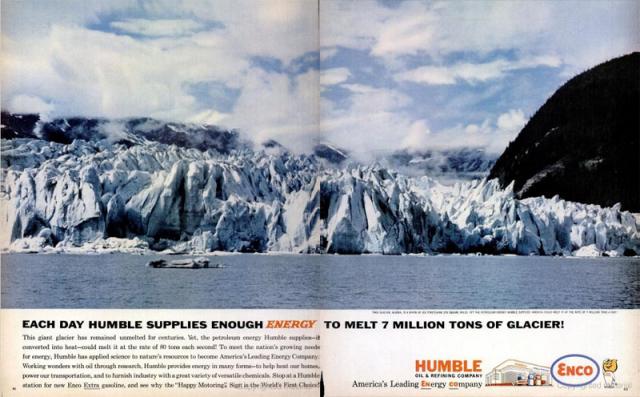
Pics: An advert from a 1962 edition of Life magazine for Humble Oil, which later became part of ExxonMobil, declares “Each Day Humble Supplies Enough Energy To Melt 7 Million Tons of Glacier!”. Irony to be turned right up to 11. Hat tip to Grist. Arctic image courtesy NSIDC.