National Drive Electric Week Combats Koch-Funded Lies With Real World Drivers

picture-7019-1570723309.jpg
on

There’s a war being waged against electric cars, the frontlines of which are dug in on Facebook feeds and embedded Youtube videos. The ammunition, supplied by the Koch brothers and their most loyal, PR savvy affiliates, are talking points meant to sow doubt in the minds of American drivers about the quality, costs, reliability, and even environmental-friendliness of electric cars.

Though many automotive experts—including some Big Oil majors—see the transition to electric vehicles (EVs) as inevitable, this war is being waged to keep the gas-guzzling internal combustion engine king for as long as possible. They are fighting to keep oil demand high enough to justify drilling, refining, and selling petroleum.

In the face of this war, Plug-In America, the country’s leading EV advocacy organization, and its partners are organizing the seventh annual National Drive Electric Week. And in the context of these PR attacks, this year’s week long event—running from September 9-17th—might be more important than ever.

National Drive Electric Week is a decentralized expo of sorts, an umbrella under which EV drivers, fans, and advocates can organize their own electric car showcases. There are more than two hundred events planned in all 50 states and in dozens of foreign countries. Most will offer test drives to the public, and all will showcase current EV models to help Americans see EVs for what they really are: practical vehicles that most households could integrate into their current driving routines.

Credit: National Drive Electric Week

Critically, real EV drivers will be on hand at every event to offer their real world perspectives on driving electric, which will help counter many of the deceptive talking points that the Kochs and the oil companies are pushing.

On Saturday, I was fortunate to be a part of the Upper Valley EV Expo in White River Junction, Vermont. An estimated 500 people came to peek under the hoods and take test drives of 15 different EV models, ranging from the luxurious Tesla Roadster to the much more modest, sub-$30,000 models like the Nissan Leaf and Chevy Volt.

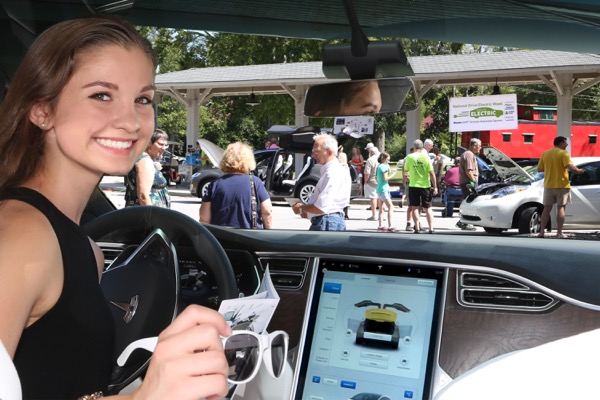
Feature Image: In Aiken, South Carolina, Cafe Scientifique Aiken’s teen board member Sydney Maddox sits behind the wheel of a Tesla Modle X. Credit: Cafe Scientifique Aiken

picture-7019-1570723309.jpg
Ben Jervey is a Senior Fellow for DeSmog and directs the KochvsClean.com project. He is a freelance writer, editor, and researcher, specializing in climate change and energy systems and policy. Ben is also a Research Fellow at the Institute for Energy and the Environment at Vermont Law School. He was the original Environment Editor for GOOD Magazine, and wrote a longstanding weekly column titled “The New Ideal: Building the clean energy economy of the 21st Century and avoiding the worst fates of climate change.” He has also contributed regularly to National Geographic News, Grist, and OnEarth Magazine. He has published three books—on eco-friendly living in New York City, an Energy 101 primer, and, most recently, “The Electric Battery: Charging Forward to a Low Carbon Future.” He graduated with a BA in Environmental Studies from Middlebury College, and earned a Master’s in Energy Regulation and Law at Vermont Law School. A bicycle enthusiast, Ben has ridden across the United States and through much of Europe.

Related Posts

on

The longtime Big Oil attorney has major ties to conservative legal groups.

The longtime Big Oil attorney has major ties to conservative legal groups.
Series: MAGA
on

CPAC GB partners with Bitcoin network as Reform leader comes under fire for industry connections.

CPAC GB partners with Bitcoin network as Reform leader comes under fire for industry connections.
on

More than a decade after Shell announced its Beaver County complex, new reports show the oil giant’s promised economic revival failed, while pollution concerns now shape debates over proposed data centers.

More than a decade after Shell announced its Beaver County complex, new reports show the oil giant’s promised economic revival failed, while pollution concerns now shape debates over proposed data centers.
on

Nearly two thirds of country’s pig and poultry farms leach polluting manure into lough that supplies half the region's drinking water, according to latest research.

Nearly two thirds of country’s pig and poultry farms leach polluting manure into lough that supplies half the region's drinking water, according to latest research.