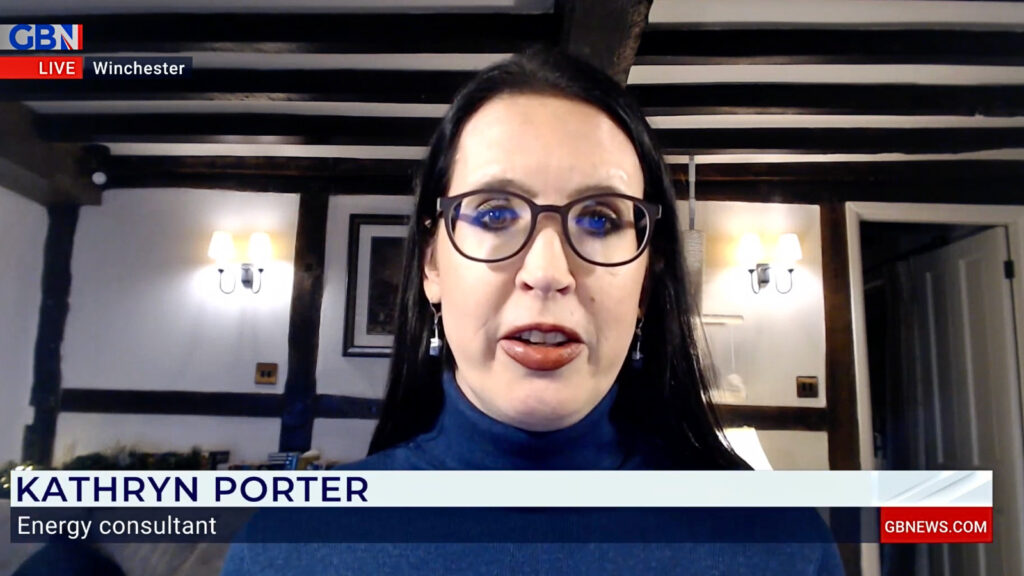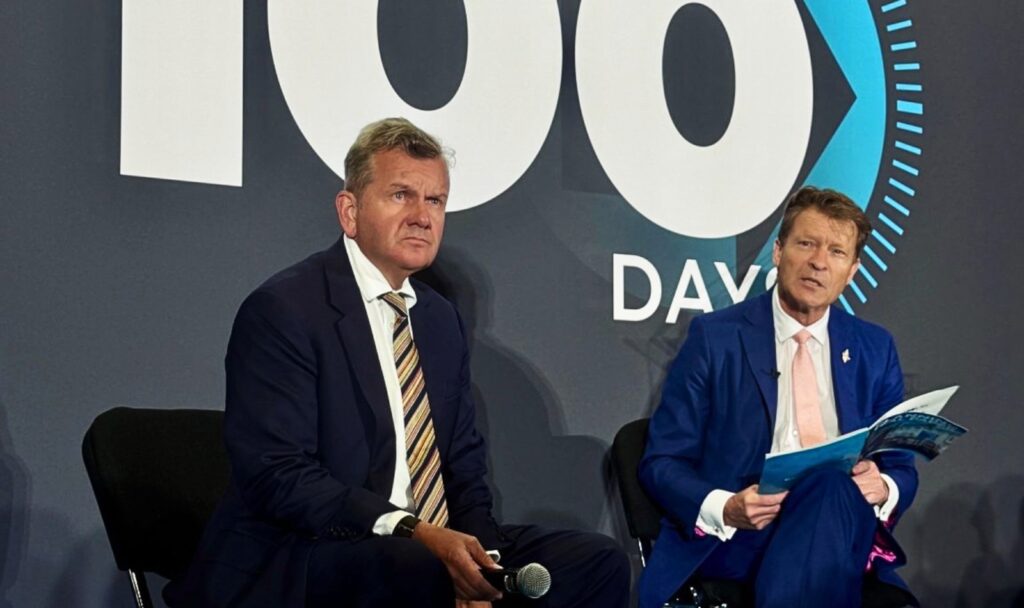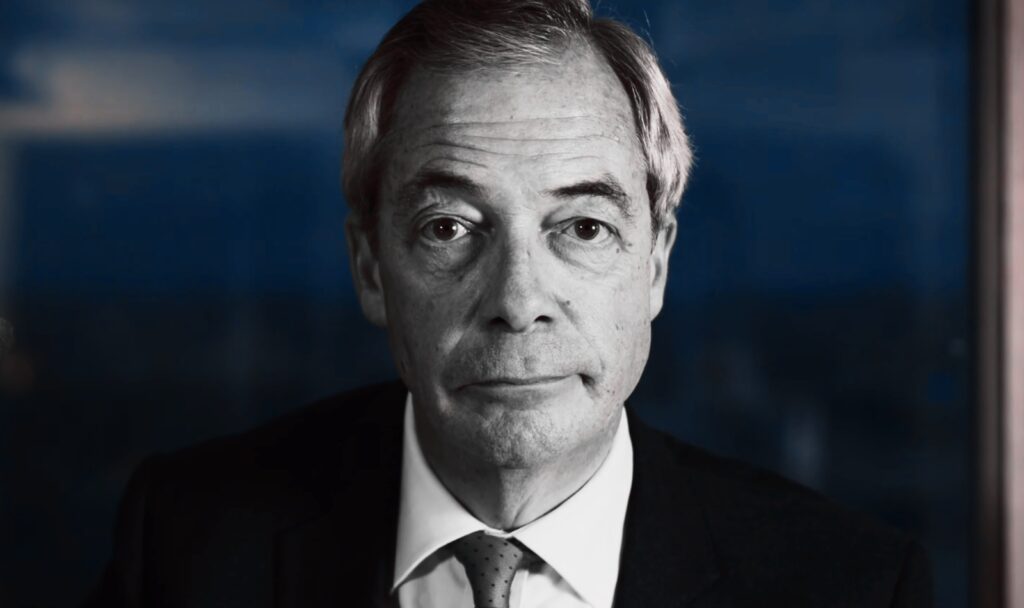

Nigel Farage’s Reform UK has stood to gain financially from the crypto connections linking it to Donald Trump’s administration, DeSmog can report.
Trump’s Commerce Secretary Howard Lutnick has been accused of shaping laws that have benefitted Tether, a firm that issues the most traded cryptocurrency in the world.
Lutnick’s family owns Cantor Fitzgerald, which holds a stake in Tether and provides financial services to the crypto giant.
Reform’s largest donor Christopher Harborne is one of Tether’s shareholders and is believed to derive much of his £18.2 billion fortune from a 13 percent stake in the company.
Tether is currently attempting to secure a multi-billion dollar injection of private finance that would dramatically elevate its value. The company previously indicated that it hoped to achieve a valuation of £500 billion – making it one of the world’s largest companies and giving a windfall to its shareholders, including Harborne and Cantor Fitzgerald.
If this happens, Harborne’s wealth would multiply – it’s estimated he would become the 30th richest person in the world – and would have near-unlimited resources to devote to his political donations.
Lutnick has denied influencing the Trump administration’s policies in favour of Tether specifically, while there’s no evidence that decisions have been taken by the U.S. government to directly boost Reform’s finances. However, this case shows how White House policies, allegedly moulded by Lutnick, have stood to significantly but indirectly benefit Farage’s principal patron.
DeSmog can also reveal that Reform received £75,000 last year from two executives at brokerage firms controlled by Cantor Fitzgerald. Timothy Charles Mallott, the chief operating officer of BGC Group’s EMEA division, donated £50,000, while Richard Barnett, the CEO of Mint Partners, gave £25,000. They donated in a personal capacity.
Farage has returned to the House of Commons after winning last week’s Clacton by-election and is facing an investigation by Parliament’s standards commissioner into a £5 million undeclared gift he received from Harborne prior to the 2024 general election.
The investigation will assess whether Farage was in politics at the time of the gift and therefore should have registered it when he first became an MP in July 2024. Farage has said he has “no case to answer” and that he’s the victim of an “establishment hit job”.
Harborne has given more than £25 million to Reform since its creation in 2019 – the majority of the party’s funds. Reform has also been heavily funded by fossil fuel interests, aristocrats, and those linked to offshore tax havens.
Lutnick, Cantor Fitzgerald, and Tether
Lutnick, a financier, is a longstanding Trump associate. He appeared on Trump’s NBC show, The Celebrity Apprentice, in 2008 and operated in the same New York real estate circles as the now-president.
When Trump won re-election in November 2024, he charged Lutnick with co-chairing his transition team – managing the handover of power.
That role gave Lutnick influence over crucial policies and job appointments in the new Trump administration – including those relating to crypto regulation.
According to Bloomberg, Lutnick used his pivotal position in Trump’s team to shape new legislation that benefitted Tether.
Lutnick reportedly worked with fellow crypto evangelist Bo Hines, who was hired as Trump’s “crypto point man”, to create the ‘Genius Act’ – a flagship law designed to create sympathetic conditions for the crypto industry in the United States.
The Commerce Department has stated that Lutnick was not involved in shaping the parts of the legislation that affect Tether.
However, the bill focused in particular on stablecoins – cryptocurrencies, like Tether, that are pegged to the value of traditional currencies, minimising their price volatility.
Tether’s key “red lines” were included in the legislation, according to Bloomberg – including a three-year grace period before the industry had to comply with the terms of the Genius Act.
There’s also a provision that potentially allows Tether’s principal cryptocurrency, known as USDT, to be regulated from El Salvador – where the company is based – as long as the U.S. determines Salvadoran regulations to be adequate.
Tether has said that the Genius Act provides no “special advantages” to the company, stating that the new law will “apply across the industry to any issuer seeking to operate under the framework.”
However, as the world’s largest stablecoin provider, Tether stands to benefit disproportionately from the terms of the Genius Act.
One month after the bill was signed, Tether hired Hines as its U.S. CEO.
Lutnick also has a long-standing business relationship with Tether. In 2021, most banks avoided working with the firm, which along with its affiliates had been fined roughly $60 million for making misleading statements about its losses and reserves, without admitting liability.
Lutnick offered a lifeline – agreeing for his financial services firm Cantor Fitzgerald to manage Tether’s sprawling assets.
One of Tether’s advantages over other crypto providers is that, for every one of its tokens issued, the firm commits to holding the same amount in U.S. dollars or easily converted equivalent assets. This in theory allows anyone holding Tether to turn the cryptocurrency into dollars at any time. There is currently around $180 billion USDT in circulation – backed by $141 billion in U.S. Treasury bills and billions more in other assets.
However, back in 2021, doubts were rife about whether Tether held the reserves it claimed. Although the firm insisted it had the assets to back up its currency, U.S. regulators concluded that it had not maintained “100 percent reserves at all times”.
And that’s where Lutnick and Cantor Fitzgerald stepped in.
As a primary dealer of U.S. Treasury bills, the bank was in a unique position to help, while Lutnick used his public clout to vouch for the ailing stablecoin provider – assuring the media that Tether’s stockpile was sound.
“We found every penny,” Lutnick said at a bitcoin conference in July 2024, “but they had it in some pretty God-forsaken places.”
Although there have been ongoing doubts about Tether’s inventory – until this month, the firm had never undertaken a full, independent audit – its profits have exploded since Cantor Fitzgerald took stewardship of its finances.
Tether declared profits of $13 billion in 2024, one-and-a-half times those of McDonald’s, and $10 billion in 2025. As a result, it has been described as the most profitable company per employee in history.
This relationship has also benefitted Cantor Fitzgerald. In 2024, under Lutnick’s stewardship, the firm paid $600 million for a 5 percent stake in Tether – an investment that is now estimated to be worth anywhere between $6 billion and $25 billion.

Credit: The White House / YouTube
Lutnick no longer owns Cantor Fitzgerald – he was forced to divest from his business interests when he joined Trump’s cabinet. However, ownership of the company has now passed to his children, who have been given a helping hand by Tether.
In March, Bloomberg reported that a trust belonging to Lutnick’s children received a loan from the crypto behemoth. The size of the loan, and whether it helped Lutnick’s children to purchase their father’s stake in Cantor Fitzgerald, is unknown. However, Brandon Fitzgerald, who now runs the company alongside his brother Kyle, has spoken of his “blossoming friendship” with Tether CEO Paolo Ardoino.
Appearing on a panel event alongside Ardoino in September 2025, Brandon said that, during his time working for Tether in Switzerland, the team “taught me everything I know.”
If Tether’s loan helped Lutnick complete a deal that “will ultimately benefit both him and his children, it’s yet another favor his family owes Tether,” Kathleen Clark, a law professor at Washington University in St. Louis and a former ethics counsel for the District of Columbia, told Bloomberg.
She added that this case is “yet another reason for concern that Howard Lutnick may use his government power to benefit Tether, and his children, rather than the public.”
A spokesperson for the Commerce Department told Bloomberg that Lutnick divested from his holdings, including Tether, when he joined Trump’s cabinet and “was not involved in any matters relating to the Genius Act’s stablecoin provisions.”
A spokesperson for Cantor Fitzgerald and the Lutnick children told Bloomberg that their acquisition of the bank “was funded through multiple sources, multiple companies and multiple trusts at market rates and market prices.”
Tether did not respond to DeSmog’s request for comment.
The Harborne Connection
Reform’s largest donor and Farage’s personal patron, Christopher Harborne, is one of a dozen individuals who own Tether, while his son used to work for the firm.
Harborne has no executive role in the company, but his personal wealth – channelled in turn to both Farage and Reform – is heavily derived from Tether.
Harborne has pledged to “give even more money” to the party following the Labour government’s attempts to cap overseas political donations. Harborne is based in Thailand and has a Thai name – Chakrit Sakunkri – although he has now registered to vote in the UK to avert restrictions on his political donations.
His philanthropy may also be unleashed by Tether’s planned expansion – with the firm attempting to raise billions from investors to boost its valuation. Even if the company achieves a $300 billion valuation – significantly below its initial target – Harborne’s stake would be worth upwards of $30 billion.
Farage has also been touting Tether and lobbying for U.S.-style crypto regulations to be introduced in the UK.
Speaking on LBC in September 2025, Farage said: “Tether is about to be valued as a $500 billion company. This world is enormous, and I’ve been urging for years that London should embrace it. We should become a global trading centre for this stuff under proper regulation.”
The day after that interview, Farage made his case directly to the governor of the Bank of England, Andrew Bailey, reportedly urging the Bank to turbocharge the UK crypto sector and drop plans to launch a state-issued rival to Tether.
Although Bailey claimed that Farage’s lobbying fell on deaf ears, the Bank later ditched its plan to limit the amount of stablecoins that any individual can hold.
Harborne has denied that he’s influenced or sought to influence any politician in support of cryptocurrencies or any other of his business interests – which include a major jet fuel supplier.
“With its aggressive lobbying operations and off-the-scale donations to super PACs, the crypto industry has largely captured crypto policy in the United States. And we are now seeing some alarming symptoms of this developing in the UK,” said Tim Picton of Spotlight on Corruption.
“Tether’s continued dominance of the stablecoin market would be hugely advantageous to at least one of Reform UK’s donors. But it should also be noted that under the current Labour government, the Treasury has been making some concerning overtures to its U.S. counterparts around finding regulatory alignment over stablecoin policies.
“There is a risk that this could open the door to the UK adopting the same carve outs and accommodations that the Trump administration is making for firms such as Tether. We should be under no illusions that when it comes to our market integrity, this would be playing with fire.”

Credit:
Shealah Craighead / White House (Public domain)
Crypto Kings
Farage, who has promised to bring about a “crypto revolution” if he becomes prime minister, also has a personal stake in the industry – having invested £215,000 in the bitcoin treasury company Stack BTC earlier this year.
Tether makes its vast profits through its colossal reserves – both the appreciation of those assets and the interest earned on them. In addition to over $100 billion in Treasury bills, that includes vast quantities of bitcoin and gold.
At the end of last year, the firm claimed to hold $24 billion in gold reserves – stored in a Swiss former nuclear bunker described as a “James Bond kind of place” by Ardoino, who has suggested that Tether is one of the biggest gold central banks in the world.
In fact, the company deals so heavily in gold that it sways the global market. As the Financial Times reported in November 2025: “Tether has been making bullion purchases so large that” the firm “probably helped underpin gold’s 64 percent gain last year.”
And one of those who may stand to benefit is Farage – who has made over £770,000 as an ambassador for the gold dealer Direct Bullion, his largest declared source of income since July 2024.
Trump himself made $1.4 billion from various crypto schemes and investments in 2025, after his campaign received $60 million from industry interests during the 2024 presidential election.
Farage has also made large sums from pro-Trump groups in recent years. Since being elected to Parliament, Farage has been paid more than £11,000 to speak at Hillsdale College – a conservative university in Michigan – and nearly £28,000 to speak at the ‘Club for Growth’, a lobby group that has endorsed and campaigned for Trump.
Farage has also racked up donor-funded flights worth at least £150,000 to speak at pro-Trump events since July 2024 – including £27,000 in flights and accommodation, gifted by Harborne, to attend events celebrating Trump’s second inauguration. The Reform leader has also received £47,000 from Trump-donating U.S. tech giants X Corp, Google, and Meta.
And senior Reform figures have actively fundraised for Trump. In June 2024, Reform treasurer Nick Candy co-hosted an event that reportedly raised £1.6 million for his re-election campaign, attended by Farage, Donald Trump Jnr., and Lutnick.
As reported by DeSmog, Farage has also spent many of his Commons appearances echoing Trump’s grievances with UK government policy, and has close ties to several groups – including climate science denial lobby groups – that have helped to shape Trump’s second term agenda.
Speaking at CPAC, the annual pro-Trump gala, a month after the president’s second inauguration, Farage said that the U.S. was at the “beginning of a golden age”.
He added: “In fact, in many ways what we’re fighting for is a very similar agenda to the one you’ve just fought for, and the one you have succeeded with.”
CPAC hosted an event in London this July, with Farage as the star speaker. The conference was sponsored by crypto lobbyists.
Reform, Harborne, Farage, Lutnick, Cantor Fitzgerald, Hines, Mallott, Barnett, the Commerce Department, and the White House were approached for comment.