
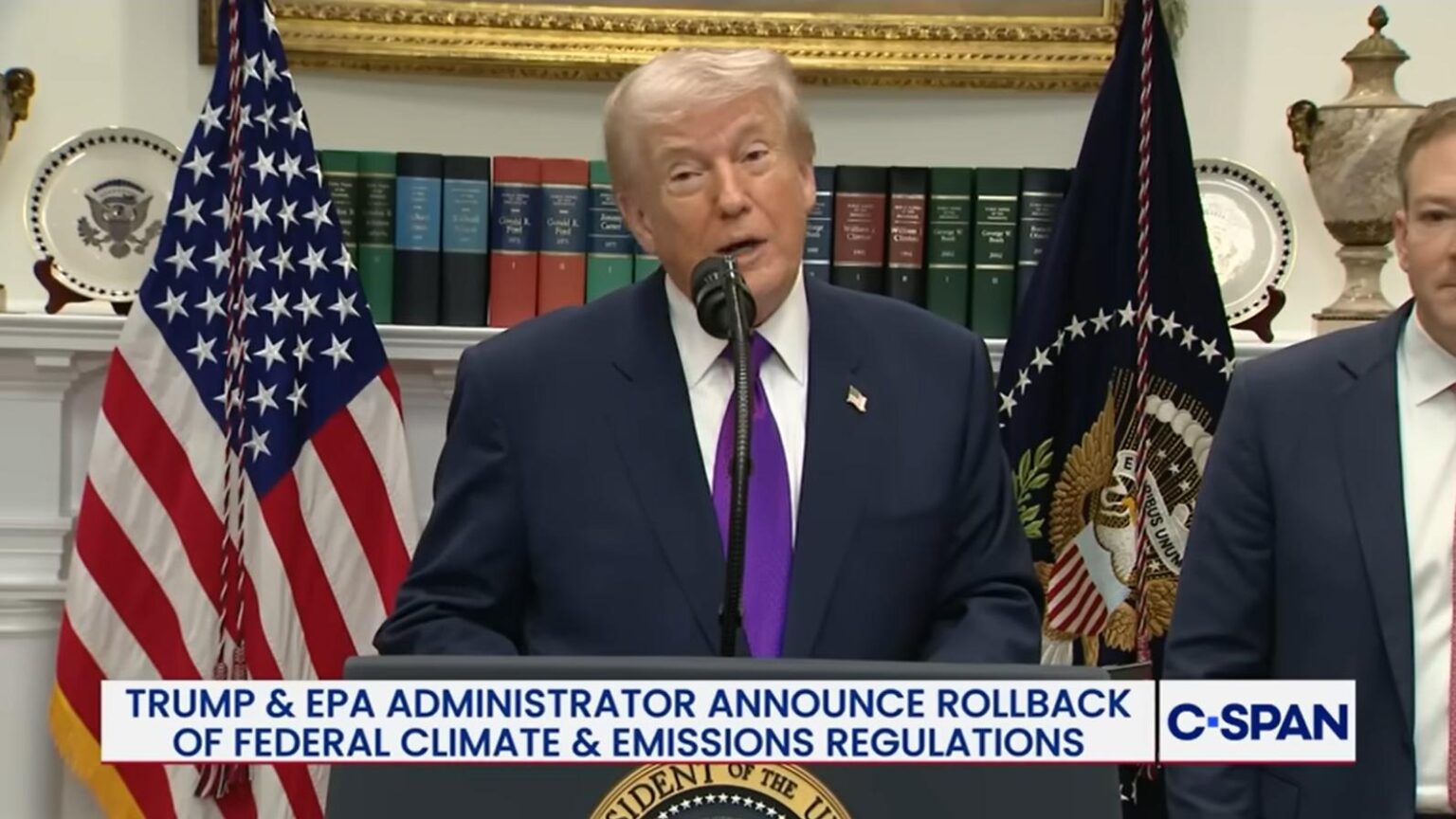
In a massive blow to the handful of scientists and academics who still dispute widely-accepted climate science, the Trump administration discarded a signature report by its own “Climate Working Group.” It comes as the U.S. Environmental Protection Agency (EPA) officially scrapped the government’s endangerment finding — the official recognition that greenhouse gases harm human health and the environment.
In an online version of the final rule, the EPA revealed late Thursday that it “is not relying on” a Department of Energy (DOE) report by the Climate Working Group, a hand-picked team composed of academics with a long history of publicly downplaying or rejecting the urgency of the climate crisis, partly “in light of concerns raised by some commenters about the draft.”
Starting last year, the Climate Working Group and their Energy Department handlers had toiled to produce a report that the Trump administration could use to scientifically justify rolling back climate regulations, emails from the group made public in late January show. Energy Secretary Chris Wright, a former fracking executive who has downplayed the threat from extreme weather, took special interest in the group’s efforts, which were kept under wraps. The endangerment finding has long been a target of fossil fuel trade associations such as the American Petroleum Institute (dating back to 1999), policymakers, and industry-backed groups.
The group of climate crisis deniers — Steve Koonin, John Christy, Ross McKitrick, Judith Curry, and Roy Spencer — took particular aim at the EPA’s 2009 endangerment finding, which provided the legal foundation for U.S. climate policies to reduce greenhouse gas pollution from transportation, power plants, and other industrial sources.
The Climate Working Group’s rejection isn’t just a black mark for the climate crisis deniers. Without a clear-cut scientific basis to dispute the endangerment finding, Trump’s EPA was forced to take a less favorable legal position, environmental attorneys told DeSmog, potentially opening the door for states, counties, or cities to take significant action of their own to curb greenhouse gases — setting up a nightmare scenario for businesses, from oil companies to automakers, that fear a patchwork of regulations.
DeSmog has reached out to all five members of the Climate Working Group and a Cato Institute official who organized their work for the Energy Department for comment.
“The EPA decided to proceed independently and we were not involved in the rulemaking process,” Climate Working Group member Ross McKitrick told DeSmog. “Our remit was to prepare a report for the DOE, which we did.”
As it announced its decision, the EPA noted that Administrator Lee Zeldin “continues to harbor concerns regarding many of the scientific inputs and analyses underlying the Endangerment Finding.”
Last August, the Environmental Defense Fund and Union of Concerned Scientists sued over the Climate Working Group’s lack of transparency — and obtained, under a court order, over 100,000 pages of documents and emails revealing the process by which the report was created. Roughly 700 pages of those documents were made public by the environmental groups on January 22, with the remainder expected to be posted within the next few weeks.
The Climate Working Group’s final report, released on July 29, was met with widespread condemnation from other scientists, including a devastating 435-page point-by-point critique assembled by 85 climate scientists and experts, including MacArthur “Genius” Fellows, members of the National Academy of Sciences, and authors of papers the Climate Working Group cited, scientists who said their studies were misrepresented.
“Notably, the Climate Working Group’s membership are the cream of the crop of climate contrarians,” Texas A&M University climate scientist Andrew Dessler, who helped to organize that critique, told DeSmog. “The DOE report therefore represents the best case against mainstream science. That they produced a report that is so lacking in credibility actually demonstrates how strong mainstream climate science actually is.”
Dessler and his peers were hardly the first to criticize the group’s work, the emails show.
Before the report was released, the Climate Working Group asked an artificial intelligence (AI) tool to review its draft scientific report for “scientific accuracy and potential bias.” The AI agent returned a cheerful mix of praise and warnings.
One section was “heavy-hitting” and “packed with technical nuance” but suffered from a “misinterpretation of NOAA projections.” On “scientific accuracy,” the AI rated another section “Mixed Quality” and dubbed some of the draft’s reasoning “Flawed but Thought-Provoking.” The AI flagged issues like “cherry-picked references” to studies by Climate Working Group members McKitrick and Christy, adding that contrary studies were “omitted.”
“This is amazing, far better than what we would get from ‘real’ scientists,” Curry, another member, wrote to the rest of the group.
Human readers would prove to be far more damning.
“Not your best work,” was the feedback from University of Sussex professor Richard Tol, Curry told the others on July 30.
“I thought Tol was on ‘our side,” replied Spencer. “Was i mistaken?” [sic]
Tol went on to become one of the 85 scientific commenters who joined the critique.
Inexpert Testimony
Members of the five-person Climate Working Group team have held a wide range of prestigious roles. Spencer is a former NASA scientist, Curry, a professor emerita from the Georgia Institute of Technology; McKitrick, a Canadian economist. Koonin was formerly the chief scientist for BP and served in the Obama administration and Christy, until recently, served as the Alabama State Climatologist.
While these academics, like much of the oil and gas industry today, acknowledge that climate change is happening, their views veer far outside the mainstream majority of practicing climate scientists. In addition, three of the group’s members have close ties to the oil and gas industry, either having directly worked with fossil fuel firms or working with think tanks that have received backing from the industry.
Dating back to the 1990s, Spencer’s and Christy’s attacks on mainstream climate science were routinely cited and promoted by the Global Climate Coalition, whose members included the American Petroleum Institute (API). The coalition was created to spread public doubt about global warming and block climate regulations. In one infamous memo from 1998, API and others described an action plan where “victory will be achieved when average citizens ‘understand’ (recognize) uncertainties in climate science.”
The internal emails reveal the Climate Working Group repeatedly offered itself high marks while dishing out scorn for mainstream experts, including the world’s most accomplished climate scientists.
“In short the climate assessment system is really broken,” Curry wrote in June as the group discussed the National Climate Assessment, a Congressionally-mandated report to the president and Congress issued every four years, “a RFK Jr style purge is needed, IMO.”
“The email records show a really deep animus, I would say, from the [Climate Working Group] members directed at the broader scientific community,” Environmental Defense Fund attorney Erin Murphy told DeSmog. “You see arrogance and flippancy about dismissing other scientists and many well-respected scientific institutions.”
Many of the emails themselves apparently were never supposed to see the light of day, with the scientists and politicos largely communicating through their personal Gmail and hotmail accounts. “We should be mindful that our email communications that go to DOE addresses are subject to FOIA,” wrote Koonin in a “high priority” August 4 email with the subject: “keeping it to ourselves.”(FOIA refers to the Freedom of Information Act, which sets the rules for when federal agencies must make records public.)
“I cannot stress enough the importance of our silence and restraint pending completion of this process,” Seth Cohen, a lawyer from the Department of Energy’s headquarters wrote to the group on June 25.
The Cato Institute’s Travis Fisher, who temporarily joined the Department of Energy and organized the Climate Working Group’s efforts, sent lengthy emails to the group detailing what might help EPA make a legal case to repeal the endangerment finding.
“[W]e have renewed buy-in that EPA will wait for this work and include it in its rulemaking,” he told the group on April 24. Since it was co-founded by now-billionaire Charles Koch in 1977, Cato has historically taken millions in funding from fossil fuel companies and Koch-related foundations.
The EPA’s decision to abandon the Climate Working Group and its signature report comes shortly after a federal court ruled that the Climate Working Group had violated the Federal Advisory Committee Act (FACA), which sets baseline standards for advice provided to the federal government.
David Pettit, a Center for Biological Diversity attorney who is leading the group’s legal challenges on the endangerment finding, told DeSmog that the EPA’s decision likely reflects doubts about whether the Climate Working Group was able to muster enough expertise for a court to allow them to offer expert testimony.
“In federal court, there are ways to keep out what’s commonly called ‘junk science,’ that has to meet a certain level before you can submit it into a proceeding,” Pettit said. “You have to qualify an expert as an expert. You can’t just pull somebody off the street and say, oh, ‘Mr. Pettit, you’re an expert in Dodgers baseball?’ ‘Well, I am a fan.’ That doesn’t work.”
“They’ve been so embarrassed by the whole FACA thing and those emails,” he added.
“Until Their Limbs Stop Twitching”
As they worked to prepare their trademark Department of Energy report, Climate Working Group members aired deep frustrations with the state of consensus climate science, the emails show.
“The extreme weather alarmism angle has been non-stop for years,” McKitrick wrote in a May 10, 2025 email, as the Climate Working Group discussed the draft of the executive summary of their work. “At this point, I want to hold the readers’ faces in it until their limbs stop twitching and then they’ll be receptive to the rest of the material.”
“Yes!” replied Koonin.
The emails also suggest other frustrations and a sense of isolation.
In July, Curry sent a note suggesting the group try to “depersonalize” its critique of the Fifth National Climate Assessment (NCA-5), which offers foundational regional science tailored for decisionmakers, by relying less on references to their own prior work.
“We would love to cite other authors who do these NCA-5 type analyses using the proper methods…there just aren’t that many out there,” Christy replied (ellipses in original).
“About all I can hope is that what we write will provide sufficient ‘reasonable scientific doubt’ … to call into question the original reasoning for the EPA Administrator’s decision that CO2 presents a threat to human health and welfare,” Spencer wrote in an April 19 email. “But if the science argument is decided upon by a vote, or by the number of published citations, we lose the science argument.”
“Again, I will say, if we treat all studies the same, we lose the war because the other side will always have more publications than us,” Spencer added in a May 9 email.
The Climate Working Group didn’t focus exclusively on the endangerment finding, the emails reveal. The group was also asked to criticize the NCA-5 head on.
“I can already tell this is going to be a whopper of an assignment (but fun, in a dark and twisted way),” Fisher wrote on June 3.
The group had already broached the topic in April, as they drafted their signature report — but the emails show some members found little to critique.
“There’s very little of the foundational science in its 1834 pages (!) that’s amenable to serious scientific critique,” Koonin wrote as he circulated a link to the NCA-5 report, its review by the National Academy of Sciences, Engineering and Medicine (NASEM), and the criteria for scientific work under President Trump’s widely criticized “gold standard” executive order.
“Without even reading the NASEM report I assume it’s useless,” replied McKitrick. “The problem is they draw experts from govt agencies and universities.”
Earlier, members of the group expressed reservations about the wisdom of trying certain attacks on the National Climate Assessment. “I still think it is a tough case to make that 5 scientists decide an assessment report authored by 500 scientists and reviewed by NASEM is scientifically inadequate, no matter how much cherry picking we identify,” Curry wrote on June 2.
“Everyone Involved Knows the Stakes”
There are, of course, times when there are big truths that no one is willing or able to confront, when a lone voice in the wilderness turns out to be right.
But not every iconoclast is iconic. History is littered with professed and self-professed brilliant minds who split from accepted wisdom — and proved over-confident. Stockton Rush, the Princeton-educated engineer, built his carbon-fiber-hulled submersible using a design so unique that U.S. regulators had never devised safety standards that would apply. Rush went to his death inside his Titan submersible, along with his four passengers, during a dive to tour the Titanic wreck — often itself cited as a symbol of the perils of hubris.
One of the tools that scientists use to prevent catastrophic errors from making it into their final product is the process of peer review. Before a paper is published, experts in the field are asked to independently review it and call out any problems they spot. It’s not a perfect process, but it offers a chance to catch weaknesses large and small.
The emails reveal that members of the Climate Working Group sought to shield their work from independent external reviews, debating ideas for hand-picked reviewers they might consult, while insisting on retaining final say over the draft.
The group had some reason for confidence that their work would carry significant impact. The emails describe repeated meetings with top Trump cabinet members, particularly Secretary of Energy Wright. President Trump has said “stupid people” were behind the types of climate projections the Climate Working Group sought to debunk.
Ultimately, the DOE sent the Climate Working Group’s draft report through a rushed internal review, the emails show, with anonymous reviewers from DOE and the national labs given two business days to assess the report. The Climate Working Group then spent a day and a half responding to those comments, the documents show.
“First of all, they didn’t substantively grapple with critiques of the report,” EDF’s Murphy told DeSmog. “They rejected a lot of substantive feedback from the DOE internal reviewers. You see that the DOE internal reviewers did a very impressive job in the tight time that they had to give some very thorough feedback and a number of critiques of the report. And the CWG members — there’s some email traffic indicating that they appreciated the review — but then ultimately, did they make substantive changes to the analysis, which is what really matters?”
“No, they didn’t,” she said.
That outcome seemed to be predetermined by another major issue, Murphy added. Before it was published in July, Fisher asked the group not to change the pagination from their May draft, which EPA planned to cite to. That, Murphy told DeSmog, suggests portions of the draft report that EPA wanted to cite were effectively locked in before the review was done.
And then, of course, there was the AI review, which the group appears to have responded to by changing the tone of the draft to, as one group member put it, “take out the snarkiness” in the text.
In response to questions from DeSmog, McKitrick pushed back on the notion that the Climate Working Group had failed to engage substantively with critical comments.
“We fully responded to the internal DOE expert review comments,” McKitrick told DeSmog. “As to the public comments, the FACA lawsuit blocked us from responding to them or publishing a revised report. We have nonetheless engaged with many of our scientific critics directly. If we are able eventually to release a revised report people will see that we are prepared to deal constructively with all the criticisms.”
The emails show the group approached their work playfully at times, despite the gravity of the topics involved, from heatwaves to rising seas.
After McKitrick, a Canadian citizen, wrote “As a non-US citizen, I am probably not eligible to run the NCA process. Drat,” the Department of Energy’s Fisher responded, “The easy answer is to annex Canada.”
“don’t underestimate the paranoia of climate alarmists :)” Curry wrote to the group on July 8.
An extended back and forth shows they debated whether to call themselves “renowned” or “eminent,” after Christy objected that “‘Renowned’ sounds a little like a circus performer.”
They also fretted over how the work might be received as political.
The emails show Climate Working Group members insisting that the work of other scientists be held to high standards, while also demanding their own drafts be given a pass.
Ultimately, the emails show, the Climate Working Group gave themselves high grades as they worked in secrecy — just before an ocean of criticism began to flood in.
Diane Bernard and Ashley Braun also contributed reporting.
CLARIFICATION (02/18/26): This article has been updated to clarify that the endangerment finding is the legal foundation for federal regulations to reduce greenhouse gas pollution from transportation, power plants, and other industrial sources.
Subscribe to our newsletter
Stay up to date with DeSmog news and alerts