

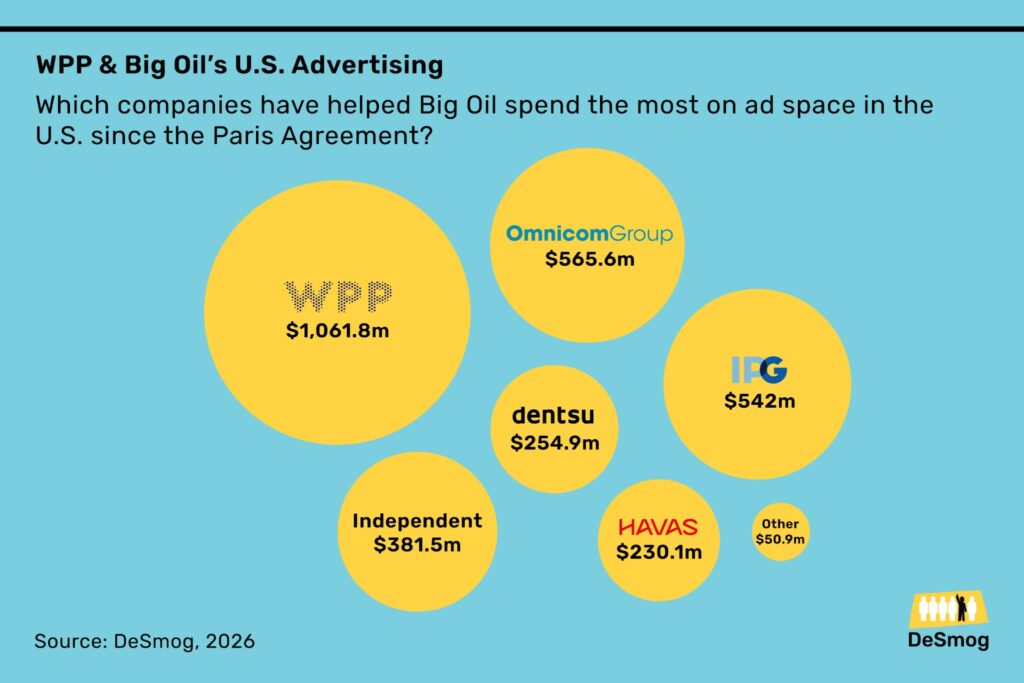
British advertising conglomerate WPP has helped oil companies ExxonMobil, Chevron, Shell, and BP spend an estimated $1 billion on ads in the United States since the 2015 Paris Agreement to tackle climate change, a new report shows.
The figure is nearly twice the respective amounts linked to U.S. rivals Omnicom and Interpublic Group (IPG), which merged in November. London-based WPP was the leading advertising group serving America’s oil industry over the past decade, according to the analysis by DeSmog.
During this period, ExxonMobil, Chevron, Shell, and BP had employed “deceptive and misleading” communications strategies designed to thwart policies to tackle the climate crisis by curbing the use of fossil fuels, a congressional investigation concluded in April 2024.
WPP’s services — from developing ideas for ads and designing logos, to securing ad space and analysing target audiences — were “crucial” to maintaining the oil industry’s public image, current and former WPP employees said. WPP is estimated to have earned millions of dollars a year from this work.
“The UK prides itself on climate leadership, and yet WPP, the supposed jewel of the British advertising industry, is facilitating dangerously misleading advertising in the U.S.,” said Victoria Harvey, holder of a PhD in the ad industry’s response to the climate crisis from the University of East Anglia, who reviewed DeSmog’s methodology.
“By creatively articulating the deception from big oil and gas, WPP has set the climate agenda back and continues to do so,” Harvey said.
ExxonMobil, Chevron, Shell, and BP spent an estimated combined total of $1.5 billion on buying U.S. ad space such as TV slots and social media feeds since the Paris Agreement, according to the analysis. That’s roughly equivalent to running ads on every billboard in New York’s advertising hotspot Times Square every day for the last decade.
WPP’s global network of subsidiary advertising agencies made an estimated two-thirds’ worth of those ads, the analysis found. WPP, which is one of Britain’s biggest companies by revenue and also works with clients such as Coca-Cola and Unilever, was the only major ad company to partner with all four oil giants on advertising projects during this time.
This work may have breached a policy WPP adopted in 2022 not to accept projects that may “frustrate” the goals of the Paris Agreement, the current and former employees said, since the oil majors were committed to increasing oil and gas production and promoting speculative climate solutions.

A version of this article has been published by the Guardian.
WPP agencies Ogilvy and Wavemaker have both worked on U.S. campaigns for BP and Chevron respectively which received misleading advertising complaints, for taglines such as “We see possibilities in planes that fly on garbage.” Neither complaint was taken forward, although BP voluntarily withdrew its ads.
A 2022 U.S. Congressional committee report cited several ExxonMobil ads made by WPP’s Group SJR as examples of greenwashing, including one that compared fossil gas paired with renewable energy to “a peanut butter and jelly sandwich”.

Staff who raised concerns about this work have been told by seniors that they are helping clients communicate about their shift to cleaner business models, the WPP employees said. But many who have worked on these projects fear they serve primarily to deflect criticism from polluters.
WPP clients BP and Shell have both weakened their own climate targets in the past three years. At the same time, their advertising output has pivoted to promoting the necessity of fossil fuels, a report published in March by industry campaign group Clean Creatives found.
BP’s 2023 campaign “And, not or” suggested that renewables should exist alongside oil and gas rather than replace them. The campaign included ads saying BP was reducing the climate impact of oil by running wells on electricity in Texas’ Permian Basin.
In a Shell YouTube ad run in October, a drone inspector identified as Tori describes how she is “helping provide American energy security” by carrying out safety checks on a drilling platform.
“We heard that a lot internally, that we were influencing them in the right direction,” said a former employee who worked on projects for BP at WPP branding agency Landor. “In reality, whatever BP decides to do, we would just deliver it.”
WPP and the other ad agencies mentioned did not respond to requests for comment.
Shell declined to comment. BP, ExxonMobil and Chevron did not respond to a request for comment.
Piece of the Pie
Advertising companies do not publish details about how much their clients spend on ad space, and increasingly avoid publicising their fossil fuel contracts.
To generate its estimates, DeSmog mapped the dozens of ad agencies that have worked for the four oil companies, using public sources such as staff social media profiles and industry award listings, confidential information shared by employees, and previous research by DeSmog and Clean Creatives. These contracts were then cross-referenced with ad spend estimates obtained from market research platform MediaRadar by the University of Oxford’s Climate Litigation Lab.
Most of the oil majors’ U.S. ad spend was channelled via subsidiaries of the handful of advertising holding companies that dominate the industry globally. After WPP, Omnicom and IPG, Tokyo-based holding company Dentsu ranked fourth in terms of its exposure to this ad spend ($255 million) and Paris-based rival Havas ranked fifth ($230 million).
The analysis did not seek to capture the millions of dollars the fossil fuel industry spends every year advertising in countries outside the U.S., as well as on lobbying, branding, public relations, and other marketing activities.
Advertising industry insiders say momentum around climate initiatives has slowed over the past few years as competition from big technology companies and artificial intelligence (AI) has squeezed margins.
New WPP CEO Cindy Rose is due to present her strategy to reverse declining profits at the company’s annual general meeting on May 8. A preview in February did not mention sustainability.
Under previous CEO Mark Read, WPP committed to reduce carbon emissions and prevent greenwashing, including via the policy adopted in 2022 “not to take on any client work…designed to frustrate the objectives of the Paris Agreement.”
But employees claim these moves have changed little.
There are concerns that WPP’s ongoing work with Shell, BP, and Chevron may breach the policy because many of these clients’ ads have distracted from or justified fossil fuel expansion, according to six current and former employees, who spoke to DeSmog anonymously for fear of professional repercussions.
New fossil fuel projects planned by the companies are incompatible with the Paris goal to limit the global temperature rise to 1.5 degrees and prevent catastrophic climate change, scientific assessments have found.
“I don’t think there’s anything that WPP could possibly be saying for BP or Shell that would adhere to the policy,” said a former director at two WPP agencies in New York.
In total, WPP has held at least 82 contracts with the fossil fuel industry around the world since the start of 2025, according to industry campaign group Clean Creatives. More than a quarter of those contracts relate to work wholly or partially targeted at U.S. audiences.
Experts say that the impact of WPP’s moves to lower carbon emissions by reducing employee travel and powering buildings with green energy is outweighed by its work for polluters.
“By shaping public narratives, increasing consumption, and normalising fossil fuel use, agencies like WPP can significantly influence emissions far beyond their operational footprint,” said Alexis McGivern, a researcher on corporate climate policy at Oxford Net Zero, a research group at the University of Oxford.
WPP ad agencies Ogilvy and VML have led BP and Shell’s respective advertising strategies since at least 2000, DeSmog found.
Ogilvy devised BP’s “Beyond Petroleum” campaign in 2000. It also popularised the concept of the “carbon footprint” through a series of BP ads in 2004 which sought to emphasise individual responsibility for reducing emissions.

Today, WPP agencies such as Ogilvy are still “deeply embedded” in BP’s advertising process and have some staff dedicated solely to working on BP projects, according to the former Landor employee.
In 2020, BP briefed seven WPP agencies — including Ogilvy, Landor, and VML — to create a new brand strategy to tackle the company’s image as “the bad guys,” according to a WPP document obtained by investigative outlet Drilled.
Subsequent U.S. ad campaigns launched by BP repeatedly promoted the company’s “#netzero” goals and said it supported regulation to limit methane emissions, despite BP having successfully lobbied the U.S. government to roll back such rules, an investigation by Unearthed found.
“WPP has had oil clients for decades, whether they were promising to go green or not,” said one former partner at a WPP agency, who has worked on Shell campaigns. “That tells you everything you need to know about whether we are actually trying to change things.”
Risks Rising for Protecting Polluters
Pressure is building on advertising companies to acknowledge their role in delaying climate action by protecting the reputations of polluters.
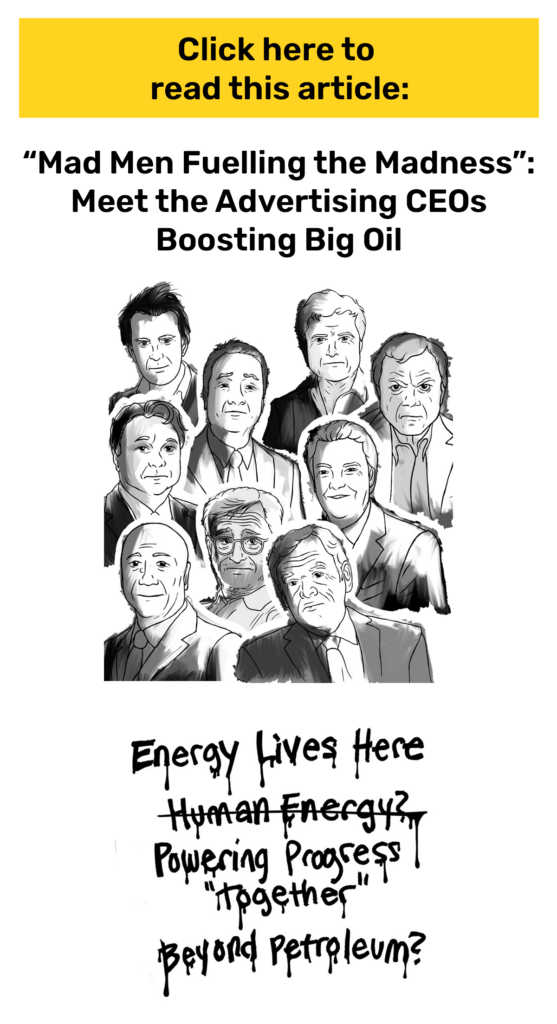
U.N. Secretary-General António Guterres has urged ad agencies to drop fossil fuel clients, calling ad executives “Mad Men fuelling the madness.”
The OECD, an intergovernmental economic organisation, is considering a complaint against WPP filed by climate and human rights campaigners in February last year. At the time, a WPP spokesperson said, “Contrary to the claims being made, we adhere to the highest regulatory standards in our work for clients.” Protesters have since targeted WPP’s Thames-front offices in London with banners reading “climate criminals”.
The “increased reputational risk associated with working on client briefs perceived to be environmentally detrimental” could affect revenue, WPP said in its 2025 sustainability report.

Legal risks are rising, too.
In a first-of-its-kind ruling in October, a Paris court found French oil giant TotalEnergies misled consumers by saying it had put “climate at the heart of its strategy” during a 2021 rebrand, despite continuing to heavily invest in new oil and gas projects.
WPP agency Wavemaker advised TotalEnergies on where to buy ad space for the rebrand campaign but was not named in the case.
In January, Michigan state filed the latest of dozens of U.S. lawsuits being brought by local and federal governments against ExxonMobil, Chevron, Shell, BP, and other oil companies accusing the companies of climate deception and disinformation.
So far, a U.S. court is yet to find against an oil company in such a case. The companies deny any wrongdoing, arguing that the courts are the wrong venue to determine climate policy.
“In the context of increasing litigation to recover substantial damages for the escalating costs of climate change on the basis of oil majors’ deceptive activities, doing large amounts of the same companies’ advertising work does not seem legally advisable,” said Johnny White, a lawyer at environmental law firm Client Earth, which advised on the TotalEnergies case.
Additional reporting by Kathryn Clare and Ellen Ormesher